
The next wave of AI startups will live in the physical world
Startups Magazine Michael Padilla-Pagan Payano
Opinion — commentary, not a factual news event.
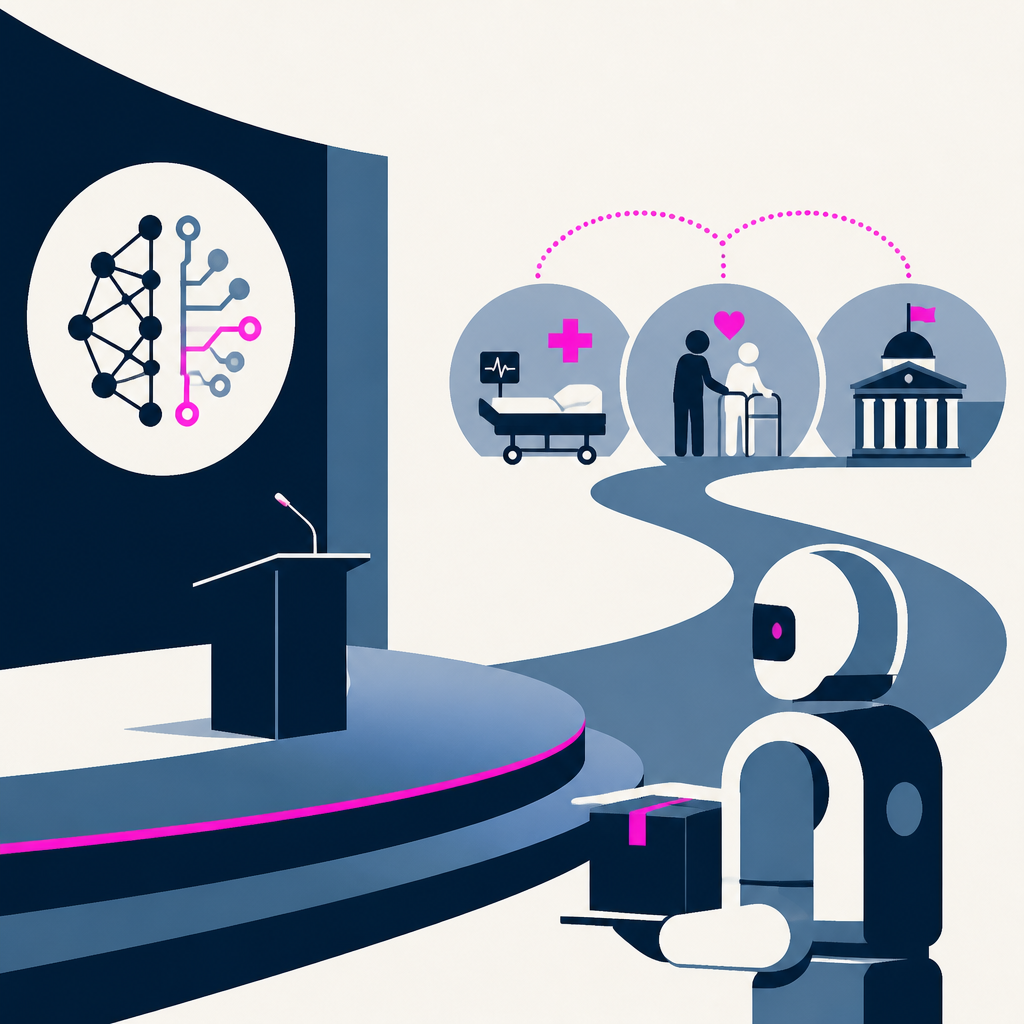
An AI investor argues the next boom won't be chatbots—it'll be AI running hospitals, elder care, and government offices. Get it wrong there, and it's not annoying, it's dangerous.
Based on reporting by Startups Magazine, Michael Padilla-Pagan Payano — read the original for the full story.
Summary, retelling and take written by AI under human oversight; images are AI-generated illustrations. How we work · Report an error
Most AI conversation right now stays inside a browser tab: emails, images, summaries, chatbots answering questions. One investor argues that's the warm-up act, not the show. The real shift, they say, is AI moving off the screen and into hospitals, homes, elderly care, government offices, transport and infrastructure—places where a bad output isn't a typo, it's a missed medication or a fall nobody notices.
The piece is unusually personal for a startup-trend essay. The author writes about losing a wife, a mother and friends to cancer, a father living with dementia, a brother with a traumatic brain injury, and their own experience with PTSD. That background shapes the argument: AI in healthcare shouldn't aim to replace doctors and nurses, it should give them back time—less chasing records, less repetitive admin, more actual minutes with patients. Success isn't measured by how many staff get cut; it's measured by whether a nurse catches a warning sign earlier or a family finally understands what support exists.
Elderly care gets the same treatment. The author imagines AI that detects a fall, flags a missed pill, or notices a broken routine and alerts a caregiver—useful, unglamorous stuff, not another app nobody asked for. But they draw a hard line against mistaking monitoring for companionship: an automated voice doesn't replace a person noticing fear or confusion in someone's face. The bar they set is that AI should protect independence and dignity, not quietly take control of someone's daily life.
The agent example is concrete rather than hypothetical. The author describes carrying a personal AI agent named Hal, which delivers weather updates, manages a task list and reminds them to take medication, without making decisions for them. Hal can also talk to the author's brother's agent to help track routines. To ground the idea historically, the piece points to Life Alert, the wearable-button emergency service that started in 1987 and became widely known in the 1990s—proof, the author says, that the underlying need for someone checking in on vulnerable people has existed for decades. Agentic AI, in this framing, doesn't replace the human dispatcher; it gives that dispatcher earlier, better information.
The advice to founders is blunt: go spend time with the nurse, the caregiver, the government clerk, the person whose internet connection drops or who can't fully explain what's wrong. Build in consent and privacy from day one, keep a human accountable for every consequential decision, and test for failure—sensor errors, uncertainty, bad data—not just for a slick demo. The same logic extends to government services, particularly in Africa and other emerging markets the author has worked in, where AI could speed up benefits, permits and emergency response, provided it doesn't quietly become a surveillance tool instead of a service improvement.
The closing argument reframes what "progress" should even mean here. Not how many jobs got automated, but whether a nurse got more time, an elderly person stayed independent, a citizen got a service faster and with more dignity. It's a modest ask, dressed up in a big claim about where AI startups go next.
My take — AI-written commentary, not fact-checked reporting
The healthcare and eldercare examples land because they're specific and lived-in, not theoretical hand-waving about disruption. But the essay conveniently skips the hard part: the businesses building this stuff will face constant pressure to cut headcount and monetize the data they collect, and good intentions in a founder's blog post won't stop that pressure once investors want returns. Anyone excited about AI agents quietly monitoring elderly relatives or patients should ask who actually owns that data and what happens to it once the company gets acquired—because that question, not the warm anecdote about Hal, is where this whole vision either holds up or falls apart.”}<br/> Wait remove stray.<br/>}
Read more about this at: Startups Magazine