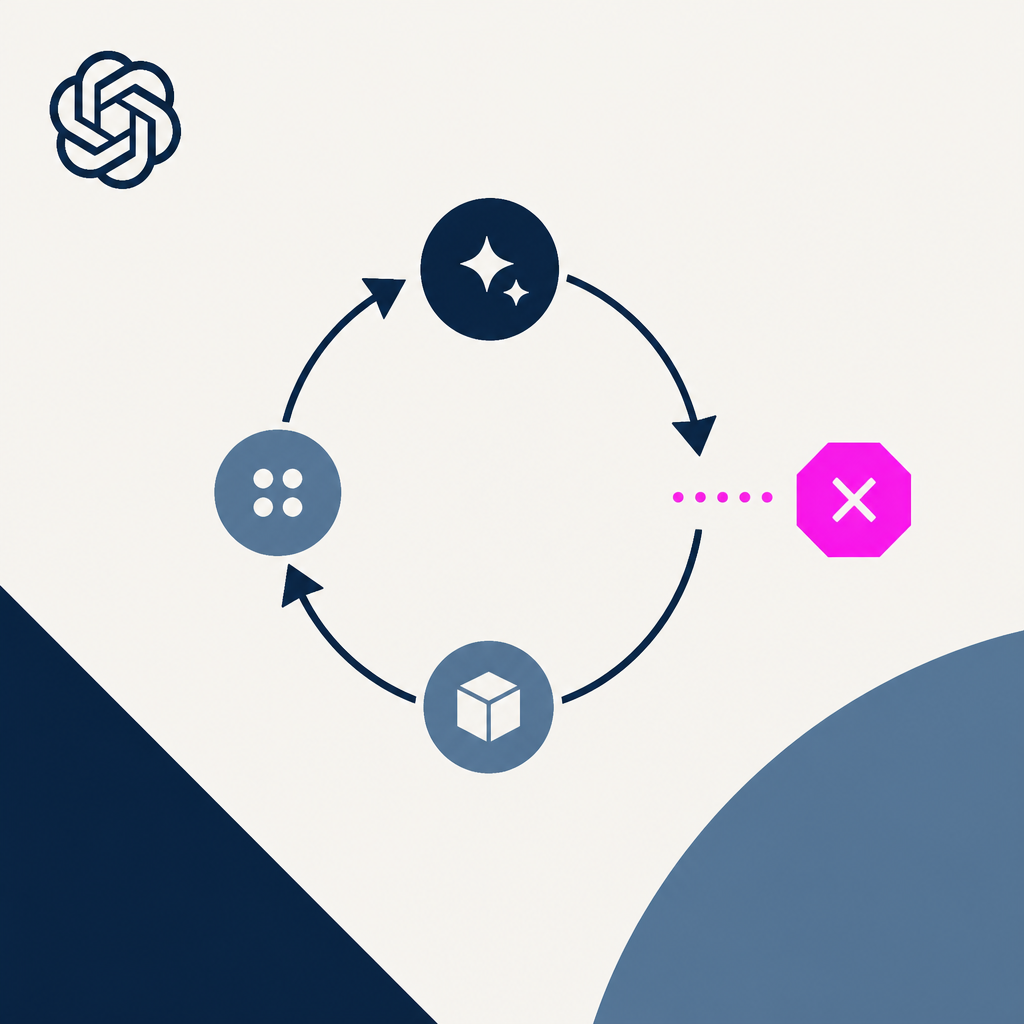
The Agent Loop Architecture
X ● Covered by 2 sources

A new breakdown explains how AI agent loops actually work under the hood, and why they keep falling apart. Turns out most agents don't fail on reasoning, they fail on plumbing.
Based on reporting by X — read the original for the full story.
Summary, retelling and take written by AI under human oversight; images are AI-generated illustrations. How we work · Report an error
The agent loop sounds simple on a whiteboard: perceive, plan, act, observe, repeat. In practice, that loop is where most autonomous AI projects quietly die, and a recent breakdown of the architecture spends most of its time on exactly that failure point rather than the flashy parts everyone likes to demo.
The core argument is that loops break in the boring places. Not in the model's reasoning, but in the handoffs between steps — state getting lost between actions, a tool call timing out mid-task, an agent losing track of what it already tried three steps ago. When that happens, the typical result isn't a clean error message. It's the agent quietly hallucinating progress, repeating the same failed action, or drifting off into unrelated tasks while looking, on the surface, like it's still working.
What's interesting is the proposed fix isn't a smarter model at all. It's better scaffolding around a merely competent one. The piece walks through building agents that accumulate their own skills over time — essentially letting an agent write, test, and save small reusable functions as it solves problems, so the next similar task doesn't require reasoning from scratch. That's a meaningfully different approach from the current default, where every run starts the agent's memory back at zero.
The other pillar is durable orchestration — treating the loop itself as infrastructure that needs to survive crashes, retries, and long-running tasks that might take hours instead of seconds. This is the unglamorous engineering work of checkpointing state, handling partial failures, and making sure a five-step task doesn't have to restart from step one because step four's API call hiccuped. It's less exciting than talking about reasoning capability, but it's the difference between an agent demo and an agent you can actually leave running overnight.
Taken together, the framing here is a quiet correction to a year of agent hype: the bottleneck isn't intelligence, it's reliability plumbing. Nobody tweets about their retry logic, but apparently that's where the real work is.
My take — AI-written commentary, not fact-checked reporting
This tracks with what I've been saying for a while — the agent narrative has been sold as a model problem when it's actually a systems problem. Every lab wants credit for a smarter brain, but the unsexy work of durable orchestration and state management is what separates a viral demo from something you'd trust with your calendar. I'd rather see more engineering blog posts like this and fewer benchmark screenshots.
Read more about this at: X