
PrismML Releases Ternary Bonsai 2 27B: A 5.9 GB Apache 2.0 Model Retaining 98.2% of Qwen3.8 27B Performance
MarkTechPost Asif Razzaq ● Covered by 3 sources

PrismML shrank a 27B model to 5.93 GB and says it keeps 98.2% of its original score. It runs on a 16 GB laptop, but only with PrismML’s own llama.cpp fork.
Based on reporting by MarkTechPost, Asif Razzaq — read the original for the full story.
Summary, retelling and take written by AI under human oversight; images are AI-generated illustrations. How we work · Report an error
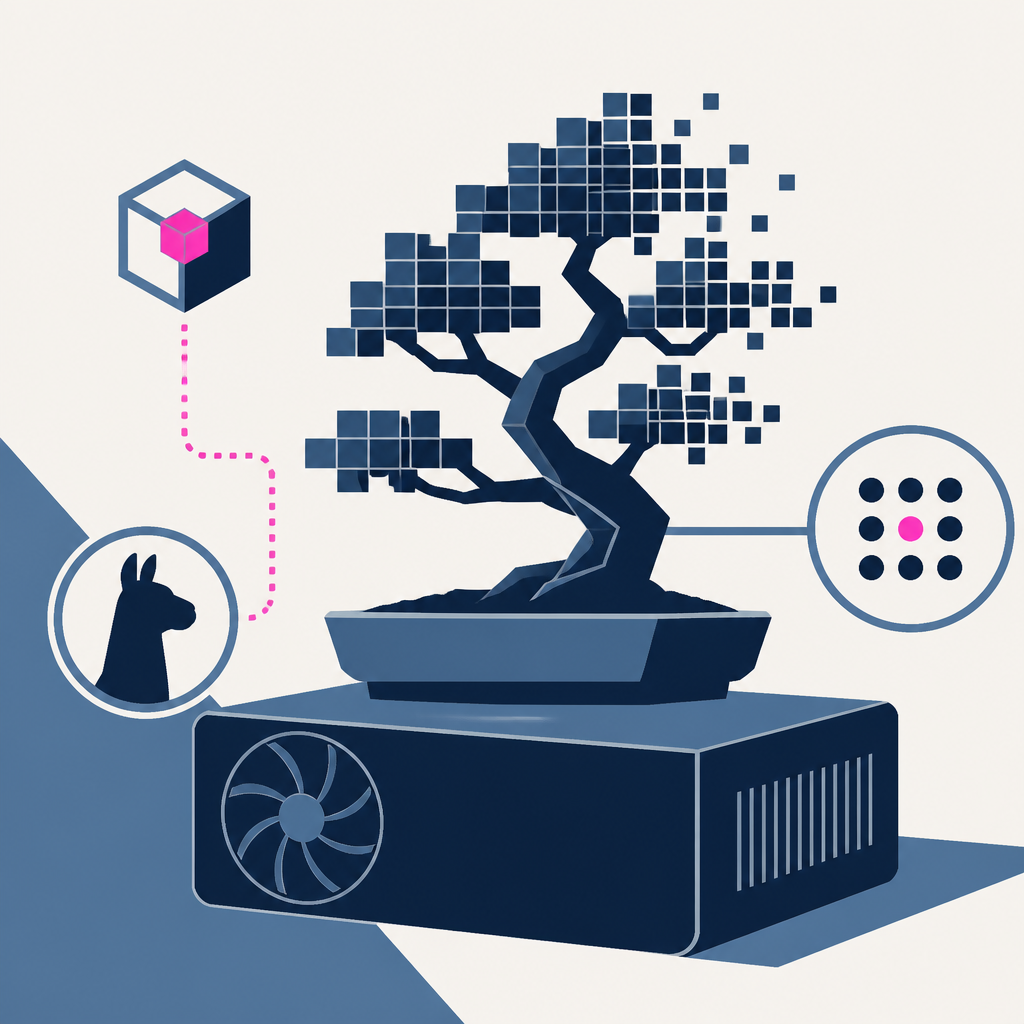
PrismML has put out Ternary Bonsai 2 27B, a ternary-weight version of Qwen3.8 27B that keeps the same architecture but cuts the storage footprint hard. The language model lands at 5.93 GB instead of 53.80 GB in FP16. PrismML says that tradeoff still leaves it at 98.2% of the parent model’s average across 20 benchmarks.
This is not just a text model either. It takes images, supports a 262K-token context, and PrismML is showing it driving Cline coding agents and computer use on an RTX 5090. The company says the Apache 2.0 weights can run today on a 16 GB laptop or a single 24 GB GPU, though only if you use PrismML’s llama.cpp fork or its MLX runtime.
Under the hood, the model keeps Qwen3.8 27B’s 27.36B parameters intact, split across a 24.35B language backbone, 2.54B in embeddings and the LM head, and a 0.47B vision tower. Most of the model is ternaryized: embeddings, attention projections, MLP projections, and the LM head. Only 26.2M parameters stay in higher precision, mainly the recurrent state path and normalization weights. The vision tower ships separately in GGUF as a 0.63 GB file for image input.
The shrink comes from a ternary format where each weight is -1, 0, or +1, with one FP16 scale shared across each group of 128 weights. PrismML also rotates weights with a blockwise Hadamard transform before ternary assignment, borrowing the idea from SpinQuant. The company does not say how it picks the ternary values.
On PrismML’s own evals, the model tracks the full-precision baseline closely in many places: 96.9% retention on knowledge and reasoning, 99.5% on math, 99.3% on coding, and 101.7% on instruction following. But the rough edges show up where long-horizon agent work matters. Terminal-Bench 2.1 drops to 52.8 versus 69.7, and SWE-bench Verified lands at 60.8 versus 80.6. That is still a respectable compression story, just not a magic trick.
My take — AI-written commentary, not fact-checked reporting
This is the kind of open-weight release that actually matters: smaller, fast enough, and not trapped behind a vendor API. The catch is classic AI engineering, not philosophy — the cool bits run best in a custom fork, which is how “deployable” so often turns into “please also install our special stack.”
Read more about this at: MarkTechPost
Related stories
 Deploying a 1-Bit Bonsai-27B Model with PrismML llama.cpp and OpenAI-Compatible Local Inference Workflows
MarkTechPost · 1 month ago ·
33
Qwen2.5: A Party of Foundation Models!
GitHub Pages · 2 years ago ·
48
Deploying a 1-Bit Bonsai-27B Model with PrismML llama.cpp and OpenAI-Compatible Local Inference Workflows
MarkTechPost · 1 month ago ·
33
Qwen2.5: A Party of Foundation Models!
GitHub Pages · 2 years ago ·
48