
Pixel-Native RAG: A Practical Guide to Visual Document Indexing
MarkTechPost Sana Hassan ● Covered by 2 sources
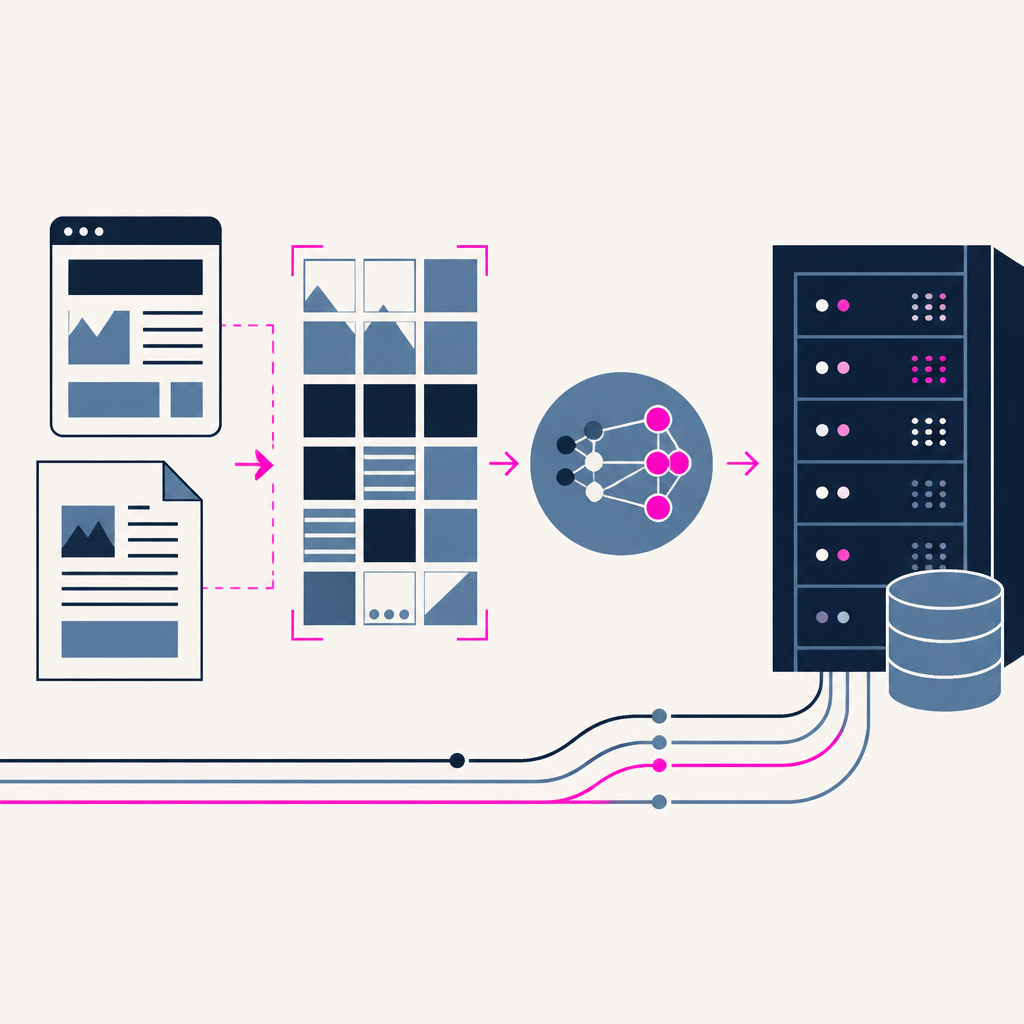
MarkTechPost built a full RAG pipeline that reads documents as images instead of parsing text or HTML. It screenshots pages, tiles them, and searches them visually with SigLIP/CLIP embeddings and FAISS.
Based on reporting by MarkTechPost, Sana Hassan — read the original for the full story.
Summary, retelling and take written by AI under human oversight; images are AI-generated illustrations. How we work · Report an error
There's a quiet argument happening in the retrieval-augmented generation world about whether text extraction is even worth the trouble anymore. A new hands-on tutorial from MarkTechPost makes the case for skipping it entirely. Instead of parsing HTML, cleaning up PDFs, or fighting with chunking heuristics, the pipeline just takes a screenshot of the whole page and treats that image as the unit of knowledge.
The mechanics are surprisingly elaborate for something that sounds simple. Playwright drives a headless Chromium browser to auto-scroll and render each URL, flattening sticky headers and stripping cookie banners so the screenshot looks clean. Each rendered page then gets sliced into overlapping 1024x1024 tiles, with near-duplicate detection via perceptual hashing so repeated navigation bars don't pollute the index. Blank or low-contrast tiles get thrown out early using a simple standard-deviation check, which saves GPU cycles down the line.
Once the tiles exist, the system embeds them with SigLIP or CLIP, with an optional Qwen3-VL backend for teams wanting a heavier multimodal model. Those vectors go into a FAISS index for nearest-neighbor search. But the author doesn't stop at pure dense retrieval. Tesseract OCR pulls text out of each tile so that a BM25 sparse-scoring pass can run alongside the embedding search, and the two rankings get merged with reciprocal rank fusion — a trick borrowed from classic information retrieval that tends to outperform either method alone.
Evaluation is treated seriously here, not as an afterthought. The pipeline computes Recall@k and mean reciprocal rank against a small labeled query set spanning topics like photosynthesis, transformers, and vector databases. It also trains a lightweight residual adapter using contrastive learning to sharpen the embeddings for this specific domain, and it wraps the whole thing in a FastAPI service so results can be queried over HTTP. For the last mile, retrieved tiles can be handed to a vision-language model, Qwen2.5-VL-3B-Instruct by default, to generate a grounded answer directly from the screenshot evidence.
What makes this notable isn't any single component — SigLIP embeddings and FAISS indexes are old news by now. It's the framing: documents as pixels, full stop, no privileged text layer. Tables, charts, sidebars, and layout cues that normally get mangled or discarded during HTML parsing survive intact because nothing is ever converted to plain text until OCR runs as a secondary signal, not the primary one.
My take — AI-written commentary, not fact-checked reporting
Pixel-native retrieval is a sensible reaction to how much information text extraction quietly destroys — anyone who has watched a PDF table turn into gibberish knows the pain. Still, running a browser and an OCR pass just to answer questions is expensive plumbing for use cases that plain text chunking already handles fine, so this approach earns its keep mainly on messy, layout-heavy documents rather than as a universal RAG replacement.'
Read more about this at: MarkTechPost