
NVIDIA Open-Sources OSMO: One YAML Orchestrates Physical AI Training, Simulation, and Robot Testing
MarkTechPost Asif Razzaq
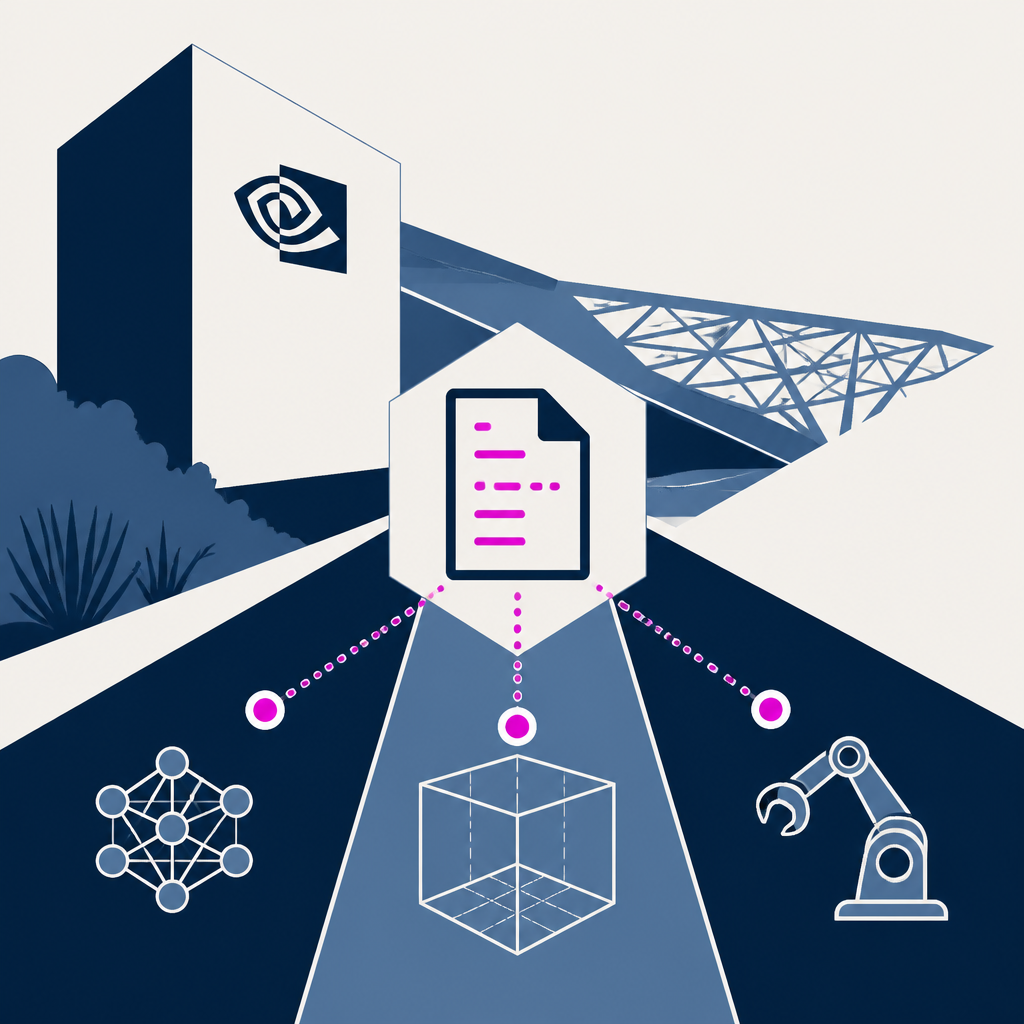
NVIDIA open-sourced OSMO, a YAML-based orchestrator for robot training, sim, and edge testing. It ties three messy compute tiers into one workflow instead of a pile of custom scripts.
Based on reporting by MarkTechPost, Asif Razzaq — read the original for the full story.
Summary, retelling and take written by AI under human oversight; images are AI-generated illustrations. How we work · Report an error
Robot teams usually end up with three separate worlds. Training runs on big GPU clusters like GB200 or H100. Simulation happens on RTX machines in Isaac Sim. Then the whole thing gets pushed into a real robot, often through a Jetson at the edge. That handoff is where the glue scripts breed.
OSMO is NVIDIA’s attempt to make that mess behave. It’s an open-source, Kubernetes-native workflow orchestrator under Apache-2.0, with Helm charts and containers on NGC, plus a local quickstart that runs the control plane on a workstation with KIND. The pitch is simple: describe the whole physical AI pipeline in one YAML file, then let OSMO route each step to the right compute pool.
The workflow model is built around platforms, not fixed clusters. A task can ask for gb200, rtx-pro-6000, or jetson-agx-thor, and OSMO sends it to whatever registered backend offers that platform. NVIDIA’s canonical example chains three steps together: simulate in Isaac Sim on rtx-pro-6000, train a PyTorch policy on gb200 with 8 GPUs, then run evaluate-thor on jetson-agx-thor and write results to a named dataset.
OSMO is trying to cover the rest of the workflow headache too. The user guide includes serial and parallel task groups, Jinja templating, retry policies, and HIGH/NORMAL/LOW priorities with preemption and GPU borrowing across pools. Version 6.3.0 added a multi-provider deploy-k8s.sh for AKS, EKS, microk8s, or an existing cluster, with storage wiring for MinIO, Azure Blob, AWS S3, or bring-your-own S3.
There’s also a lot for operators, not just experimenters. OSMO uses the NVIDIA KAI Scheduler by default, added NVLink topology-aware placement in 6.2.8, and made exec_timeout and queue_timeout per group in 6.3.0 so one stalled simulation group won’t sink a sibling training group. Security got the usual enterprise treatment too: RBAC, OAuth2 proxy integration, device-code login, TLS termination at Envoy, and cloud workload identity support so services do not need to mount storage keys as Kubernetes Secrets.
My take — AI-written commentary, not fact-checked reporting
This is NVIDIA doing the rare sensible thing: admitting that physical AI is mostly orchestration pain, not just model magic. The open-source part matters because the alternative is another glossy demo hiding five layers of brittle scripts. Also, the dataset CLI getting deprecated right as the platform grows is very on-brand for infrastructure software: progress, plus one migration people will complain about for months.
Read more about this at: MarkTechPost
Related stories
 NVIDIA AI Releases NOOA: An Object-Oriented Python Framework That Turns an AI Agent Into a Single Python Class
MarkTechPost · 1 month ago ·
7
NVIDIA AI Releases NOOA: An Object-Oriented Python Framework That Turns an AI Agent Into a Single Python Class
MarkTechPost · 1 month ago ·
7
 Into the Omniverse: How Open World Models Push the Frontier of Physical AI
NVIDIA · 1 month ago ·
21
NVIDIA's GTC 2025 Announcement for Physical AI Developers: New Open Models and Datasets
Hugging Face · 1 year ago ·
56
Into the Omniverse: How Open World Models Push the Frontier of Physical AI
NVIDIA · 1 month ago ·
21
NVIDIA's GTC 2025 Announcement for Physical AI Developers: New Open Models and Datasets
Hugging Face · 1 year ago ·
56