
Lawsuit claims Anthropic, OpenAI, SpaceXAI and Google violated antitrust laws when they coordinated AI slowdown, reducing value of subscriptions
Fortune The Associated Press
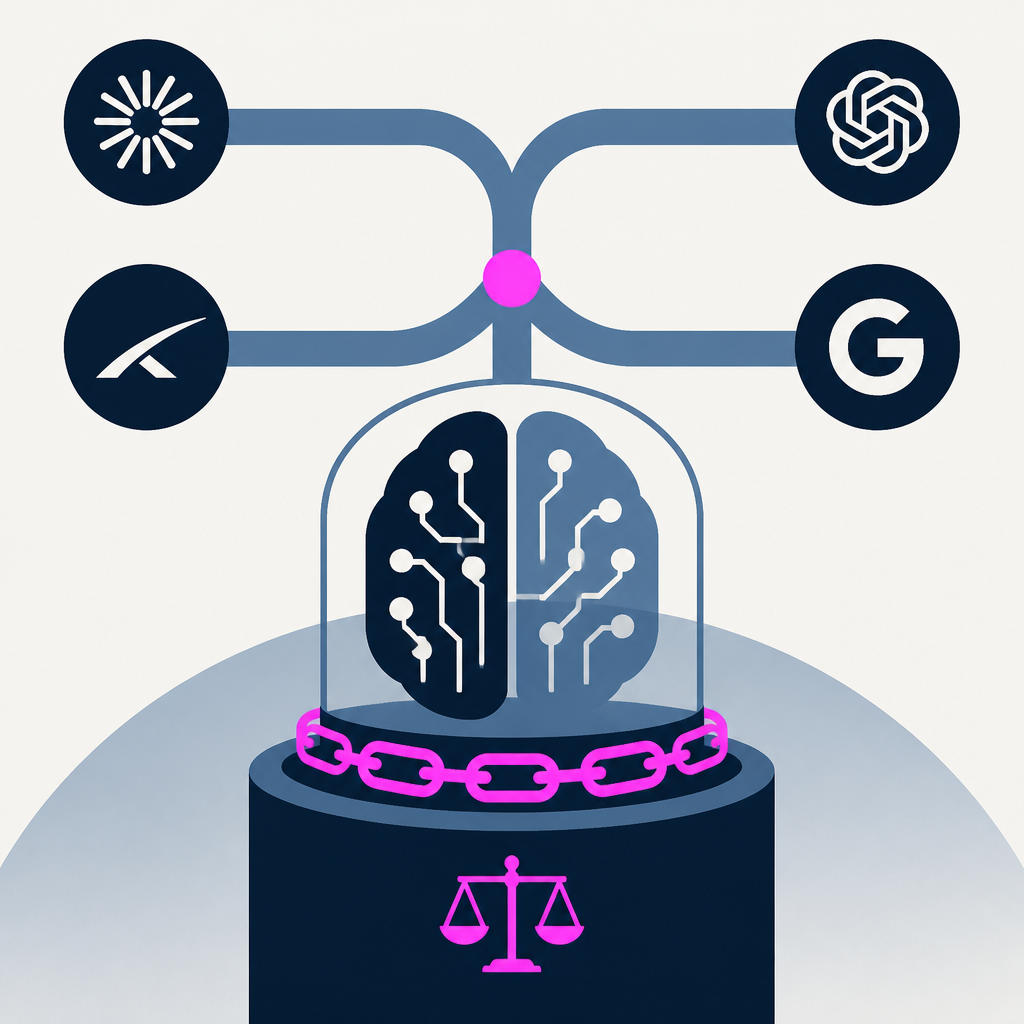
A new suit says Anthropic, OpenAI, SpaceXAI and Google teamed up to slow AI. It claims paid subscribers got less value when the rivals eased off at the same time.
Based on reporting by Fortune, The Associated Press — read the original for the full story.
Summary, retelling and take written by AI under human oversight; images are AI-generated illustrations. How we work · Report an error
A new antitrust lawsuit says four of the biggest names in AI made a deal to slow their own progress. The complaint, filed Friday in U.S. District Court for the Northern District of California, names Anthropic, OpenAI, SpaceXAI and Google and says the companies coordinated to decelerate development in a way that hurt people paying for AI subscriptions.
The case centers on Sept. 12. That’s when Anthropic CEO Dario Amodei published an essay calling for industrywide cooperation on slowing down AI advances while safety work catches up. The same day, according to the suit, OpenAI CEO Sam Altman, SpaceXAI CEO Elon Musk and Google DeepMind co-founder and chair Demis Hassabis publicly backed the idea.
The plaintiffs say that kind of alignment among direct rivals is exactly what antitrust law is supposed to stop. Their lawyers represent four paid subscribers, each tied to one of the services named in the case — ChatGPT, Claude, Grok and Gemini — and want to expand the suit into a nationwide class of other subscribers.
The filing leans hard on a simple claim: if the leading labs decide their progress should be slower than competition would naturally produce, customers lose out. Or, as the complaint frames it, the value of paid subscriptions drops when the industry acts in concert instead of competing.
Amodei’s own essay acknowledged that coordination could raise antitrust issues. He said government help would be useful to mediate or at least enable cross-lab talks, and suggested a narrow waiver for safety discussions. Altman later said OpenAI supports a federal framework with consistent safety requirements, but does not think the industry needs to wait for an antitrust exemption or new law to start.
The suit lands in the middle of a broader political fight over AI safety and regulation. President Donald Trump has dismissed regulatory calls as a “conspiracy,” said he is forming an AI task force and will appoint an “AI czar,” and his administration has pushed for American labs to outpace China. Some Democrats want sweeping regulation; Republicans, by and large, are following Trump’s lead. Sen. Josh Hawley, a Missouri Republican, has already said he would not give the biggest tech companies in history an exemption to collaborate.
My take — AI-written commentary, not fact-checked reporting
This is the oldest trick in tech: call it safety when it helps the margins. If the biggest AI labs want to coordinate, they should expect antitrust lawyers to show up with very little sympathy and a very large stapler.
Read more about this at: Fortune