Launch HN: Hyper (YC P26) – Company brain to power agentic development
Hacker News shalinshah
Two YC founders launched Hyper, a shared "company brain" that feeds AI agents your team's scattered knowledge. It's built to fix the amnesia problem that makes AI agents forget everything between sessions.
Based on reporting by Hacker News, shalinshah — read the original for the full story.
Summary, retelling and take written by AI under human oversight; images are AI-generated illustrations. How we work · Report an error
Shalin and Kanyes have been hacking together for over a decade, and their latest project, Hyper, tackles a problem anyone who's tried to get an AI agent to actually understand their company will recognize. Models are plenty smart now. They can handle long, gnarly tasks without much hand-holding. What they can't do is know that your team decided to ditch the blue button after a whiteboard session three weeks ago, or that your CEO writes emails in a very specific clipped style. That stuff lives in Slack threads, half-finished docs, and people's heads, and it evaporates the moment a chat session ends.
The founders spent their undergrad years obsessed with the tools-for-thought scene, building elaborate personal knowledge systems in Notion, Obsidian, Roam, and Anki. When GPT-3.5 landed, they had the same realization a lot of that crowd did: a second brain is only as useful as the AI's ability to actually read it. Hyper is their attempt to build that for companies rather than individuals, and to solve the gaps they say plain MCP integrations can't touch — sessions that die and take their context with them, information that's scattered across five different tools, and a total absence of meta-reasoning about why a decision got made or when it changed.
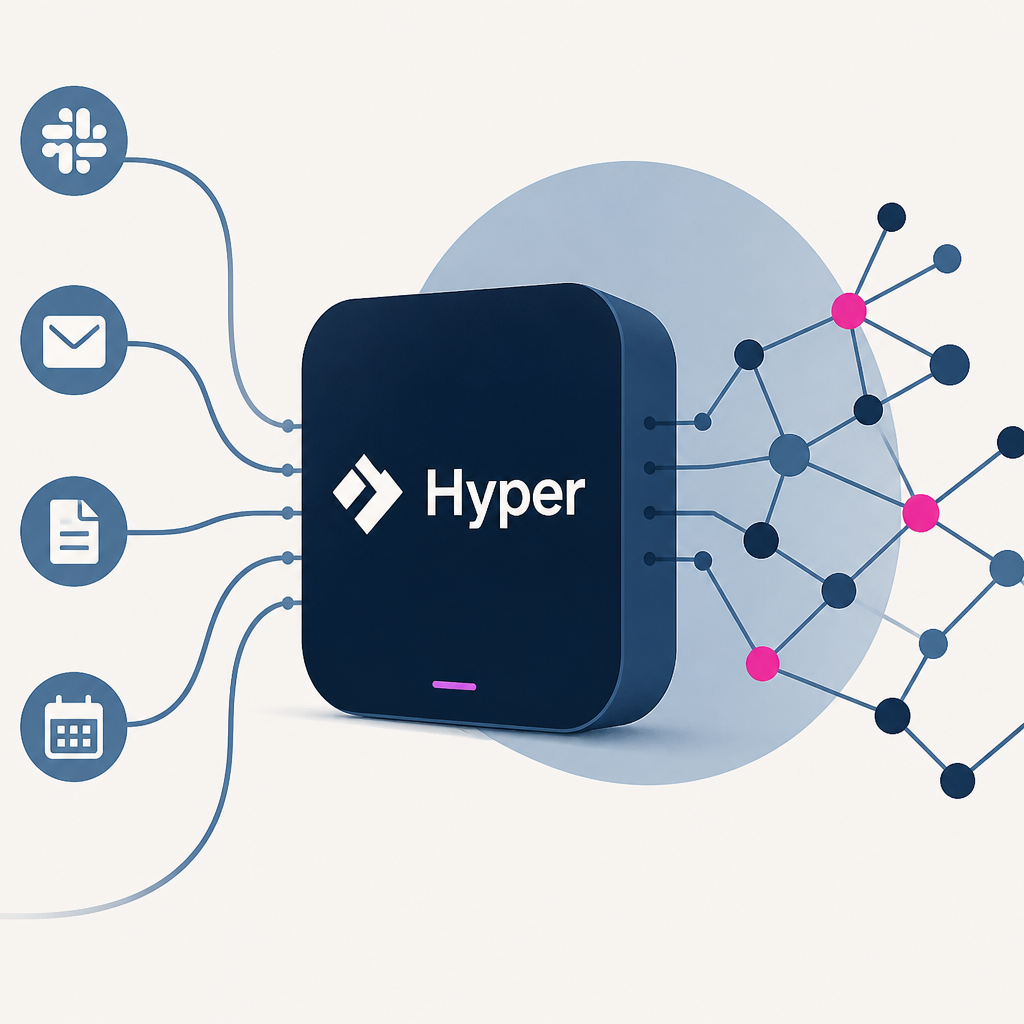
Under the hood, Hyper ingests everything it's given access to — Docs, Slack, email, calendar, meeting notes from Granola — and turns it into a knowledge graph. Raw items get stored as "episodes," the source of truth, while "facts" are extracted as subject-predicate-object triples with timestamps marking when something was introduced and when it got invalidated. When a decision changes, like a Friday ship date sliding to Monday, the new fact supersedes the old one without erasing it, so an agent can still explain how the team landed on Monday if asked. Every fact keeps provenance and access-control tags, and retrieval blends semantic embedding search with Postgres full-text search, filtered per person, so two teammates asking the identical question can get genuinely different answers based on what they're each allowed to see.
On the plumbing side, Hyper leans on webhooks where available and polling with content hashing where it isn't, and it plugs into agent tools like Claude Code, Cursor, Codex, and Cowork through lifecycle hooks, injecting relevant context into every prompt and harvesting new facts out of every response. Anything without hooks gets handled through plain MCP calls. Early users are already leaning on it for oddly personal tasks — one CEO says drafting emails in his own voice went from hours a week to minutes, and a fellow YC founder says Hyper one-shotted a launch video script because it already understood the product's positioning from months of accumulated context.
Hyper's founders are upfront that this isn't for everyone, and that's probably the right framing. It's a bet that persistent, access-controlled organizational memory is the actual unlock for agentic workflows, not bigger models or fancier prompts. They're offering a three-day free trial to let people test that bet themselves.
My take — AI-written commentary, not fact-checked reporting
Every few months someone reinvents the second brain, and it always sounds great until you ask who's babysitting the knowledge graph when the facts get messy or the access controls get it wrong. The access-per-person retrieval trick is the genuinely interesting bit here — most memory tools treat a company as one undifferentiated blob of context, and that's a naive way to think about how real organizations actually gatekeep information. Worth watching, but the market is about to get very crowded with "company brain" pitches, and most of them will quietly die when the free trial ends.
Read more about this at: Hacker News