
Import AI 475: Swarm scaling; Google DeepMind watermarks biology; and the AI science economy
Import AI Jack Clark
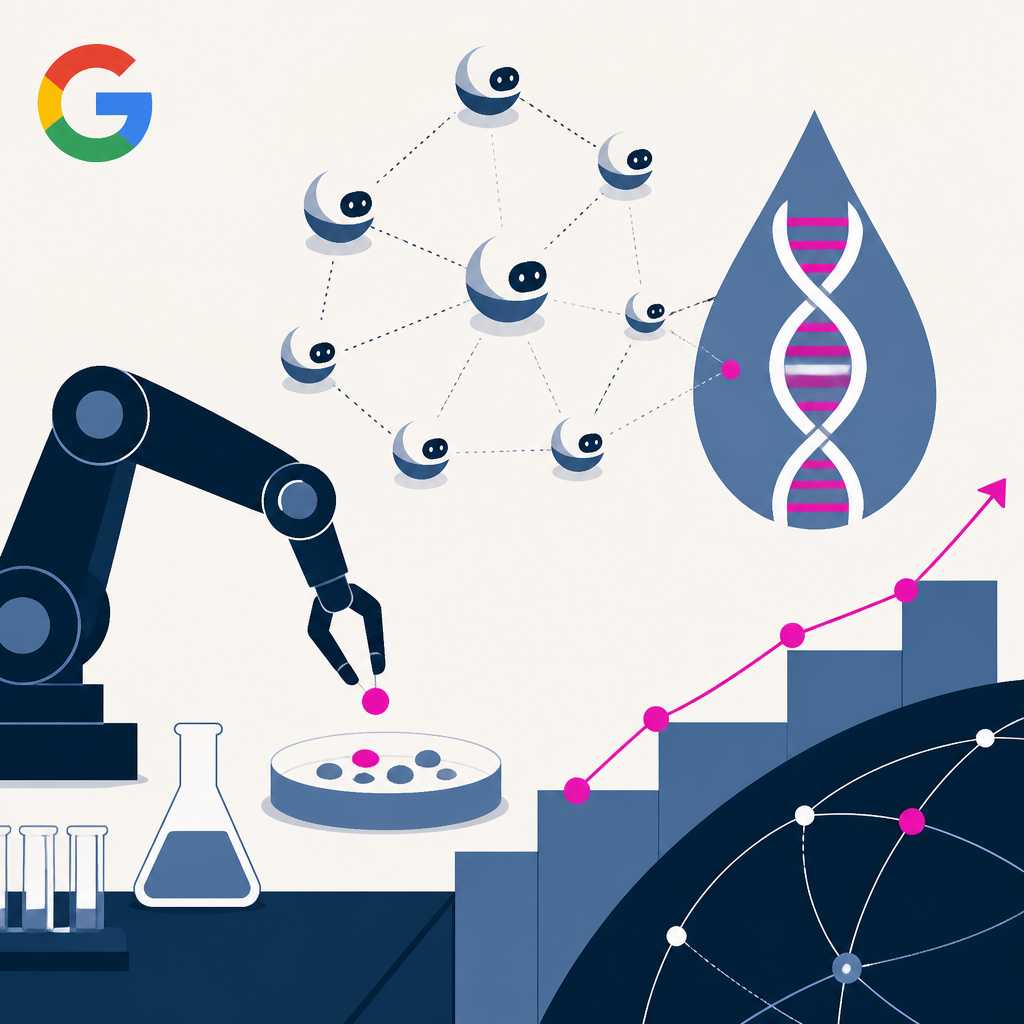
AI swarms can finish faster, but they burn more tokens. Google DeepMind also wants watermarks for AI-made biology, and the science lab story gets stranger.
Based on reporting by Import AI, Jack Clark — read the original for the full story.
Summary, retelling and take written by AI under human oversight; images are AI-generated illustrations. How we work · Report an error
Toby Ord has a neat frame for swarms: treat them as a kind of inference scaling. The point isn’t that a swarm is cheaper. It isn’t. The point is speed. A four-agent swarm, he argues, can use roughly twice the total tokens of a single agent and still get the same result, while finishing in about half the wall-clock time because the work runs in parallel.
That gain comes with a catch. As more agents join in, the returns fade. Ord borrows the economists’ idea of a “stepping on toes” parameter to describe the coordination tax, and says the slowdown looks a lot like what happens when human teams get too big. Push a swarm ten times larger and you do not get ten times the performance you’d get from a single agent with ten times the tokens. The gap compounds as the swarm grows.
Ord’s bigger worry is that swarms do not make runaway AI less likely. He had hoped coordination would be hard enough to blunt an intelligence explosion. Instead, the evidence points the other way. That matters because agents are adding a new knob to AI scaling, beyond the familiar mix of compute, data, and longer chains of thought.
Elsewhere in the issue, Google DeepMind is trying to watermark synthetic biology with SynthID Bio, a system that alters sequence and structure details so watermarked designs can still be detected. DeepMind says wet-lab tests on VEGF-A, the SARS-CoV-2 spike protein RBD, and PD-L1 matched unwatermarked designs on hit rate, binding affinity, and natural sequence diversity. It is a narrow tool, but a serious one.
The lab frontier is moving too. C5R Corp’s SciUniverse benchmark spans 92 tasks across 17 task families, from NMR structure assignment to expressing sfGFP and pressing BaTiO3 pellets. Claude Fable 5.1 (xhigh) tops the list with a 45.3% pass rate, while DeepMind is already thinking one step ahead: if AI scientists arrive in force, science may need its own market to allocate scarce physical resources. That sounds cold. It’s also probably where the bottleneck ends up.
My take — AI-written commentary, not fact-checked reporting
This is the sort of paper that quietly admits the future is not one giant model, but a pile of coordinating agents fighting over time, tools, and lab space. The hype crowd loves “autonomy”; the interesting story is bureaucracy, just with GPUs. And yes, if AI science becomes real, someone is going to have to price the beakers.
Read more about this at: Import AI
Related stories
 Import AI 469: Science AI; RSI simulator; and Zuck's technological pessimism
Import AI · 1 month ago ·
18
Import AI 469: Science AI; RSI simulator; and Zuck's technological pessimism
Import AI · 1 month ago ·
18
 Import AI 470: No rights for machines; automating environment generation with SPADE; and building better GPU kernels with Hawkeye
Import AI · 1 month ago ·
40
Deep Learning Weekly: Issue 447
Deep Learning Weekly · 6 months ago ·
30
Import AI 470: No rights for machines; automating environment generation with SPADE; and building better GPU kernels with Hawkeye
Import AI · 1 month ago ·
40
Deep Learning Weekly: Issue 447
Deep Learning Weekly · 6 months ago ·
30