Heart of the Matter: How a Major Children’s Hospital Uses Open Source NVIDIA AI for Cardiac Care
NVIDIA Blog Isha Salian
CHOP is using open-source AI to model kids’ hearts in seconds. It could make rare, tricky heart surgeries safer and more precise.
Based on reporting by NVIDIA Blog, Isha Salian — read the original for the full story.
Summary, retelling and take written by AI under human oversight; images are AI-generated illustrations. How we work · Report an error
Children’s Hospital of Philadelphia is turning pediatric heart care into a faster, more precise software problem. Using open source AI tools built on MONAI, the hospital can now produce anatomically accurate heart models in seconds from scans it already has — CT, MRI, and 3D ultrasound — instead of sending a skilled researcher to a workstation for hours.
That matters because congenital heart disease is messy in the way medicine hates most: about 1% of live births involve a defect, and no two cases are quite the same. A child with a hole between the lower chambers or a leaking valve in a single pumping chamber needs a plan tailored to that exact heart. Dr. Matthew Jolley put it bluntly: the old setup was a one-of-a-kind kid paired with an off-the-shelf device.
CHOP’s modeling service grew out of a long push to make that kind of tailoring routine. Jolley joined in 2015, when 3D echocardiography was just emerging and pediatric tools were thin on the ground. His team worked with the open source community on SlicerHeart, an extension of 3D Slicer for visualizing, segmenting and analyzing 3D medical images, and then used MONAI Label and NVIDIA’s Auto3DSeg implementation to train segmentation networks from pairs of prior images and models. The result now matches human-quality output in seconds.
The clinical payoff showed up quickly. CHOP now models complex ventricular septal defects routinely before surgery. In one early case, a child had already gone through two failed repair attempts because surgeons could not find the defect using traditional methods. The 3D model clarified the anatomy, and the repair worked on the first try. Boston Children’s Hospital has taken this kind of work even further, using modeling in more than half of its cardiac surgeries, or roughly 500 cases a year. CHOP expects to reach about 200 modeled cases this year.
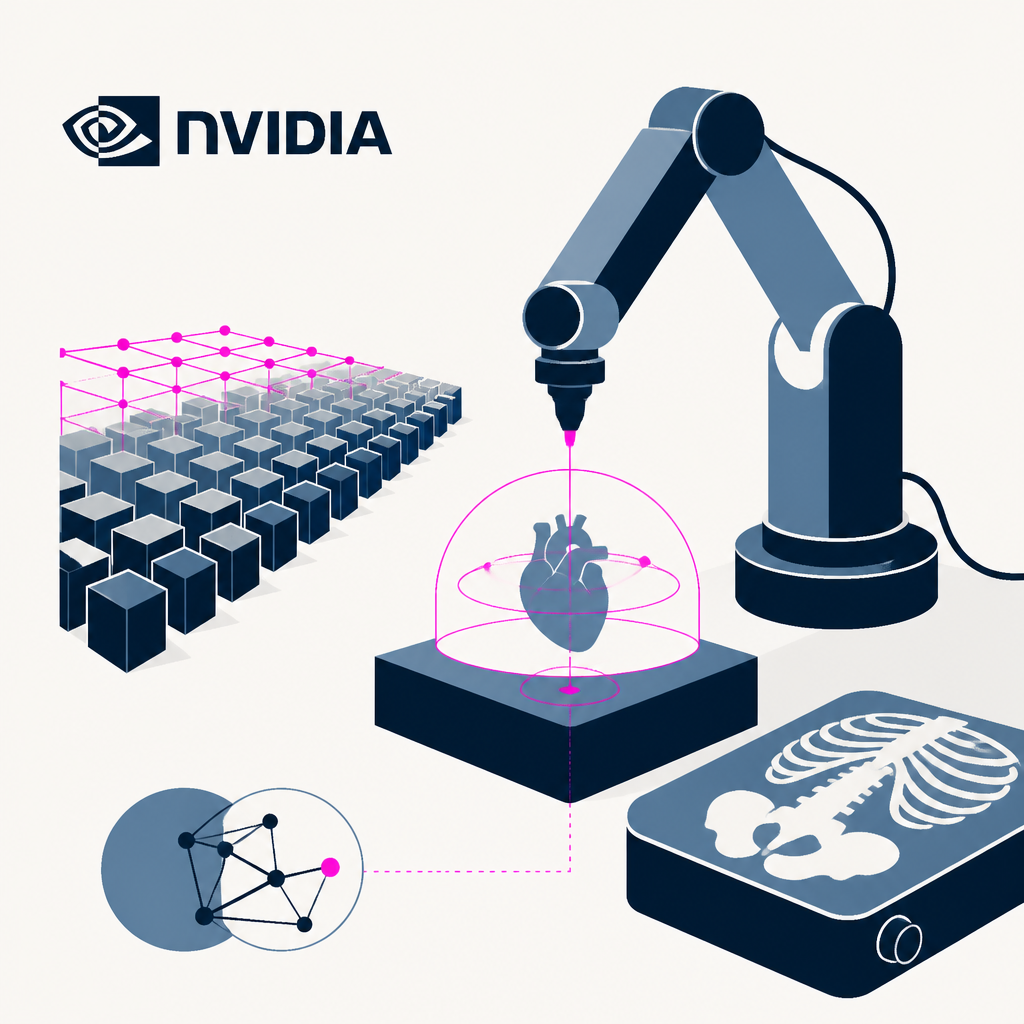
The next step is less about seeing the heart and more about simulating what happens inside it. CHOP is working with NVIDIA and the open source community on Newton, an open source physics engine built on NVIDIA Warp, to make device simulation run on GPUs instead of burning up to four hours or even a full overnight run. The goal is near-real-time answers for closure devices and, eventually, transcatheter valves — fast enough to help with same-day decisions. The hospital is also developing a coupler with SlicerHeart and NVIDIA Omniverse digital twins, powered by OpenUSD, so these simulations can feed into virtual reality and interactive clinical tools.
My take — AI-written commentary, not fact-checked reporting
This is the kind of open source story that actually earns the hype. Not another demo, not another polished keynote slide — just a rare, hard problem that no single company wanted to pay for, and a stack of shared tools that lets hospitals build anyway. If more of medicine worked like this, fewer patients would be stuck waiting for some vendor to discover a market in their exact anatomy.
Read more about this at: NVIDIA Blog