
Google’s A.I. Detector Arrives With Big Gaps on Text and Anthropic
Trending Topics Jakob Steinschaden ● Covered by 3 sources
Google’s SynthID Detector is now open to everyone, but only for images, video and audio. It misses text and anything without Google’s watermark, so the blind spots are the point.
Based on reporting by Trending Topics, Jakob Steinschaden — read the original for the full story.
Summary, retelling and take written by AI under human oversight; images are AI-generated illustrations. How we work · Report an error
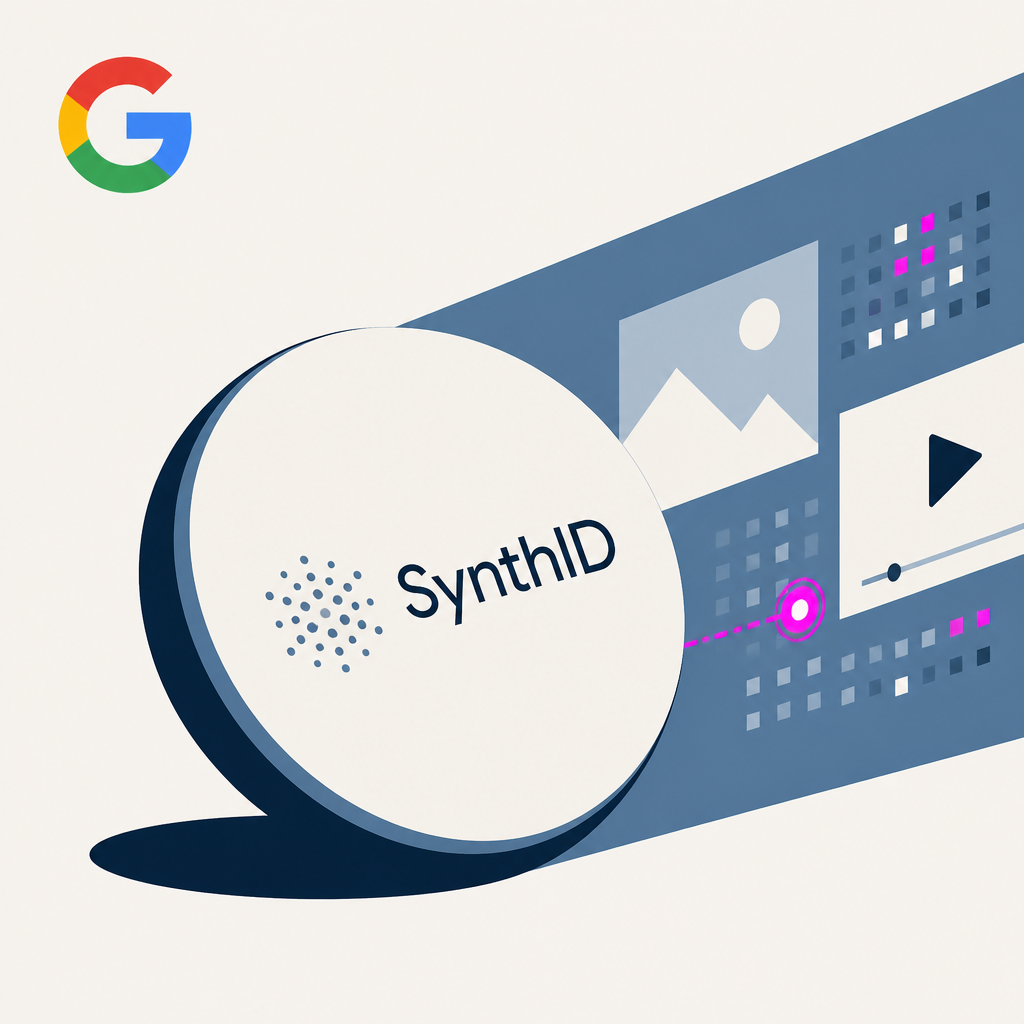
Google has opened its SynthID Detector to the public, letting anyone upload an image, video or audio file and ask whether it was made with one of Google’s A.I. systems or a partner’s. The catch is blunt: if the file was never stamped with a SynthID watermark, the detector sees nothing. Text is out of scope entirely.
That makes the tool useful, but only in a narrow lane. Google says it has watermarked more than 180 billion images and videos since 2023, plus audio equal to 240,000 years. The watermark is embedded in the pixels or the audio track, and it shows up in content from Nano Banana, Veo, Lyria, Gemini and Flow. A first version of the detector launched last year for journalists and media professionals; now it is free to anyone who signs in with a Google, OpenAI or Apple account.
The detector accepts common file types, including JPG, PNG, HEIC and WEBP for images, MP4, MOV and WEBM for video, and MP3, WAV and M4A for audio. It also checks C2PA metadata, the digital origin label used by a number of A.I. providers. And it already exists inside Google Search, the Gemini app and Chrome, where Google says those services now process more than one million verification requests a day.
But the gaps are doing most of the talking. OpenAI’s ChatGPT text uses its own system, textGrain, not SynthID, and only selected researchers can access that detector. Anthropic’s Claude text is marked with a variant of SynthID Text, yet Google’s detector does not cover Anthropic, so Claude files have to be checked through a separate closed interface. Microsoft and Meta use different watermarks, while open-source image models often carry no label at all.
Editing can also strip a watermark away, and the detector cannot say whether a file was fully generated by A.I. or only edited with it. A negative result just means no SynthID was found. In other words, the public got a detector, not a truth machine.
Opinion: This is the usual A.I. industry move: build a standard, then ship it like the standard is the world. It isn’t. Google gets points for opening the tool, but the patchwork of watermarks means users still get a polite shrug from every company outside its fence. The EU is at least pushing everyone toward machine-readable labels; the rest of the market is still busy inventing its own badge and calling that progress.
My take — AI-written commentary, not fact-checked reporting
This is the usual A.I. industry move: build a standard, then ship it like the standard is the world. It isn’t. Google gets points for opening the tool, but the patchwork of watermarks means users still get a polite shrug from every company outside its fence. The EU is at least pushing everyone toward machine-readable labels; the rest of the market is still busy inventing its own badge and calling that progress.
Read more about this at: Trending Topics
Related stories
 Google's SynthID watermark is hard to break, but it doesn't solve AI misinformation
Ars Technica · 2 months ago ·
46
Making it easier to understand how content was created and edited
Google DeepMind · 4 months ago ·
43
How we’re bringing AI image verification to the Gemini app
Google DeepMind · 10 months ago ·
10
Google's SynthID watermark is hard to break, but it doesn't solve AI misinformation
Ars Technica · 2 months ago ·
46
Making it easier to understand how content was created and edited
Google DeepMind · 4 months ago ·
43
How we’re bringing AI image verification to the Gemini app
Google DeepMind · 10 months ago ·
10