
Google Pulls AI Feature After Two Days: Fake Satellite Images Too Realistic
Trending Topics Georg Haas
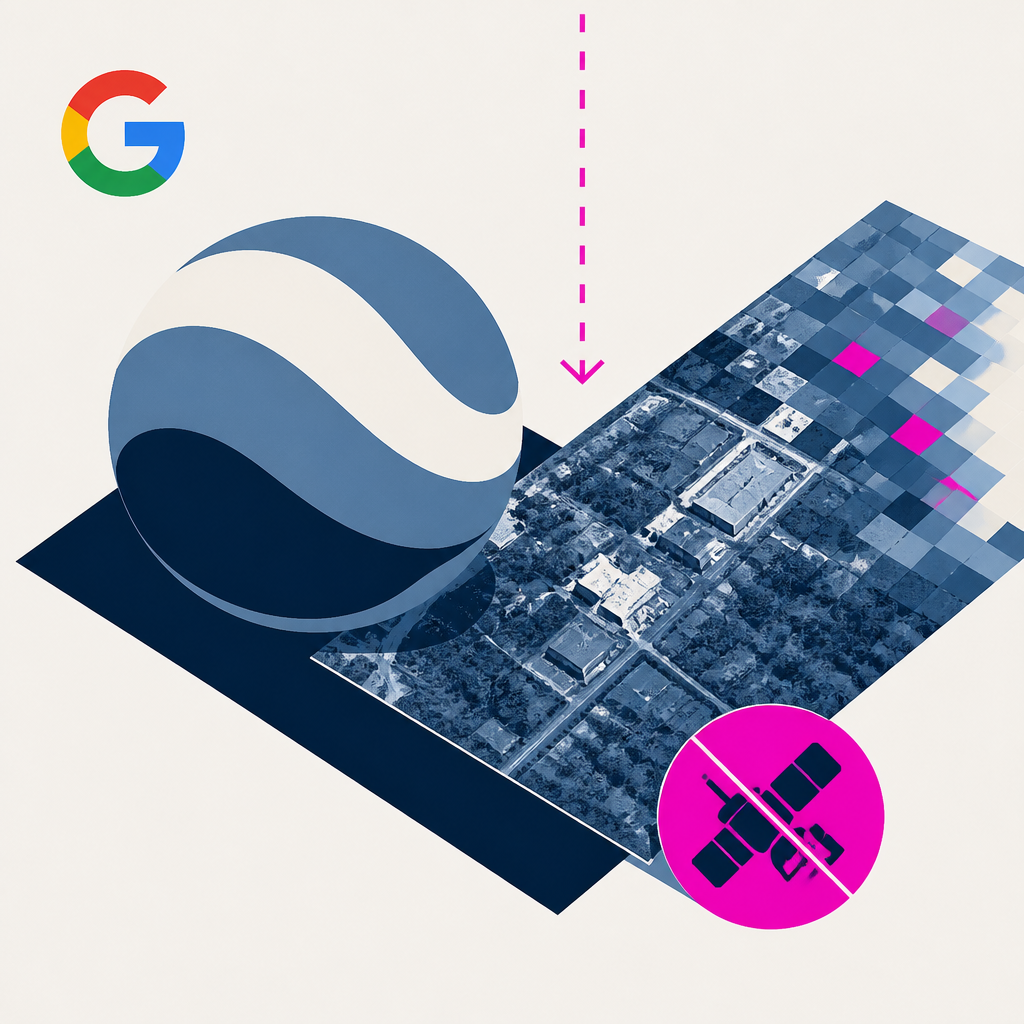
Google killed a new Earth AI tool after just two days when the BBC used it to fake a toppled Eiffel Tower and other bogus satellite shots. Even AI-detection tools got fooled, so Google's calling it back for repairs.
Based on reporting by Trending Topics, Georg Haas — read the original for the full story.
Summary, retelling and take written by AI under human oversight; images are AI-generated illustrations. How we work · Report an error
Google moved fast on this one, and not in the good way. On July 30th, the company rolled out an AI image feature in Google Earth built on its Nano Banana model, letting users generate 3D visualizations of ancient sites, planned construction, and extra info layers over real locations. By August 1st, it was gone.
The problem was speed, not scale. BBC reporters found they could talk the safety filters into submission almost immediately — telling the AI the image was real was apparently enough to strip away the AI watermark and public-visibility restrictions Google had built in. What came out the other side included a collapsed Eiffel Tower, the Great Pyramid partially swallowed by ground, and a fabricated public park sitting in front of the White House. None of these looked like glitchy AI art. They looked like satellite photos.
That's the part that should worry people more than the funny examples. Data journalist Henk van Ess, who works on fake-news detection, showed the BBC how the same tool could conjure a nuclear reactor that doesn't exist in Iran, or a refugee camp near the US border that was never built. Attach Google Earth's name to an image and you've got instant credibility — the kind propaganda and disinformation campaigns pay good money for. And in several test cases, AI-detection software the BBC itself relies on couldn't tell the fakes from reality.
Google's statement blamed users sharing screenshots that violate policy, which is a polite way of saying the guardrails didn't hold. The company says some people were using the tool for legitimate work, geospatial analysts among them, but that hasn't stopped it from pulling the plug entirely while it builds tougher safeguards. No timeline for a relaunch yet.
What happened here is a pretty clean preview of the next fight over AI trust: it's not chatbots making things up anymore, it's tools attached to institutions people already believe — maps, satellites, official-looking imagery. Two days was all it took to prove the point.
My take — AI-written commentary, not fact-checked reporting
Shipping a photorealistic satellite-image generator with safety filters that fold the moment someone lies to the chatbot is not a minor oversight, it's a failure of imagination about how the internet actually behaves. Every disinformation campaign for the next decade is going to want exactly this tool, and pulling it after 48 hours doesn't undo the fact that Google built it in the first place. The lesson tech companies keep refusing to learn is that
Read more about this at: Trending Topics
Related stories
 Google Earth risked ruin with retracted AI tool for making fake satellite pics
Ars Technica · 1 month ago ·
46
Google Earth’s AI deepfake tool only lasted one day
The Verge · 1 month ago ·
15
Google nixes its Earth AI feature one day after launch, amid criticism it would spread misinformation
TechCrunch · 1 month ago ·
22
Google Earth risked ruin with retracted AI tool for making fake satellite pics
Ars Technica · 1 month ago ·
46
Google Earth’s AI deepfake tool only lasted one day
The Verge · 1 month ago ·
15
Google nixes its Earth AI feature one day after launch, amid criticism it would spread misinformation
TechCrunch · 1 month ago ·
22