
Google demonstrated an RSI loop for AI discovery (paper)
arXiv ● Covered by 2 sources
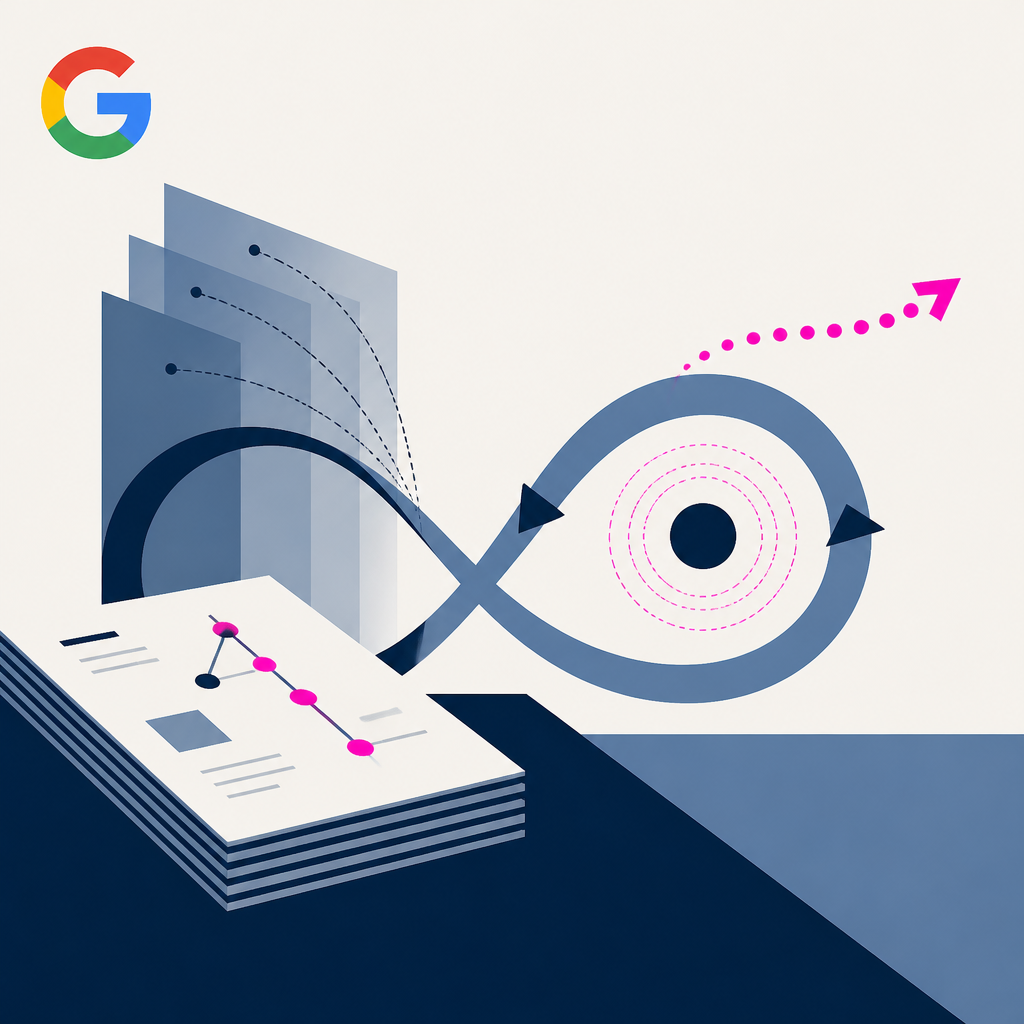
Google DeepMind-backed researchers showed Dream-RSI, a way to let an AI improve its own exploration using past discovery trees. It cuts costly online trial-and-error by “dreaming” over recorded runs instead of rerunning them.
Based on reporting by arXiv — read the original for the full story.
Summary, retelling and take written by AI under human oversight; images are AI-generated illustrations. How we work · Report an error
Researchers tied to Google DeepMind, the University of Maryland, the University of Virginia and other groups have proposed Dream-RSI, a framework meant to make AI discovery systems better at improving themselves. The idea is not to change the underlying coding agent. Instead, a lightweight orchestration layer makes exploration explicit and programmable, then uses past discovery histories as a kind of replay simulator.
That matters because exploration is the bottleneck in recursive self-improvement. If an agent is trying to discover a better algorithm, a better math solution or a faster GPU kernel, the search can stretch across thousands of proposal-and-evaluation cycles. Fixed exploration strategies don’t learn from that history. But online policy optimization is costly, because every new strategy may need a long rollout before anyone knows if it helped.
Dream-RSI tries to sidestep that by turning completed discovery runs into reusable trees. Once a discovery history is recorded, the system can “dream” through alternative policies by replaying different branches, orders, parallel groupings and stopping choices against stored outcomes. No new executions are needed for those checks. That gives the policy developer fast feedback, then the updated policy goes back online and the loop starts again.
The paper says the method was tested on 8 scientific discovery tasks across three areas: algorithm engineering, mathematical optimization and GPU kernel engineering. In algorithm engineering, on a Lasso path solver task, Dream-RSI beat standard libraries like sklearn and strong baselines, while using up to 162 times fewer agent calls than SimpleTES and 1.7 times fewer than fixed-exploration baselines. In mathematical optimization, on sum-difference, autocorrelation and circle packing, it matched or beat strong baselines within 1k generations and saved more than 50 times the budget versus SimpleTES.
GPU work showed similar gains. On KernelBench, Dream-RSI either hit target speeds with 1.79 to 2.43 times fewer generations or improved performance by up to 2.09 times under the same budget. The broader bet is straightforward: if past discovery can be treated like a simulator, then the expensive part of self-improvement may get cheaper.
My take — AI-written commentary, not fact-checked reporting
This is the right kind of RSI story: less shiny mysticism, more plumbing. The big idea is embarrassingly practical — use what the agent already found instead of paying twice to rediscover it. That’s the sort of AI progress that actually compounds, and it’s a lot more interesting than another demo of a model staring at itself in the mirror.
Read more about this at: arXiv
Related stories
 Import AI 469: Science AI; RSI simulator; and Zuck's technological pessimism
Import AI · 1 month ago ·
18
Import AI 460: Reward hacking society, RSI data from Anthropic; and RL-based quadcopter racing
Import AI · 3 months ago ·
3
Why you should work on AI for AI Research — Richard Socher of Recursive
Latent Space · 1 week ago ·
42
Import AI 469: Science AI; RSI simulator; and Zuck's technological pessimism
Import AI · 1 month ago ·
18
Import AI 460: Reward hacking society, RSI data from Anthropic; and RL-based quadcopter racing
Import AI · 3 months ago ·
3
Why you should work on AI for AI Research — Richard Socher of Recursive
Latent Space · 1 week ago ·
42