
Black Forest Labs Releases FLUX 3 Action: A 7B Open-Weights World Action Model That Tops RoboLab-120
MarkTechPost Asif Razzaq

Black Forest Labs just put out FLUX 3 Action, a 7B robot policy that tops RoboLab-120. It also comes with license limits, so this isn’t an open door for everyone.
Based on reporting by MarkTechPost, Asif Razzaq — read the original for the full story.
Summary, retelling and take written by AI under human oversight; images are AI-generated illustrations. How we work · Report an error
Black Forest Labs, best known for the FLUX image models, has moved into robot control with FLUX 3 Action. The new model is a 7B open-weights World Action Model, and on RoboLab-120 it takes the top spot with a 42.92% task success rate.
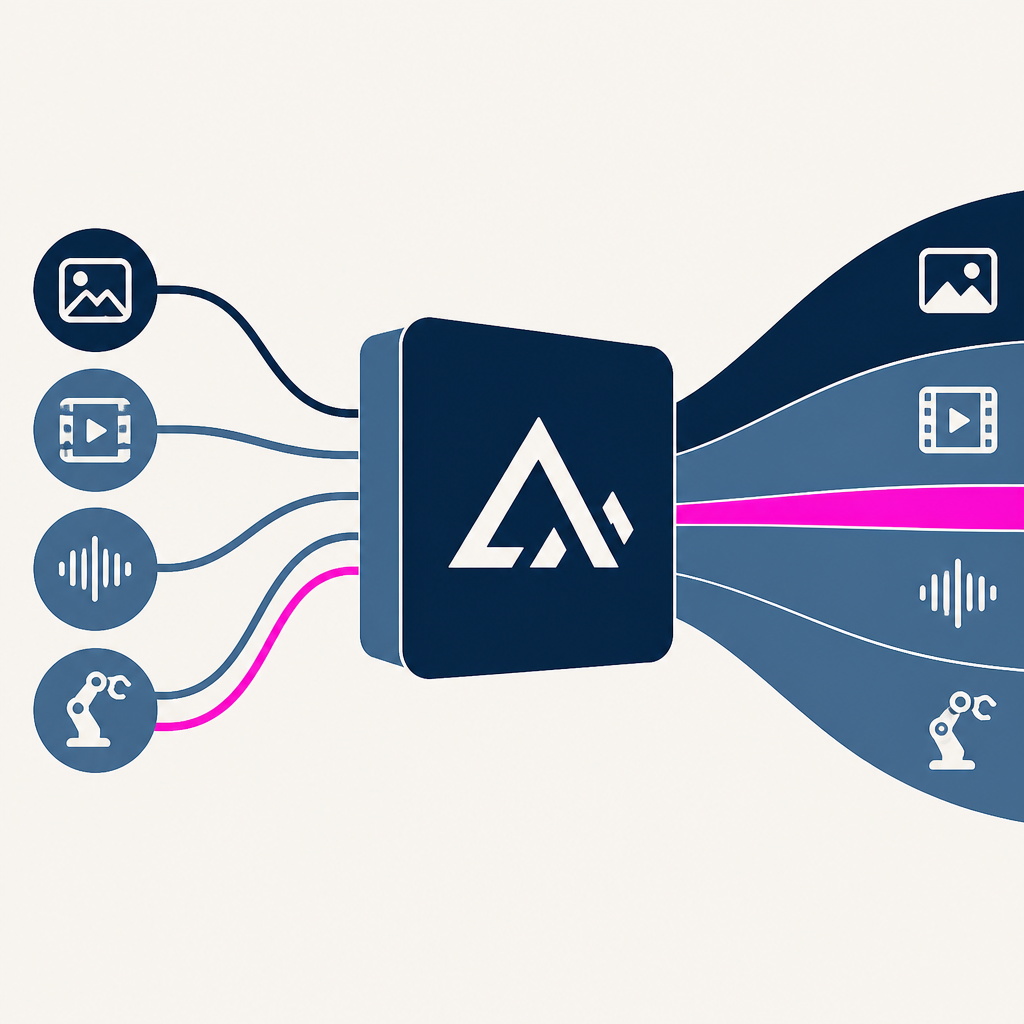
The appeal is obvious. Robot policies usually make you choose between richer world modeling and speed. FLUX 3 Action tries to keep both: it reads camera frames, robot state, and a text instruction, then predicts future video frames and the next chunk of actions together. That puts it in the same broad family as NVIDIA’s Cosmos 3 Nano, but BFL says it closes the speed gap with a smaller backbone and distillation.
The training mix is doing a lot of the work here. BFL says pretraining used image, video, and audio data, with video making up more than 95% of the tokens. Midtraining then blended pretraining data with action-aligned video, and that action data included game recordings, egocentric human hand video, handheld grippers, and teleoperation across 14 embodiments. Most robot data was mapped into a shared 50-dimension end-effector action space called EE50.
The numbers suggest pretraining mattered a lot. Without it, DROID-only training stayed below 1% on RoboLab. With pretraining, the same setup reached 11.6%. On the benchmark itself, FLUX 3 Action’s 42.92% beats Cosmos 3 Nano’s 36.8% by 6.1 points, while using 56% fewer parameters. BFL’s own multi-seed mean for the guidance-distilled FP8 checkpoint was 42.24% ± 0.36.
Hardware results point in the same direction. On a blind evaluation run by Positronic Robotics with a Franka arm, FLUX 3 Action completed 28 of 30 attempts, versus 27 for Cosmos 3 Nano, 20 for DreamZero, and 13 for π0.5. BFL also ships three checkpoints for the DROID policy, with the guidance-distilled version running faster than the base recipe and the step-distilled one going faster still, though with lower success. The catch is practical, not theoretical: the model can run on 24 GB cards with FP8 and text encoder offload, but the FLUX Kommunity License keeps it in non-commercial territory.
There’s also a hybrid setup with GPT 6 Astra, where the reasoner can execute, edit, or replace the policy’s predicted actions. BFL says that combination solved 90% of episodes at lower cost and lower time per success than pure Astra at maximum effort. So yes, this is another reminder that the robot stack is becoming a game of clever tradeoffs, not just bigger models.
My take — AI-written commentary, not fact-checked reporting
This is the right kind of AI story: a model that actually has to survive contact with hardware, not just a leaderboard. But the non-commercial license means the industry gets another shiny robot brain to admire from behind the rope line. Open-weights, closed door — the modern classic.
Read more about this at: MarkTechPost
Related stories
 Black Forest Labs Releases FLUX 3: A Multimodal Flow Model for Image, Video, Audio and Robot Action Prediction
MarkTechPost · 1 month ago ·
16
[AINews] Black Forest Labs FLUX 3 - Multimodal Flow Models that beat Seedance 2.0, Gemini Omni and Grok Imagine, and FLUX-mimic video-action robotics model
Latent Space · 2 months ago ·
12
FLUX 3 Expands Black Forest Labs' Image Generation Capabilities
Black Forest Labs · 2 months ago ·
16
Black Forest Labs Releases FLUX 3: A Multimodal Flow Model for Image, Video, Audio and Robot Action Prediction
MarkTechPost · 1 month ago ·
16
[AINews] Black Forest Labs FLUX 3 - Multimodal Flow Models that beat Seedance 2.0, Gemini Omni and Grok Imagine, and FLUX-mimic video-action robotics model
Latent Space · 2 months ago ·
12
FLUX 3 Expands Black Forest Labs' Image Generation Capabilities
Black Forest Labs · 2 months ago ·
16