
AI Fiction Is Easy to Detect Because It's Stupid and Bad, Research Finds
404 Media Matthew Gault
Researchers found AI-written short stories are easy to spot, and it's not just the em-dashes. The plots are too tidy, the morals too obvious, and the characters too flat.
Based on reporting by 404 Media, Matthew Gault — read the original for the full story.
Summary, retelling and take written by AI under human oversight; images are AI-generated illustrations. How we work · Report an error
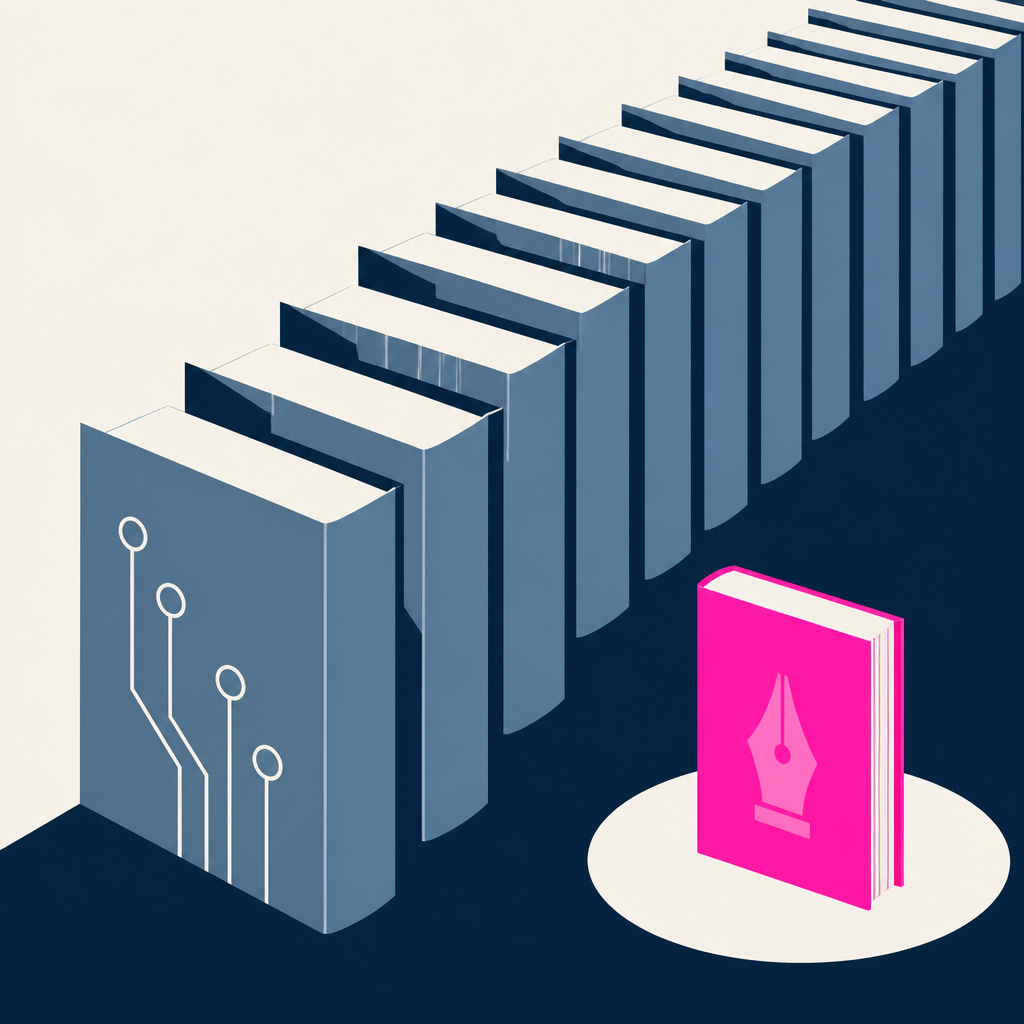
A new preprint out of the University of Maryland and Google DeepMind takes a hard look at more than 50,000 AI-generated short stories and reaches a conclusion that will feel obvious to anyone who's read one: the machines can't plot to save their lives. Forget the usual AI tells like em-dashes or a fondness for the word "tapestry." The real giveaway is structural. These stories over-explain their own themes, wrap up in neat single-track plots, and rarely let a character's choice feel morally messy the way human fiction does almost by instinct.
The researchers also found each major model has its own tics. Claude tends to flatten the escalation of events, so nothing in the story really builds. GPT can't resist a dream sequence, apparently reaching for one whenever the plot needs a shortcut. Gemini leans hard on describing what characters look like from the outside rather than what they're thinking or feeling. Put those habits together across tens of thousands of samples and you get something the paper describes as a shared region of narrative space — a fancy way of saying the AI stories all kind of blur into the same handful of shapes, while human-written fiction sprawls all over the map.
What's notable here is that the researchers aren't just flagging surface style, the kind of thing a simple word-frequency check might catch. They're pointing at something deeper: how these systems structure time, cause and effect, and character motivation. Human writers, even mediocre ones, tend to let timelines jump around and leave some ambiguity about why a character did what they did. AI models, trained to predict the statistically likely next sentence, gravitate toward whatever wraps up cleanest.
That has real implications beyond literary criticism. If AI-generated fiction clusters this predictably, it becomes a lot easier to build detection tools that don't rely on stylistic fingerprints alone, which are already getting easier for models to fake. It also raises an uncomfortable question for publishers drowning in AI-submitted short story slush: the problem isn't just volume, it's that the stories are recognizably, structurally samey in a way that's almost measurable.
And that sameness might be the real story here. Large language models are optimized to satisfy an average of training data, which nudges them toward the tidy moral arc and the safe dream-sequence twist. Human writers get to be weird, inconsistent, and morally unresolved. For now, at least, that messiness is still the tell.
My take — AI-written commentary, not fact-checked reporting
I'll take the messy, morally ambiguous human short story over the tidy AI one every time, and this study basically proves why: LLMs are trained to average out weirdness, and weirdness is exactly what makes fiction worth reading. The bigger lesson for the industry chasing 'AI-written novels' as a product is that flattening narrative space isn't a bug you patch with more training data, it's the whole architecture working as designed.
Read more about this at: 404 Media
Related stories
 ‘They’re likely to get squeezed’: AI slop books are flooding online marketplaces—and it’s coming at the expense of paychecks for human authors
Fortune ·
27
China’s web novel platforms embraced AI. Now they are fighting it
Rest of World · 2 months ago ·
49
‘They’re likely to get squeezed’: AI slop books are flooding online marketplaces—and it’s coming at the expense of paychecks for human authors
Fortune ·
27
China’s web novel platforms embraced AI. Now they are fighting it
Rest of World · 2 months ago ·
49