
34 Amazon Research Awards Build on Trainium recipients announced
Amazon Science
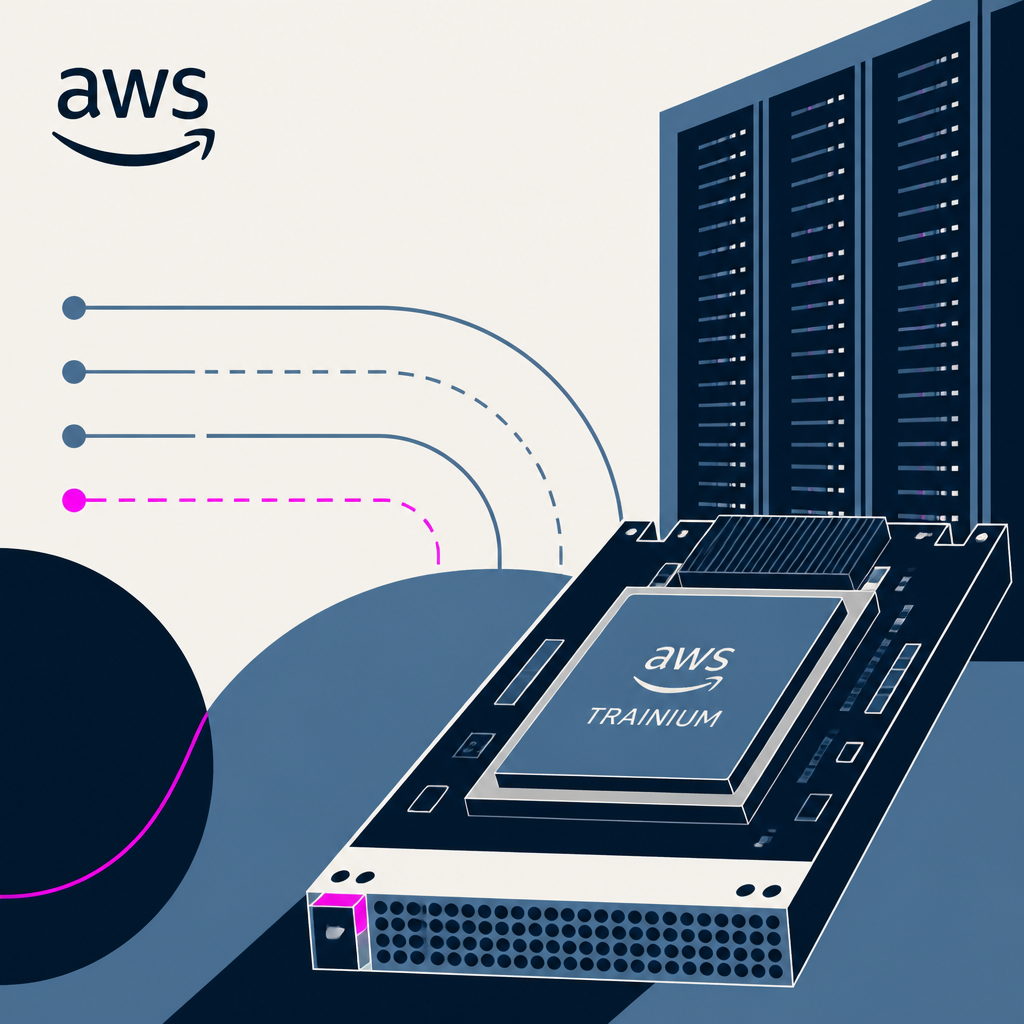
Amazon picked 34 university teams for its Build on Trainium research awards. Winners get free AWS chip time to study AI safety, multilingual models and more.
Based on reporting by Amazon Science — read the original for the full story.
Summary, retelling and take written by AI under human oversight; images are AI-generated illustrations. How we work · Report an error
Amazon's $110 million Build on Trainium credit program just handed out its latest round of awards, and this cycle carries a specific theme: Responsible AI. The Fall 2025 call for proposals asked academic teams to tackle five areas — AI safety and alignment, multilingual language models, representation engineering, sustainability and small language models, and synthetic data generation — all while running their work on AWS's custom Trainium chips. Thirty-four teams made the cut.
The range of topics is wide, which is the point. Shen Shen at MIT is benchmarking agent tool-use safety with LoRA-based mitigations. Haojian Jin at UC San Diego is looking at how social bias shows up in AI image generation. Marios Kogias at Imperial College London is chasing deterministic model inference, while ThanhVu Nguyen at George Mason is pairing Trainium with verifiable AI and math reasoning. Add in projects on differentially private synthetic data, LLM hallucination detection, and youth safety in multimodal generative AI, and you get a snapshot of where academic Responsible AI work is heading right now — not just theory, but stuff meant to run on real infrastructure.
Winners don't just get compute credits and walk away. Each team gets access to more than 700 Amazon public datasets, AWS Promotional Credits to use Amazon's AI and ML tooling, a dedicated Amazon research contact for consultation, and hands-on Trainium tutorials. That's a fuller package than a typical grant — it's meant to plug researchers directly into the AWS ecosystem while they work.
Two projects got called out by name in Amazon's own announcement, and they're instructive. Researchers at the University of Illinois Urbana-Champaign are studying topology-aware parallelization strategies for mixture-of-experts models as large as one trillion parameters, spread across up to 1,024 Trainium chips. Meanwhile, a University of Washington team is building an inference-optimization framework aimed at boosting token efficiency broadly for anyone deploying large language models on Trainium, with portability and performance as the twin goals.
AWS AI Principal Applied Scientist Yida Wang framed the program as removing compute as the bottleneck for ambitious research. Whether or not that's the full story, funding 34 teams across this many subfields — safety, multilingual coverage, sustainability, synthetic data — is a fairly deliberate way to seed a research community around a chip that's still fighting for mindshare against the incumbents.
My take — AI-written commentary, not fact-checked reporting
Handing academics free chip time and calling it Responsible AI research is a smart move for Amazon, not just a generous one — every published paper that runs on Trainium is free marketing and free debugging for AWS's silicon. Nobody should pretend this is neutral philanthropy, but that doesn't make the actual research less useful; safety benchmarks and hallucination detection work matter regardless of whose GPUs, or in this case chips, they run on. The bigger pattern here is chipmakers courting universities the way cloud providers once courted startups, and it's worth watching whether that shapes which research questions get asked in the first place.
Read more about this at: Amazon Science
Related stories
 AWS Trainium Frontier competition: Co-design models and kernels on purpose-built AI chips
Amazon Science · 1 month ago ·
6
Amazon’s AI Resurgence: AWS & Anthropic’s Multi-Gigawatt Trainium Expansion
SemiAnalysis · 1 year ago ·
30
AWS Trainium Frontier competition: Co-design models and kernels on purpose-built AI chips
Amazon Science · 1 month ago ·
6
Amazon’s AI Resurgence: AWS & Anthropic’s Multi-Gigawatt Trainium Expansion
SemiAnalysis · 1 year ago ·
30