MarkTechPost
·
5 days ago
Zyphra released ZUNA1.1, an open-source EEG foundation model that reconstructs, denoises, and upsamples brain signals across variable channel layouts and recording lengths. The model accepts input lengths from 0.5 to 30 seconds (compared to ZUNA1's fixed 5-second segments) and uses 4D rotary positional encoding to handle arbitrary electrode configurations. The training expanded from 2 million to 3.5 million channel-hours of EEG data and introduced four dropout patterns instead of one, enabling better performance on realistic reconstruction tasks like region-based electrode recovery.
Sakana AI
● 2 sources
Sakana AI developed the Namazu model series by applying post-training techniques to open-weight foundation models to adapt them for Japanese cultural context and safety requirements. The Namazu-DeepSeek-V3.1-Terminus model maintained base model performance on benchmarks like MMLU-Redux and LiveCodeBench while improving neutrality and factual accuracy on politically sensitive topics from 28% to nearly 100% in answering related questions. Sakana launched Sakana Chat, a search-integrated service using Namazu models, following 1,000 beta testers' feedback to make localized AI models broadly accessible to Japanese users.

Sakana AI
● 5 sources
Sakana AI published a Nature paper describing The AI Scientist-v2, an agent that autonomously executes machine learning research by generating ideas, conducting experiments, and writing papers. A paper generated by the system achieved a 69% balanced accuracy score from an Automated Reviewer that matched human peer-review performance on actual conference submissions. The results demonstrate a scaling law where improved foundation models produce higher-quality generated papers, suggesting the system's capabilities will improve substantially as underlying models advance.
Sakana AI
● 2 sources
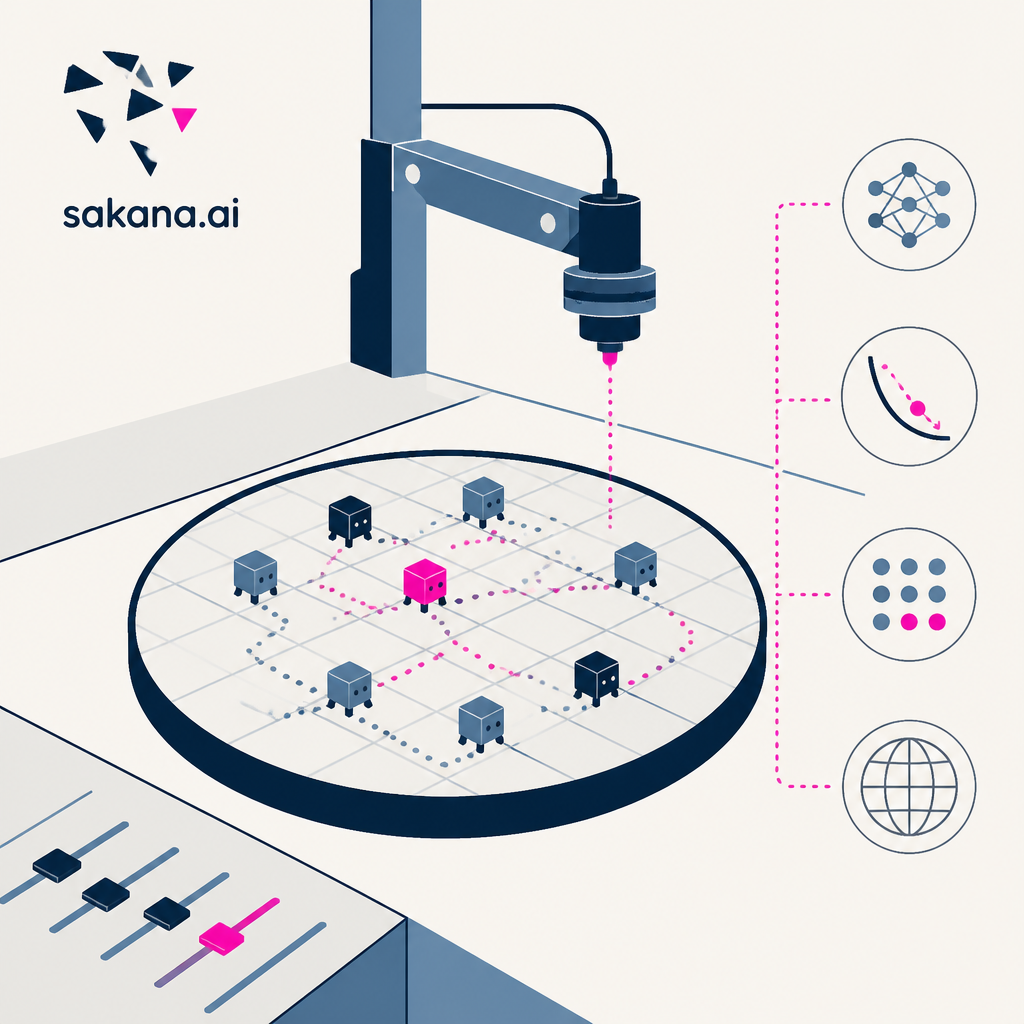
Sakana AI released Digital Ecosystems, a browser-based platform where small neural networks compete on a 2D grid, learning via gradient descent while the simulation runs. The system contains 40+ tunable parameters and runs entirely in the browser without installation. The research found that gradient descent stabilizes the ecosystem by preventing species from overextending or stagnating, enabling exploration of complex emergent behaviors.
Sakana AI
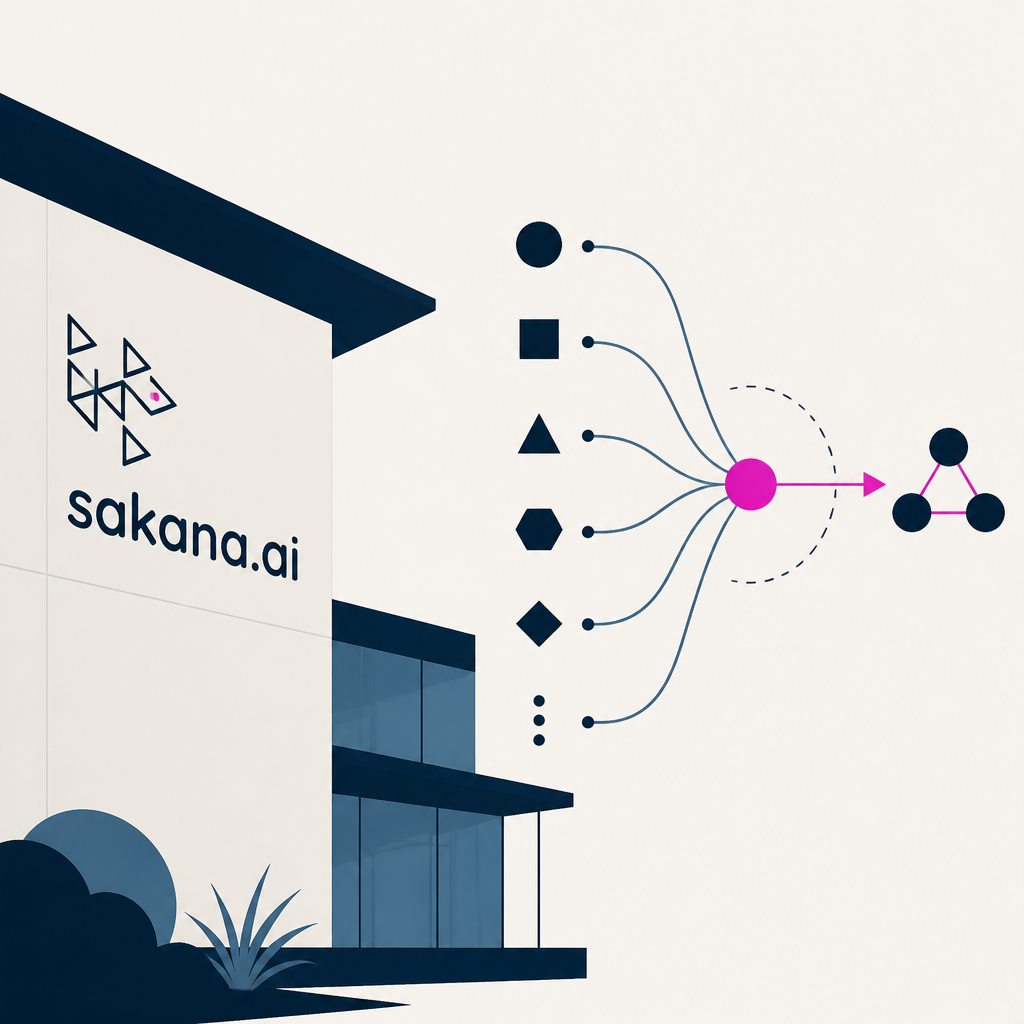
Sakana AI discovered a prompting technique called String Seed of Thought (SSoT) that reduces output bias in large language models by instructing them to generate random strings internally before deriving answers. Testing across multiple LLMs showed SSoT achieved accuracy close to actual random sampling on reasoning models and improved diversity on the NoveltyBench benchmark across all six categories. The method requires only a small prompt addition with no external random number generator, making it applicable to content generation and ideation tasks where varied outputs are needed.
Sakana AI
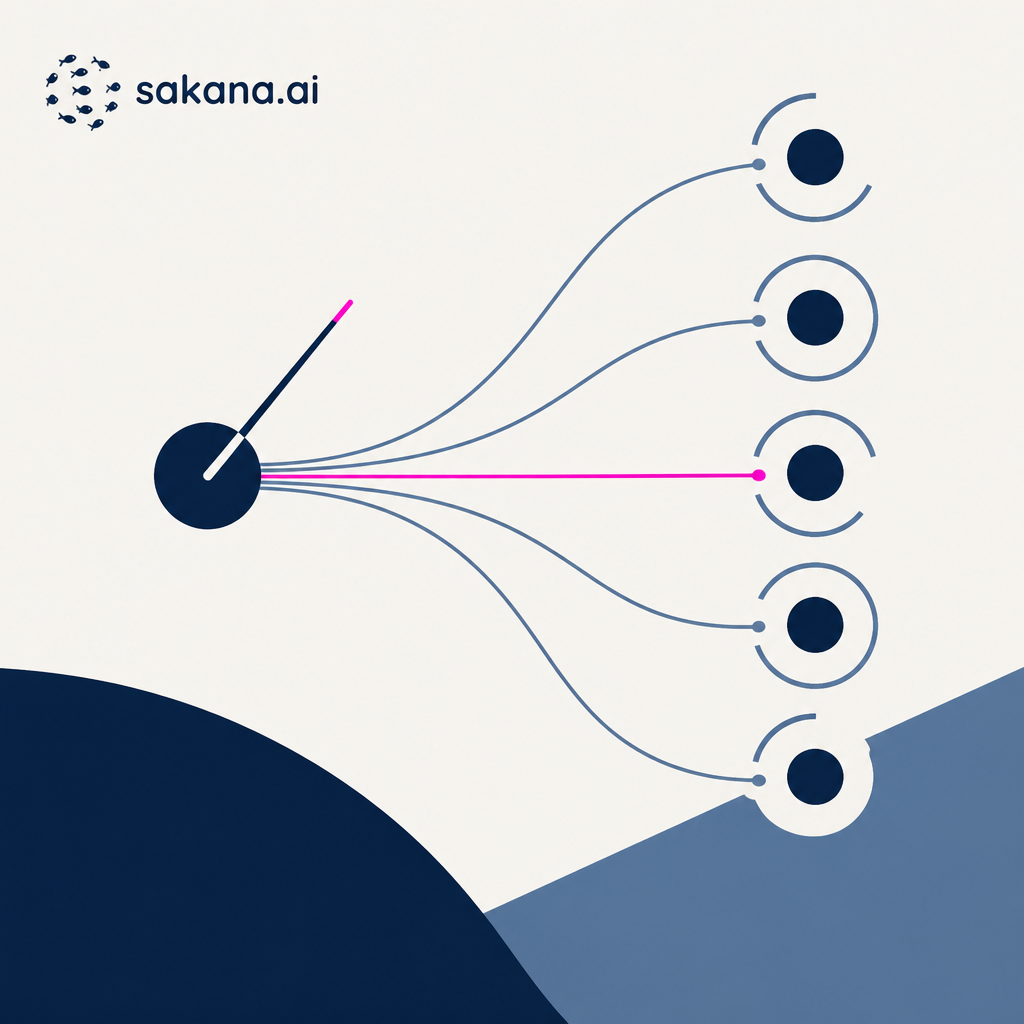
Sakana AI developed TRINITY, a coordinator system that orchestrates multiple specialized AI models at test-time without modifying their weights, using an evolutionary algorithm to optimize a 20K-parameter routing mechanism. The system achieved an 86.2% pass@1 score on LiveCodeBench and generalized zero-shot to four unseen tasks while outperforming individual models including GPT-5 and Claude-4-Sonnet. This approach replaces the industry focus on scaling single monolithic models with collaborative multi-model systems that combine complementary strengths through dynamic task assignment.
Sakana AI
Sakana AI trained a 7-billion-parameter Conductor model using reinforcement learning to manage and coordinate a team of other AI models by writing natural language instructions tailored to each task. The Conductor achieved 83.9% on LiveCodeBench and 87.5% on GPQA-Diamond, surpassing individual models in its pool while dynamically adapting its approach—using single queries for simple questions and constructing multi-step workflows for complex problems. This approach enables AI systems to leverage collective intelligence by learning to delegate tasks across diverse models rather than relying on fixed human-designed workflows.
Sakana AI
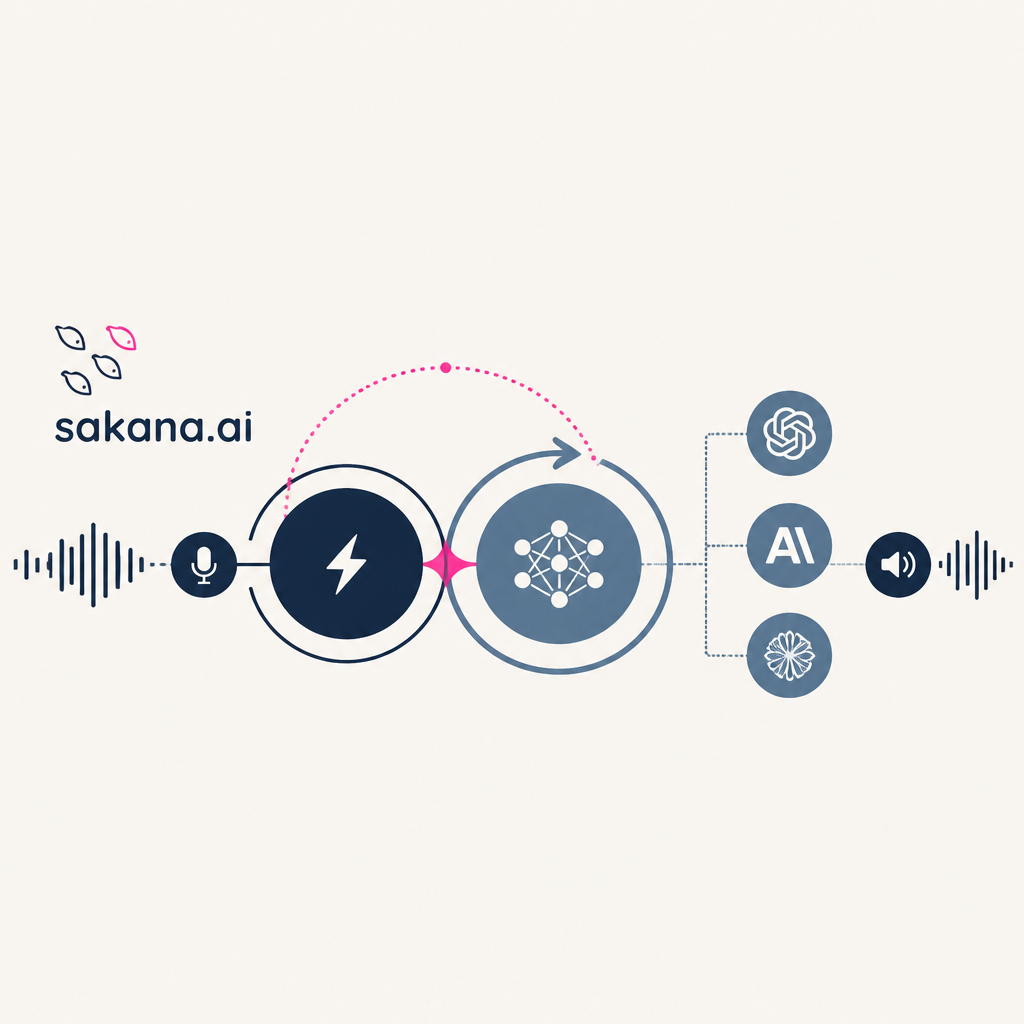
Sakana AI introduced KAME, a speech-to-speech conversational AI system that combines a fast response model with an asynchronous backend LLM to enable real-time reasoning during conversation rather than before speaking. The architecture allows swapping different LLMs like GPT-4.1, Claude Opus, or Gemini 2.5 Flash without changing the frontend system. The paper was accepted at ICASSP 2026 and demonstrated that different models excel at different tasks, with Claude scoring higher on reasoning and GPT on humanities questions.

Google DeepMind
·
5 days ago
● 4 sources
Google introduced Gemini 3.5 Flash Cyber, a lightweight AI model fine-tuned for finding and fixing software vulnerabilities faster than larger models. On internal benchmarks, the model found 55 unique vulnerabilities in Google's V8 JavaScript engine compared to 47 found by mainline Flash and 36 by Claude Opus 4.6, and discovered critical remote code execution flaws in Google Cloud systems within 2 hours. The model will initially be available only to governments and trusted partners through CodeMender, with broader deployment planned later to help defenders patch vulnerabilities before attackers exploit them.

Rest of World
·
5 days ago
Five AI language models (ChatGPT, Claude, Gemini, Copilot, and Perplexity) predicted World Cup matches with 50-60% accuracy, while Swimbappé the goldfish achieved 80% accuracy by swimming toward flags representing different outcomes. The AI models correctly identified Spain, France, England, and Argentina as semifinalists before the tournament but stumbled on individual match predictions, missing Brazil's elimination by Norway and Germany's loss to Paraguay. Animal predictors like Swimbappé and the hippo Moo Deng have outperformed the AI systems, continuing a tradition established by Paul the Octopus in 2010.

TLDR
·
5 days ago
● 4 sources
Google pushed back the launch of Gemini 3.5 Pro several months because the model did not meet internal capability targets, with coding performance as a key area needing improvement. The delay occurred as the company works to refine the model before release. The postponement extends competitive pressure from rival AI systems and forces Google to reassess its product roadmap.

The Neuron
·
5 days ago
Addy Osmani outlined an approach to AI evaluation that relies on manually reviewing model outputs, documenting errors, and constructing systematic assessment frameworks. The methodology prioritizes hands-on analysis over automated metrics, with particular attention to capturing failure patterns through logging. Organizations implementing these practices can develop more reliable processes for measuring AI system performance and identifying improvement areas.
The Neuron
·
5 days ago
● 6 sources
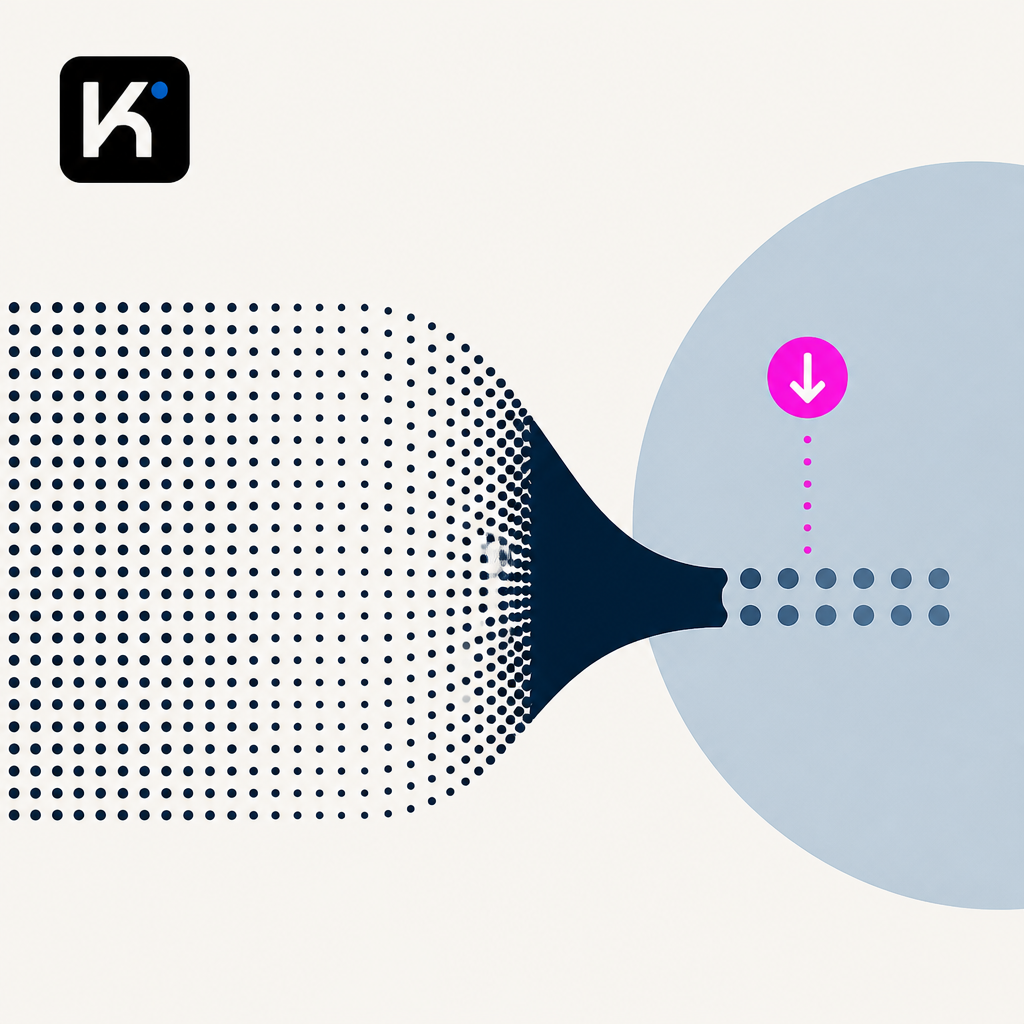
Artificial Analysis reported that Kimi K3 reduces output token usage by 21% compared to Kimi K2.6. The newer model version demonstrates improved efficiency in token generation. This efficiency gain reduces computational costs for users running the Kimi model.
The Neuron
·
5 days ago
● 6 sources
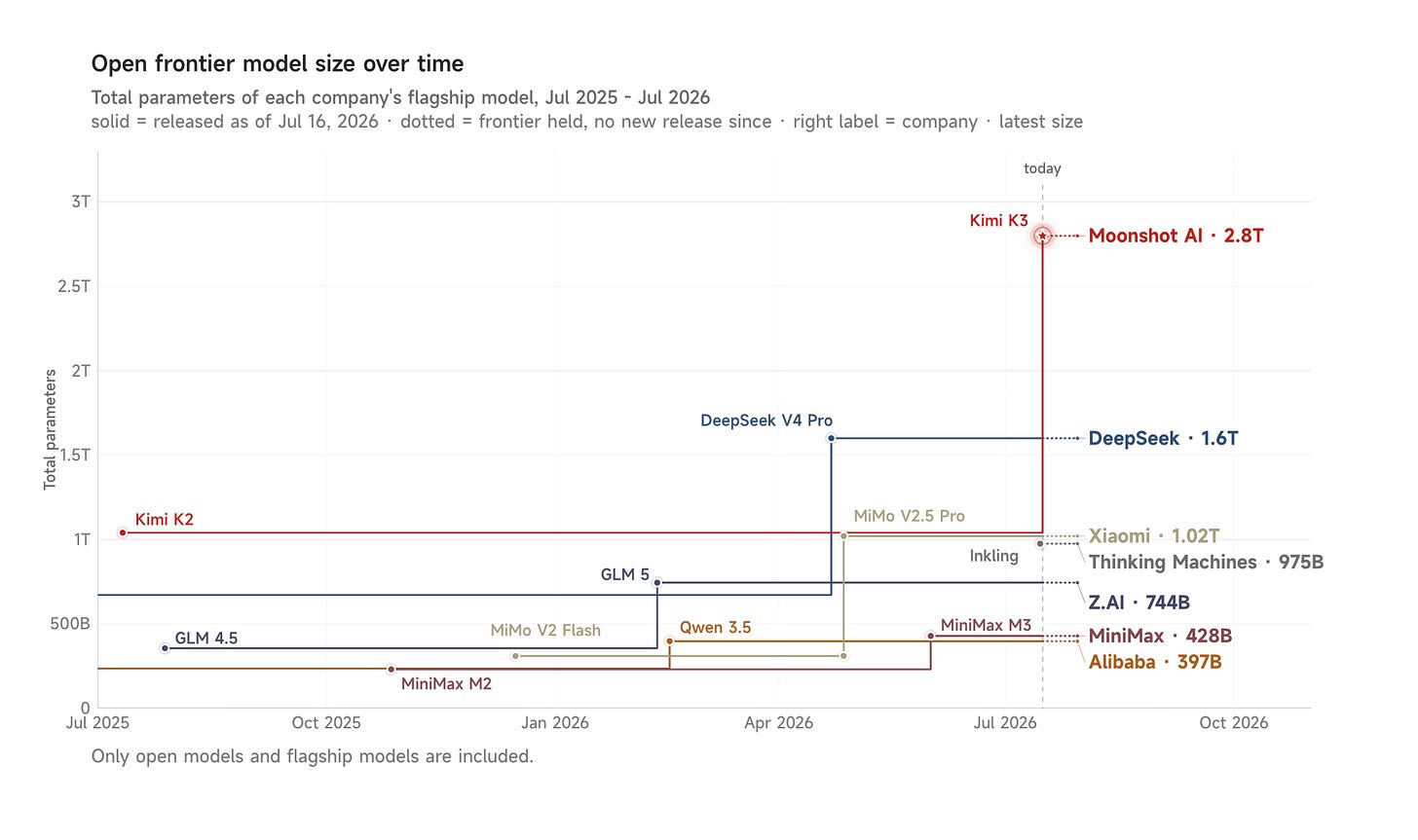
Moonshot released Kimi K3, a 2.8-trillion-parameter open-source model featuring native vision capabilities and a 1-million-token context window. The model will have full weights available by July 27, 2026, with pricing starting at $0.30 per million input tokens for cached content. Kimi K3 enables users to perform complex long-horizon tasks including GPU kernel optimization, compiler development, chip design, and scientific research with substantially reduced time requirements compared to manual approaches.

MarkTechPost
·
5 days ago
● 2 sources
NVIDIA released Nemotron 3 Embed, a collection of open embedding models for retrieval-augmented generation and agentic systems. The 8B model ranks #1 on the RTEB benchmark with an average NDCG@10 score of 78.46, and the 1B-NVFP4 variant achieves 99.5% accuracy retention of its BF16 parent while delivering up to 2x higher throughput on Blackwell hardware. The release includes three checkpoints supporting 32,768-token sequence lengths across multilingual tasks, with the smaller models created through neural architecture search pruning and knowledge distillation from the larger 8B teacher model.
Latent Space
·
6 days ago
● 12 sources
Moonshot AI released Kimi K3, an open-weights model with 2.8 trillion parameters and 1 million token context, claiming frontier-class performance comparable to closed models like Opus 4.8. Independent evaluations from Artificial Analysis placed it at index score 57 (between Opus 4.8 and GPT-5.5), while Arena ranked it #1 in frontend code tasks with a 76% pairwise win rate, and pricing was set at $3 per million input tokens and $15 per million output tokens, similar to Claude Sonnet 5. The release intensifies competition in open-source large language models and raises questions about deployment economics for the industry, though some evaluators noted persistent gaps in user experience versus the very top closed models and concerns about inference speed.

Platformer
·
6 days ago
● 17 sources
AI Moonshot released Kimi K3, a Chinese AI model that has generated significant hype despite questions about whether the reality matches the expectations. The model has drawn attention from critics and industry observers evaluating its actual capabilities. The release contributes to intensifying competition in the global AI model landscape with new entrants challenging established players.

Apple ML Research
·
6 days ago
Researchers introduced VICIS, a task that evaluates whether vision-language models can infer shared visual concepts from sets of example images and apply them to new inputs. State-of-the-art VLMs performed poorly on this benchmark, often ignoring visual context or producing biased outputs. The authors developed a training framework and architecture that learns to infer visual concepts from image sets, demonstrating improved accuracy and generalization to unseen concepts and modalities like sketches on ImageNet and WordNet data.
Apple ML Research
·
6 days ago
Researchers developed an unlearning framework that identifies training data points with negligible influence on model outputs and removes them before the unlearning process. The method achieves approximately 50% computational savings on real-world examples by reducing dataset size prior to unlearning. This enables faster and more efficient removal of specific data from trained models while maintaining privacy compliance.
