
Exponential View
·
1 month ago
A researcher tested whether LLM councils (multiple models deliberating together) avoid groupthink by comparing their outputs to individual model answers across 16 open-ended prompts. LLM councils kept only about 22-25% of good ideas that appeared in just one model's answer, while ideas from multiple models survived at roughly the same rate but received an 11% uplift in peer-review settings. The findings suggest that LLM councils risk losing novel ideas through consensus bias similar to human committees, requiring more explicit protocols to preserve valuable unique insights rather than relying on automatic blending or peer review.
TheSequence
·
1 month ago
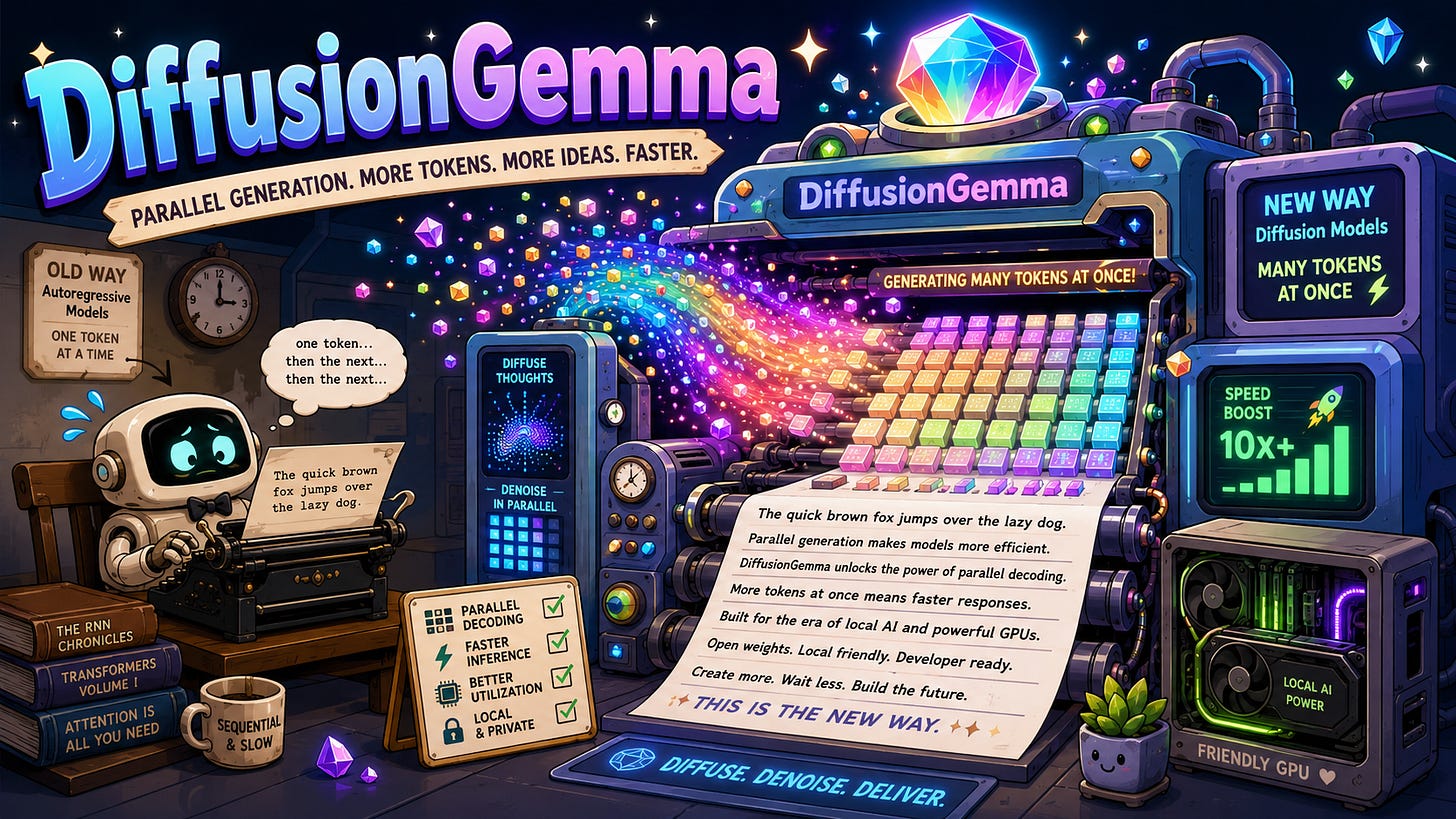
Google DeepMind released DiffusionGemma, a text-diffusion model that generates text differently from transformer-based language models by not sequentially predicting one token at a time. The model uses diffusion-based generation to challenge the conventional left-to-right, next-token prediction approach that has dominated the modern LLM era. This alternative architecture potentially offers a different pathway for text generation beyond the sequential token-by-token method used in GPT-style models and other transformer-based systems.

Hugging Face Blog
·
1 month ago
Zhipu released GLM-5.2, a language model designed for long-horizon coding tasks with a stable 1M-token context window. The model achieves 81.0 on Terminal-Bench 2.1 (compared to 63.5 for GLM-5.1) and ranks as the highest open-source model on three long-horizon coding benchmarks. The architecture introduces IndexShare, which reduces per-token computation by 2.9× at 1M context length, and users can now select effort levels to balance performance against latency and computational cost.

Allen Institute (AI2)
·
1 month ago
Researchers released MolmoMotion, a model that predicts how 3D points on objects will move in the future based on video frames and language instructions describing actions. The model achieved 0.109 meters average displacement error on the PointMotionBench benchmark, outperforming existing forecasting methods. The model and accompanying datasets enable applications in robot manipulation planning and controllable video generation.
OpenAI Blog
·
1 month ago
Researchers released LifeSciBench, a benchmark dataset created and reviewed by life science experts to assess AI system performance on real-world research tasks. The benchmark contains expert-authored test cases covering practical decision-making scenarios in life sciences. This provides a standardized way to measure whether AI systems can handle actual research workflows rather than generic benchmarks.
