
The Sequence AI of the Week #891: Prompting a Spreadsheet : Inside Google’s TabFM for Tabular AI
Substack Jesus Rodriguez
Google Research dropped TabFM, a foundation model that predicts on spreadsheet data with zero training or tuning. It just reads the table and answers, no more manual feature engineering rituals.
Based on reporting by Substack, Jesus Rodriguez — read the original for the full story.
Summary, retelling and take written by AI under human oversight; images are AI-generated illustrations. How we work · Report an error
Machine learning has a dirty secret: the models actually running enterprise operations aren't flashy transformers, they're gradient-boosted trees chewing through CSV files. Churn prediction, fraud detection, credit risk scoring — the stuff that keeps businesses running still relies on XGBoost pipelines, and the process behind them hasn't shifted much in ten years. Load the table. Engineer features. Cross-validate. Tune hyperparameters. Watch the AUC creep up. Then do it all over again for the next dataset.
Google Research just released something aimed squarely at that grind. TabFM is a foundation model built for tabular classification and regression, and it does something the old workflow never could: it makes predictions on tables it's never encountered before, in a single forward pass, without any training, tuning, or feature engineering. Feed it the entire problem at once — training rows, test rows, everything — as one massive prompt, and it produces an answer. It's in-context learning, except instead of text it's working on spreadsheets.
The lineage here matters. TabFM comes from the same team behind TimesFM, Google's time-series foundation model that ended up being deployed far more widely than most research releases ever are. That's not a coincidence — it's a playbook. Take a domain that's traditionally been dominated by bespoke, per-dataset modeling, and try to replace it with a single foundation model that generalizes across problems instead of being retrained for each one.
What makes this notable isn't just the technical trick of feeding tables through a model as a giant context window. It's the target. Tabular data is unglamorous compared to language or images, but it's also where an enormous share of applied machine learning actually lives. If TabFM's approach holds up outside a lab, it's chipping away at one of the most tedious and repetitive corners of the field — the part that never got much attention because it wasn't exciting, just necessary.
My take — AI-written commentary, not fact-checked reporting
Tabular ML has been the industry's boring backbone for years while everyone chased chatbots and image generators, so it's about time someone with real resources pointed a foundation model at it. The real test isn't the demo, it's whether teams drowning in fraud and churn datasets actually trust a single forward pass over a tuned XGBoost model they understand inside out. Given how quietly TimesFM ended up everywhere, betting against this team's tabular follow-up seems unwise.
Read more about this at: Substack
Related stories
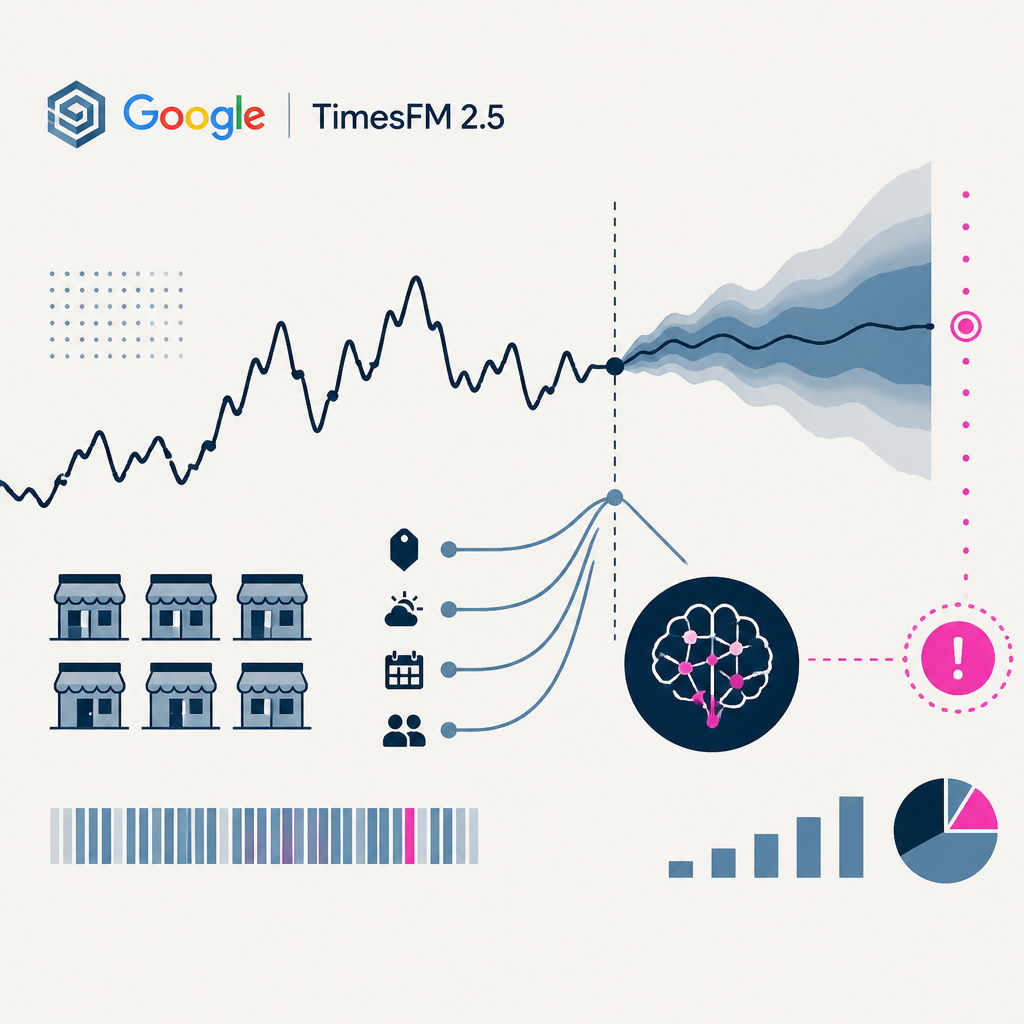 End-to-End Forecasting with TimesFM 2.5: Backtesting, Covariates, Anomaly Detection, and Scalable Colab Deployment
MarkTechPost · 1 month ago ·
30
End-to-End Forecasting with TimesFM 2.5: Backtesting, Covariates, Anomaly Detection, and Scalable Colab Deployment
MarkTechPost · 1 month ago ·
30