Sakana AI Teams With NVIDIA to Advance Open Model Innovation from Japan
Sakana AI ● Covered by 3 sources
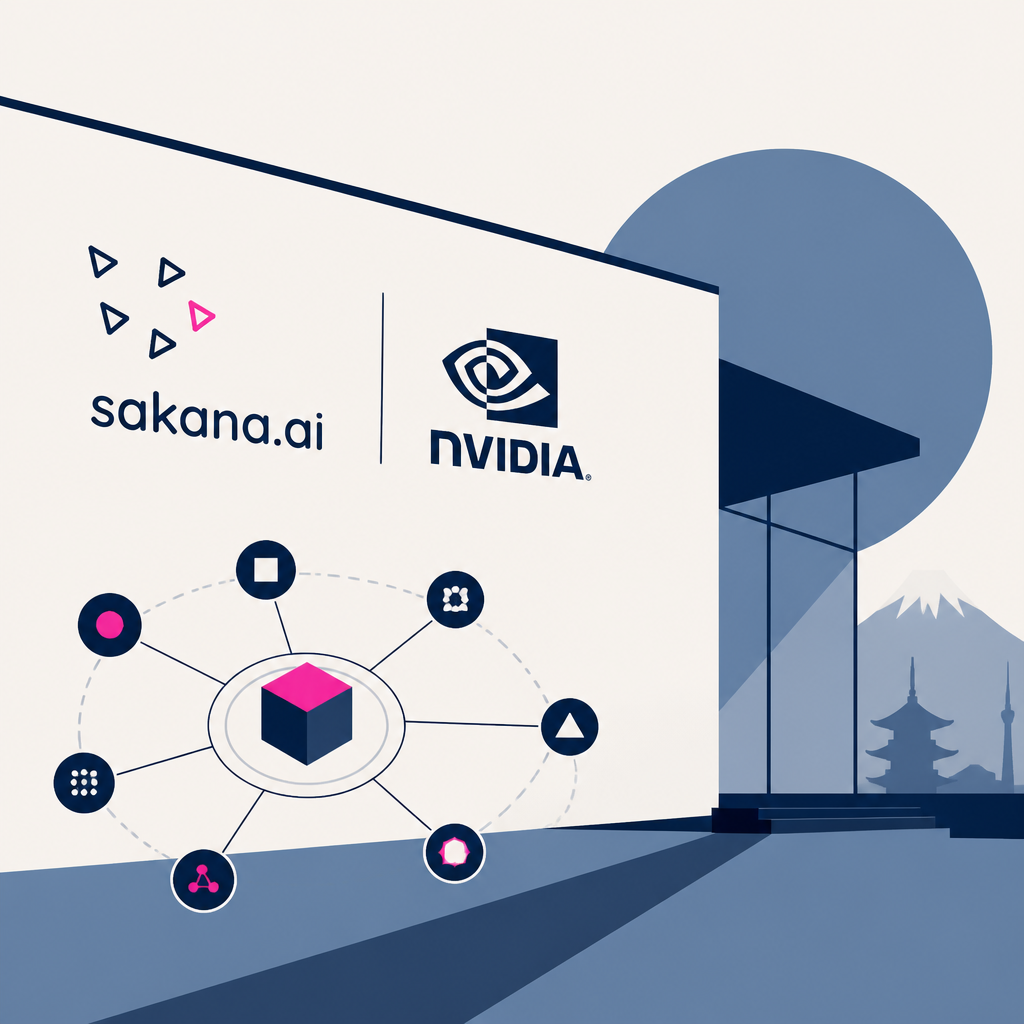
Sakana AI is plugging NVIDIA's open Nemotron models into its multi-agent system Fugu instead of building one giant model. The bet: a team of specialized open models beats a single frontier model at complex tasks.
Based on reporting by Sakana AI — read the original for the full story.
Summary, retelling and take written by AI under human oversight; images are AI-generated illustrations. How we work · Report an error
Sakana AI, the Tokyo-based lab known for pushing collective intelligence over brute-force scaling, just deepened its partnership with NVIDIA. The plan is to fold NVIDIA's open Nemotron model family into Sakana Fugu, Sakana's orchestration system that coordinates multiple AI models like a conductor rather than trying to be the world's smartest single model.
Fugu itself is the interesting piece here. It's a language model whose job is to call other language models, including copies of itself, picking whichever combination of agents best suits a given task and stitching their outputs into one answer behind a single API. That architecture means Fugu doesn't age the way a static model does. Add a stronger open model to the pool and Fugu gets better without anyone retraining its core. Sakana says early testing already has this orchestration approach matching frontier systems on certain benchmarks, which is a bold claim worth watching rather than taking at face value.
Nemotron slots in as a specialist rather than a generalist. NVIDIA has tuned it for coding, tool calling, and instruction following, and those are exactly the narrow, high-value skills that make sense to hand off inside a multi-step agent workflow instead of asking one do-everything model to cover. The two companies plan to run a feedback loop: NVIDIA gets real usage data on how Nemotron behaves inside agentic pipelines, Sakana gets deeper model diversity for Fugu, and NVIDIA will offer tuning guidance so Nemotron performs well specifically when it's one voice among many rather than the whole conversation.
The bigger argument Sakana is making is that no single model, however large, will hold every advantage across every language, task, and industry. As open models multiply, the real bottleneck shifts to evaluation and orchestration — figuring out which model to call when, and how to combine outputs reliably. NVIDIA supplies the accelerated computing and a growing open model stack to run on; Sakana supplies the coordination layer built from years of work on collective intelligence out of Japan. Whether that combination actually outperforms scaling a single frontier model long-term is still an open question, but it's a genuinely different bet than the one most big labs are making.
My take — AI-written commentary, not fact-checked reporting
I like this bet more than another round of 'our model is 2% bigger than last quarter's.' Orchestrating specialized open models is basically admitting that scaling laws have diminishing returns and that engineering the coordination layer is where the next real gains hide — and it's refreshing to see that argument coming from Tokyo instead of the usual Bay Area suspects. My skepticism is reserved for the benchmark claims until independent evals show Fugu actually beating, not just matching, frontier single models on hard multi-step tasks.
Read more about this at: Sakana AI
Related stories
Sakana AI Launches Fugu Max and Fugu Ultra v2 for Cheaper, Stronger Multi-Agent Orchestration
MarkTechPost · 20 hours ago ·
25
Sakana AI Wins Award at US-Japan Competition for Defense Innovation
Sakana AI ·
46
Sakana AI Defense and Intelligence Team Places 5th in Diver OSINT CTF 2026 Using Fugu Agent
Sakana AI ·
25