Petri Dish Neural Cellular Automata
Sakana AI ● Covered by 2 sources
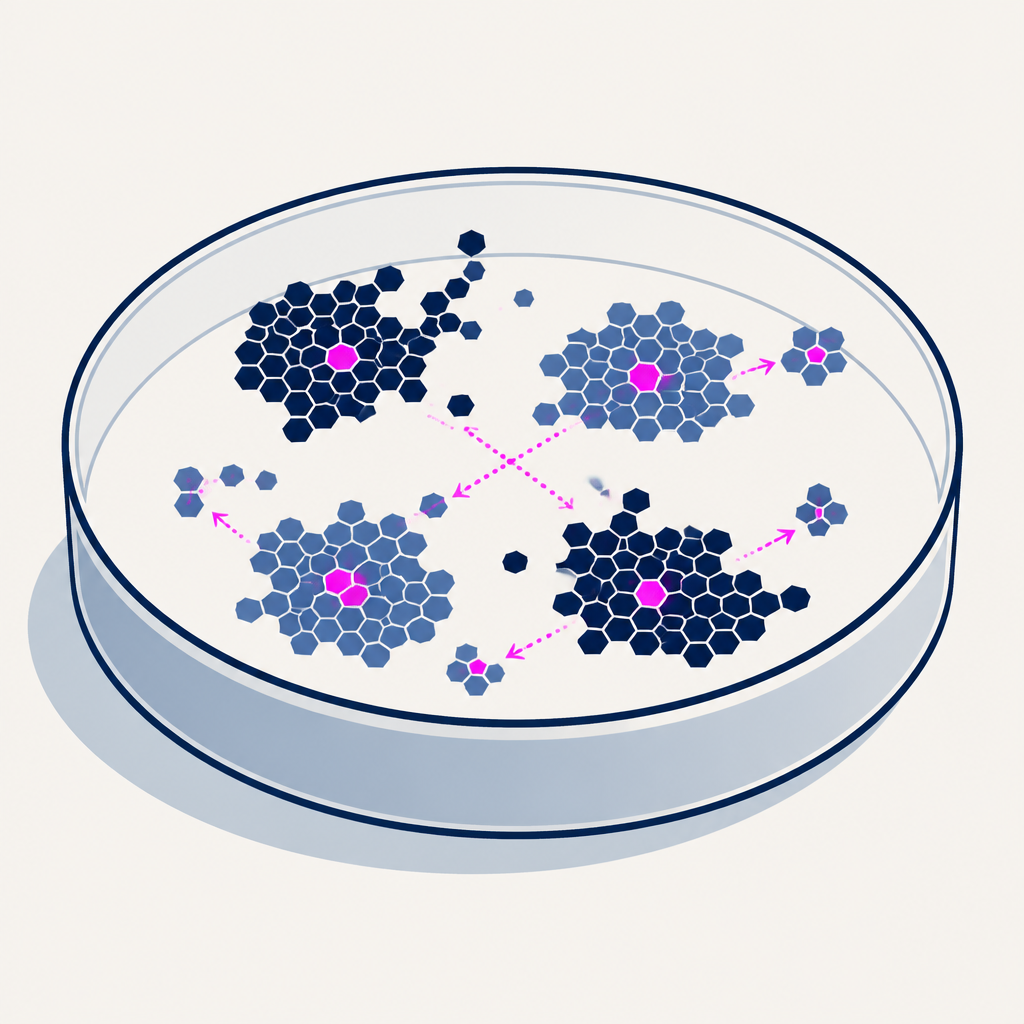
Sakana AI built digital cells that keep learning and rewriting themselves while they compete for space in a simulated dish. Instead of fixed rules, each cell uses live gradient descent to grow, defend territory, or even team up with rivals.
Based on reporting by Sakana AI — read the original for the full story.
Summary, retelling and take written by AI under human oversight; images are AI-generated illustrations. How we work · Report an error
Sakana AI has a habit of poking at the edges of artificial life, and its newest project, Petri Dish Neural Cellular Automata, is one of the stranger and more fun examples yet. The idea builds on neural cellular automata, a class of models where simple grid-based cells grow into patterns using a shared neural network. But PD-NCA breaks from the usual setup in one key way: the cells never stop learning. Instead of running a fixed, pre-trained network forever, each NCA in the simulation is constantly updating its own parameters through gradient descent while the simulation is live.
That sounds like a small technical tweak, but the effect is anything but small. Because every organism in the petri dish is trying to grow and self-replicate at the same time as its neighbors are doing the same thing, and adapting on the fly, you get a shifting arms race instead of a static pattern. Sakana's team, who also presented this work at the ALIFE2025 conference, describe watching cyclic dynamics emerge, where different colored colonies of NCA seem to cycle through phases of dominance, retreat, and resurgence. Other runs show territorial behavior, with clusters carving out and defending patches of the grid. And in some cases, colonies that could just as easily fight instead settle into a kind of spontaneous cooperation, coexisting rather than crowding each other out.
What makes this interesting for the ALife crowd specifically is the framing around open-ended complexification, a phrase that gets thrown around a lot in artificial life research but is genuinely hard to achieve. Most ALife systems eventually stabilize or converge on some steady state because the underlying rules don't change. Sakana's bet here is that continual adaptation, letting the substrate itself keep learning mid-simulation rather than locking in a fixed set of parameters, is one path toward systems that keep generating novelty instead of settling down.
It's still early-stage research, closer to a proof of concept than anything deployable, and the videos Sakana shared are the main evidence so far rather than a rigorous quantitative benchmark. But the visual variety on display, colonies pulsing, fighting, retreating, and occasionally making peace, is a decent argument that differentiable, ever-learning cellular automata might be a genuinely richer sandbox for studying emergent complexity than the static versions researchers have leaned on for years.
My take — AI-written commentary, not fact-checked reporting
I like this more as a glimpse of technique than as a finished result: gradient descent running inside the simulation itself, rather than baked in beforehand, is the actual interesting move, and it's the kind of trick that tends to quietly show up in bigger systems a year or two later. Sakana keeps producing these playful ALife curiosities, and I'd rather a lab spend its compute on open-ended weirdness like this than another marginal chatbot benchmark win.
Read more about this at: Sakana AI