
Partnering with Bunkerhill Health: AI Agents that Improve Patient Outcomes
Sequoia By Alfred Lin ● Covered by 2 sources
Bunkerhill Health is selling AI agents to hospitals. It matters because the pitch is simple: get useful AI out of pilots and into patient care.
Based on reporting by Sequoia, By Alfred Lin — read the original for the full story.
Summary, retelling and take written by AI under human oversight; images are AI-generated illustrations. How we work · Report an error
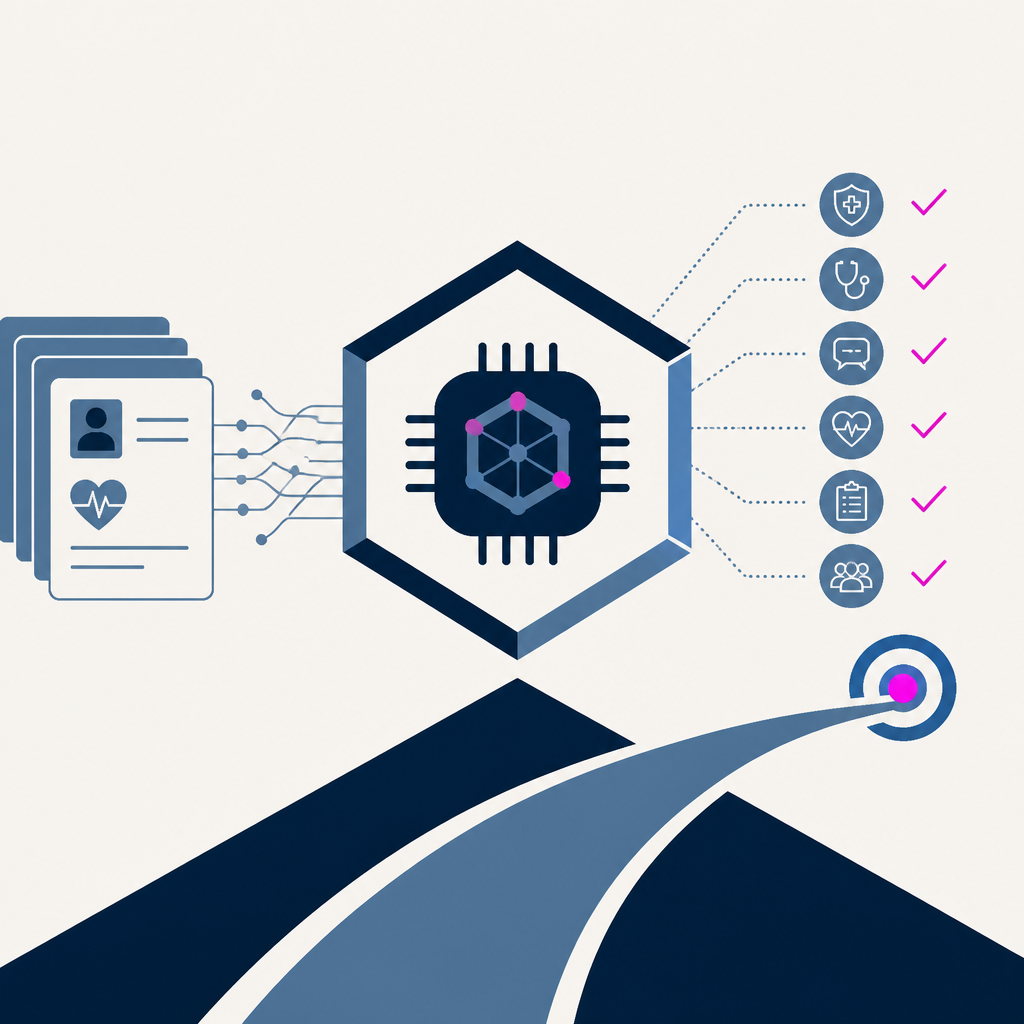
Healthcare has a habit of moving slowly when the tech world wants it to sprint. Bunkerhill Health is trying to fix that with Carebricks, a platform that lets health systems build and deploy AI agents for clinical, operational, and administrative work from one place.
The company’s pitch starts with a problem the source describes plainly: hospitals and researchers have good ideas, but they get stuck in the mess between a model and real care. External data is hard to reach, collaboration is clumsy, regulation slows things down, and too many vendor tools end up as little more than experiments. Carebricks is meant to turn the data a hospital already creates into action for the patients who need it.
Sequoia says it first backed Nish Khandwala and David Eng at seed and is now doubling down. Nish’s credibility here comes from having lived the problem. As a graduate student at Stanford, he helped build an algorithm that could estimate coronary artery calcium score from a routine chest scan, and the work was published in Nature Digital Medicine. But the algorithm went nowhere. Around the same time, Nish’s father had a heart attack, and his CT scan showed the calcium signals the Stanford system was built to catch.
That is the blunt lesson behind Bunkerhill’s evolution: the bottleneck is not the model, it is everything around the model. The company first focused on getting ideas from research to the bedside, including sourcing data from a consortium of leading academic medical centers, validating models, shepherding them through FDA clearance, and installing them in hospitals. Then it saw that health systems do not have the bandwidth for a string of one-off AI deployments, so Carebricks became the central platform.
Sequoia points to UTMB Health as the proof. One agent in production turned into more than twenty, spreading across specialties as clinicians saw what the system could do. UTMB also consolidated multiple vendors’ point solutions into one platform. The agents sit in the background, surfacing findings and catching cases the system might miss, while leaving clinicians to do the work only humans should do.
My take — AI-written commentary, not fact-checked reporting
This is the rare healthcare AI story that doesn’t smell like demo theater. Hospitals do not need another shiny pilot; they need something that survives contact with procurement, regulation, and actual wards. The industry keeps acting surprised that software meant for medicine has to work in medicine, which is adorable in the worst way.
Read more about this at: Sequoia
Related stories
 A new benchmark for evaluating patient-facing health AI agents
Amazon Science · 1 month ago ·
12
Google Research at The Check Up: from healthcare innovation to real-world care settings
Google Research · 6 months ago ·
8
A new benchmark for evaluating patient-facing health AI agents
Amazon Science · 1 month ago ·
12
Google Research at The Check Up: from healthcare innovation to real-world care settings
Google Research · 6 months ago ·
8