
NVIDIA Open Sources First GPU-Accelerated Medical Physics Simulation Framework
NVIDIA David Niewolny
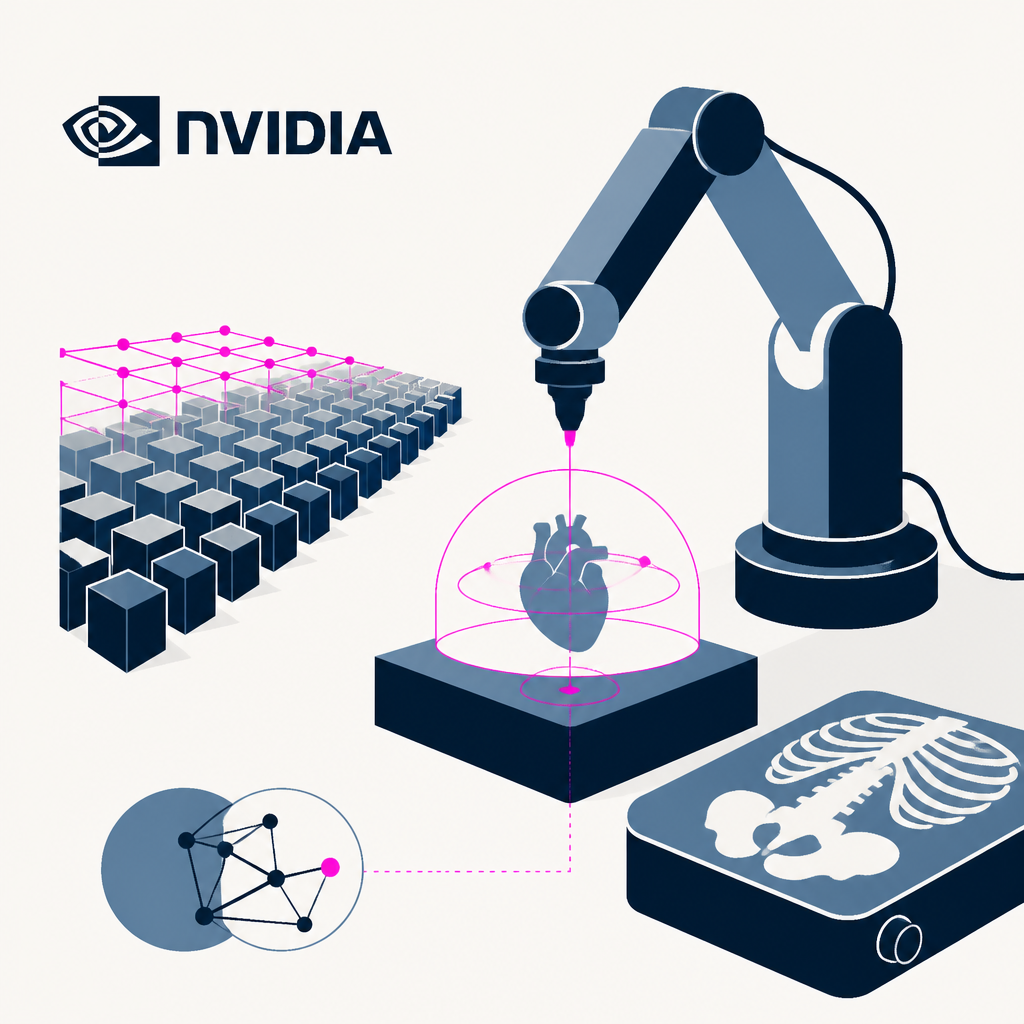
Nvidia just open-sourced a GPU-powered simulator for training medical robots. It lets developers test devices like catheters on virtual anatomy before touching real patients or hardware.
Based on reporting by NVIDIA, David Niewolny — read the original for the full story.
Summary, retelling and take written by AI under human oversight; images are AI-generated illustrations. How we work · Report an error
Medical robotics has a data problem that's hard to solve with more cameras or more clinical trials. Bodies differ, instruments flex and slip inside them unpredictably, imaging is often noisy, and the rare edge cases that matter most simply refuse to show up on a testing schedule. Nvidia's answer, announced today, is called Medical Physics Simulation — a new open-source, GPU-accelerated piece of its Isaac for Healthcare platform designed to let developers model how anatomy and devices interact, generate the hard-to-capture scenarios, and train robot policies entirely in simulation before anyone touches physical hardware.
The pitch is reusability. Instead of engineering a bespoke simulated scene for every new workflow, teams get a shared foundation that combines anatomy modeling, device behavior, sensor simulation and robot learning in one place. Because it's open source, developers can inspect exactly what's driving the simulation, adapt it to their own devices, and — importantly for a regulated field — actually show their work. Nvidia frames that transparency as a regulatory asset: open weights and open data make it easier to reproduce results, test across different anatomies, and build the kind of evidence base regulators want to see.
Under the hood, the framework runs on CUDA and leans on Nvidia's Warp, Newton and Cosmos simulation technologies, and it can spin up hundreds of parallel simulation environments at once. Nvidia says a benchmark using 8,192 parallel robot-training environments cut a training run from over five hours down to under two minutes — the kind of speedup that turns simulation from a slow, one-off engineering exercise into something closer to everyday infrastructure. The framework's reference example pairs vascular anatomy with flexible instruments like catheters and guidewires, simulated X-ray imaging, and reinforcement learning, though Nvidia says it's built to extend to other devices and anatomies too. It also blends classical physics simulation — friction, contact, motion, the stuff governed by known rules — with Cosmos-H Dreams, a generative AI component that models visual scene dynamics learned from procedural data rather than hard-coded equations.
The more interesting part might be who's already using it. CMR Surgical and Cambridge Consultants are applying Cosmos-H-Dreams to soft-tissue surgery, and CMR has contributed close to 500 hours of anonymized data from its Versius robotic system to an open dataset covering procedures like cholecystectomy and hysterectomy. Johnson & Johnson MedTech is building digital twins of its endoluminal MONARCH platform for kidney-stone scenarios. XCath is using the framework for endovascular autonomy training, Inner Logic is generating synthetic evidence for regulatory pathways, and Medtronic Structural Heart is looking at simulated X-ray sensing for catheter navigation. That's a fairly broad cross-section of the surgical robotics world betting on the same simulation layer rather than building their own from scratch.
Whether open-sourcing this kind of infrastructure actually speeds up safe deployment, or just speeds up everyone converging on Nvidia's stack, is the real question hanging over the announcement. But as a modular layer that slots alongside Isaac Lab and Nvidia's existing digital twin and sensor tools, it's clearly meant to be the connective tissue for a much bigger push into physical AI for healthcare.
My take — AI-written commentary, not fact-checked reporting
Calling something open source in healthcare robotics sounds noble until you notice it also happens to be the fastest way to get every surgical robotics company standardizing on Nvidia's CUDA stack. That's not a knock on the technology — cutting a training run from hours to minutes is a genuinely useful result, and the regulatory-transparency argument is real. But when J&J, Medtronic and CMR Surgical all start building on the same simulation foundation, the interesting story isn't the openness, it's who ends up owning the plumbing underneath medicine's next generation of robots.
Read more about this at: NVIDIA