
NVIDIA AI Releases NOOA: An Object-Oriented Python Framework That Turns an AI Agent Into a Single Python Class
MarkTechPost Asif Razzaq
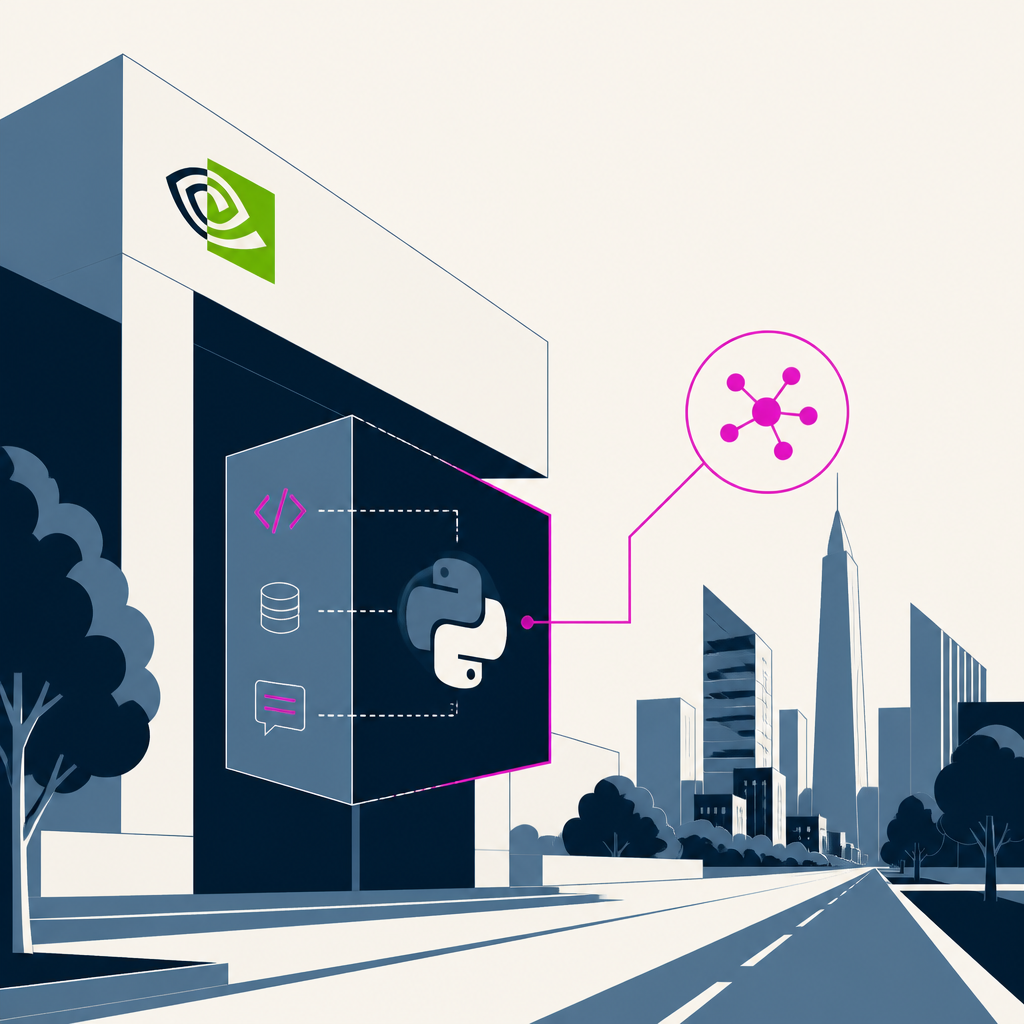
NVIDIA open-sourced NOOA, a framework that turns an entire AI agent into one Python class. It beats top agent harnesses on coding and hacking benchmarks using half the tokens.
Based on reporting by MarkTechPost, Asif Razzaq — read the original for the full story.
Summary, retelling and take written by AI under human oversight; images are AI-generated illustrations. How we work · Report an error
NVIDIA Labs just dropped something that quietly rethinks how agents get built. Instead of scattering an agent's logic across prompt templates, tool schemas, callback functions, and workflow graphs — the usual mess — NOOA (NVIDIA Object-Oriented Agents) folds all of it into a single Python class. Methods become the actions an agent can take. Fields hold its state. Docstrings double as prompts. Type annotations aren't just decoration; the runtime actually enforces them as contracts. Write a method body as just "..." and it gets completed on the fly by an LLM loop. Write a normal body and it stays plain deterministic code the model can call like any tool. Developers and the model end up speaking the exact same language, which means agents can finally be tested and version-controlled the way normal software is.
The numbers back up the pitch. NVIDIA reports 82.2% on SWE-bench Verified using GPT-5.5, ahead of OpenCode's 78.6% and PI's 78.2%, and 86.8% on CyberGym L1 — reportedly the best open-source score out there, achieved with network access blocked. On ARC-AGI-3, a single agent armed with a one-page world-model skill hits 85.1% mean RHAE running GPT-5.6-sol, for under $20 a game. What's more interesting than the raw scores, though, is the efficiency: NOOA hits its SWE-bench result using roughly 1.1 million tokens and about 28 model calls per task, versus 2.2 million tokens and 66 calls for PI to get a lower score. A lot of that comes down to a trick called pass by reference, where big Python objects stay live in the execution environment and the model only sees a compact preview — a hundred-item list shows up as roughly thirty tokens instead of the whole thing getting stuffed into context.
NVIDIA also credits the efficiency gain to how NOOA ends tasks. Instead of letting the model just stop talking once it decides it's done, the way OpenCode and similar harnesses do, NOOA forces a typed TaskResult object that has to carry actual evidence and a verification command. It's a small structural choice, but it seems to cut down on wasted turns and false completions across the board.
None of this comes without caveats, and NVIDIA is upfront about them. The package is Apache 2.0 licensed, installs via pip, and just hit version 0.0.8 on July 30, 2026 — but PyPI still tags it alpha, and NVIDIA itself calls it a research preview. Agents built on NOOA can execute LLM-generated code, and the built-in AST checks and module deny-lists are explicitly described as defense-in-depth, not real containment. Anyone deploying this needs an actual boundary — a container, a VM, or NVIDIA's own OpenShell — around it. That puts NOOA squarely in the hands of AI-native startups and research teams running pilots for now, with regulated production environments told plainly to wait.
Model support is broad since NOOA routes through LiteLLM, covering hosted APIs, Ollama, and vLLM endpoints alike. NVIDIA benchmarked it against fourteen other frameworks, including LangGraph, Google's ADK, PydanticAI, smolagents, and the Claude Agent SDK, claiming NOOA is the first to combine six specific capabilities — typed I/O, pass by reference, code as action, programmable loop control, explicit object state, and model-callable harness APIs — on one surface. Whether that framing holds up under wider community use is the real test still ahead.
My take — AI-written commentary, not fact-checked reporting
Turning an agent into a plain Python class is the kind of idea that sounds almost too simple, which is usually a sign someone finally cut through the accidental complexity everyone else was tolerating. The efficiency gains matter more than the leaderboard numbers — halving token spend while beating rivals is the difference between an agent framework that's a fun demo and one that's actually affordable to run at scale. That said, NVIDIA slapping "defense-in-depth, not containment" on the security model is doing a lot of quiet work, and anyone skipping the sandbox because the benchmarks look good is going to learn that lesson the hard way.
Read more about this at: MarkTechPost
Related stories
 NVIDIA Open-Sources OSMO: One YAML Orchestrates Physical AI Training, Simulation, and Robot Testing
MarkTechPost · 1 week ago ·
32
NVIDIA Open-Sources OSMO: One YAML Orchestrates Physical AI Training, Simulation, and Robot Testing
MarkTechPost · 1 week ago ·
32
 NVIDIA AI Releases Molt: A PyTorch-Native Agentic Reinforcement Learning Framework
MarkTechPost · 1 month ago ·
21
NVIDIA AI Releases Molt: A PyTorch-Native Agentic Reinforcement Learning Framework
MarkTechPost · 1 month ago ·
21