Most tech revolutions made work worse for employees. AI could be the exception
this+that ● Covered by 2 sources
Opinion — commentary, not a factual news event.
Piece argues AI might be the first tech wave that actually gives workers time back instead of just more to do. Past tools like PCs and smartphones sped up work but never did any of it themselves — AI does.
Based on reporting by this+that — read the original for the full story.
Summary, retelling and take written by AI under human oversight; images are AI-generated illustrations. How we work · Report an error
Everyone's nervous about AI, and everyone's using it anyway. That contradiction makes more sense once you look at what past waves of workplace tech actually did to people's days. The PC didn't cut anyone's workload; it just moved the typing from the secretarial pool to everyone's own desk. Email replaced the mail cart with something faster, so faster became the expectation. Smartphones and laptops finished the job by making the office follow people home. None of these tools did the actual work — they just raised the pace at which humans had to do it themselves.
Researchers Melissa Mazmanian, Wanda Orlikowski and JoAnne Yates studied what happened when mobile email hit knowledge workers and called it the autonomy paradox: people grabbed the freedom to work from anywhere and ended up working from everywhere, all the time. Nobody voted for that outcome. The slack the tool created simply got absorbed by rising expectations, and the person who generated the savings rarely got to keep them.
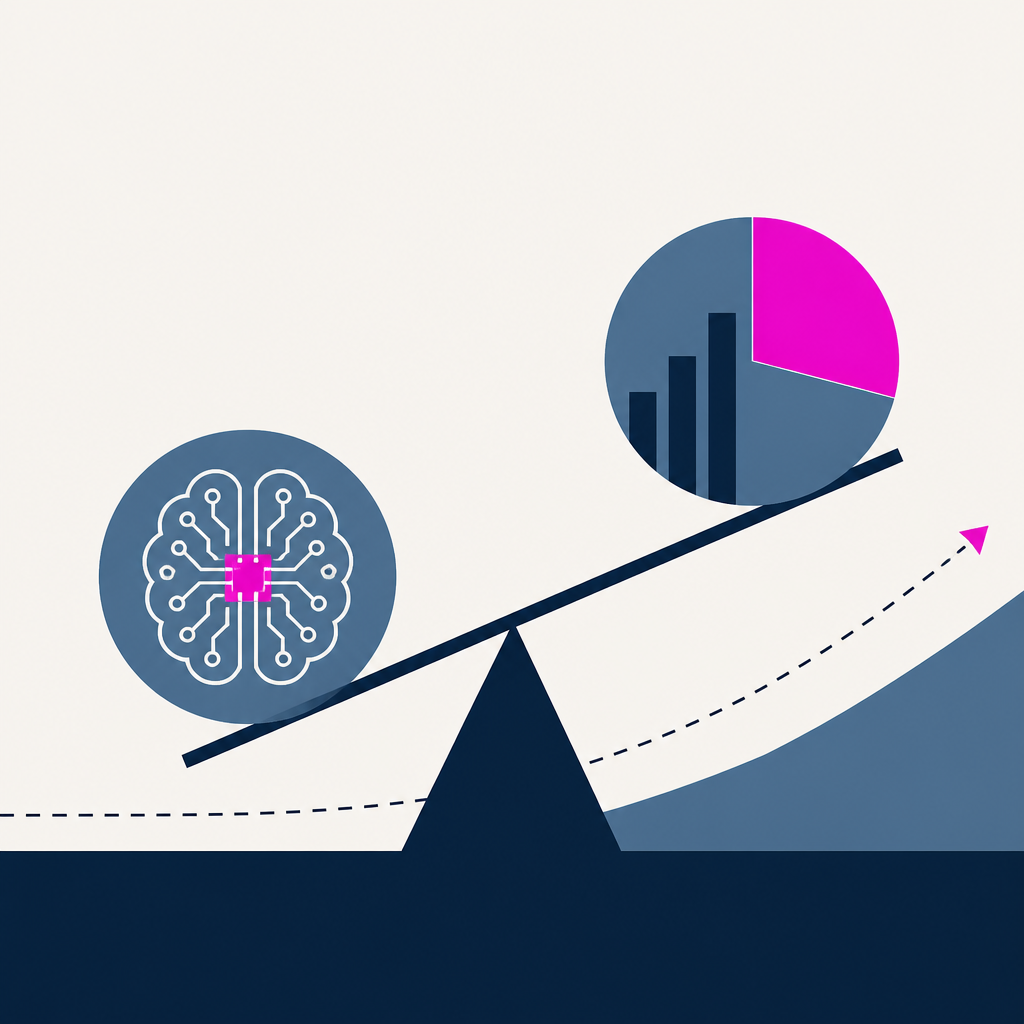
AI, this piece argues, is structurally different because it doesn't just accelerate the work — it can actually do chunks of it, including the new work created by everything else moving faster. McKinsey's estimate, cited here, is that knowledge workers could get back roughly 30% of their day by 2030, something like 2.5 hours. Right now the early signs look like the same old story: role boundaries blurring, tasks piling up, intensity rising even for people who aren't chasing AI on purpose. That's consistent with what economists call the productivity J-curve, where big technology shifts cause disruption and a dip in output before any payoff shows up.
The hopeful precedent here is desktop publishing. In the 1990s, people assumed it would wipe out printshops and typesetters as everyone made their own newsletters and wedding invites. Some of that did happen. But the tools didn't just speed up existing work — they raised the bar for what counted as good work, because it turned out clip art and five different fonts do not make a professional-looking flyer. Design skill and taste became the differentiator, and the number of designers employed in the U.S., per Census Bureau figures cited in the piece, roughly doubled between 1983 and 2001, climbing from 393,000 to 788,000, while total employment across the economy grew 34% over the same stretch.
The piece bets AI could follow that path rather than the PC's. An AI agent can write fast in almost any voice, but speed alone doesn't pick a subject worth writing about — that still takes taste, and taste tends to come from thinking time and human collaboration, not automation. The essay leans on research showing proximity and unstructured time matter: Bell Labs' Mervin Kelly reportedly designed a corridor specifically to force cross-discipline encounters, MIT's Thomas Allen found that collaboration between coworkers drops off sharply once people are separated by roughly 50 meters, and a study by Ethan Bernstein and Stephen Turban found face-to-face interaction fell around 70% when two Fortune 500 companies switched to open floor plans. If AI actually hands back a few real hours a day, the argument goes, that time could go into walks, hallway conversations, and the kind of thinking that produced past leaps in quality — rather than just getting swallowed by higher output targets again.
My take — AI-written commentary, not fact-checked reporting
History's pretty clear that companies pocket efficiency gains and hand workers a bigger to-do list, so betting AI breaks that streak requires either a lot of faith in management or a very generous reading of a McKinsey projection. The desktop-publishing comparison is a fair one, but it also quietly admits that some jobs got wiped out along the way while others got harder to break into. If firms actually let people use reclaimed hours for thinking and collaborating instead of cranking out more widgets, that would be a genuine first. Nobody should hold their breath waiting for it.
Read more about this at: this+that