
Meet Kyutai REKI: The 2.4B VLA Model Bringing Efficient Memory to Robot Manipulation
MarkTechPost Asif Razzaq
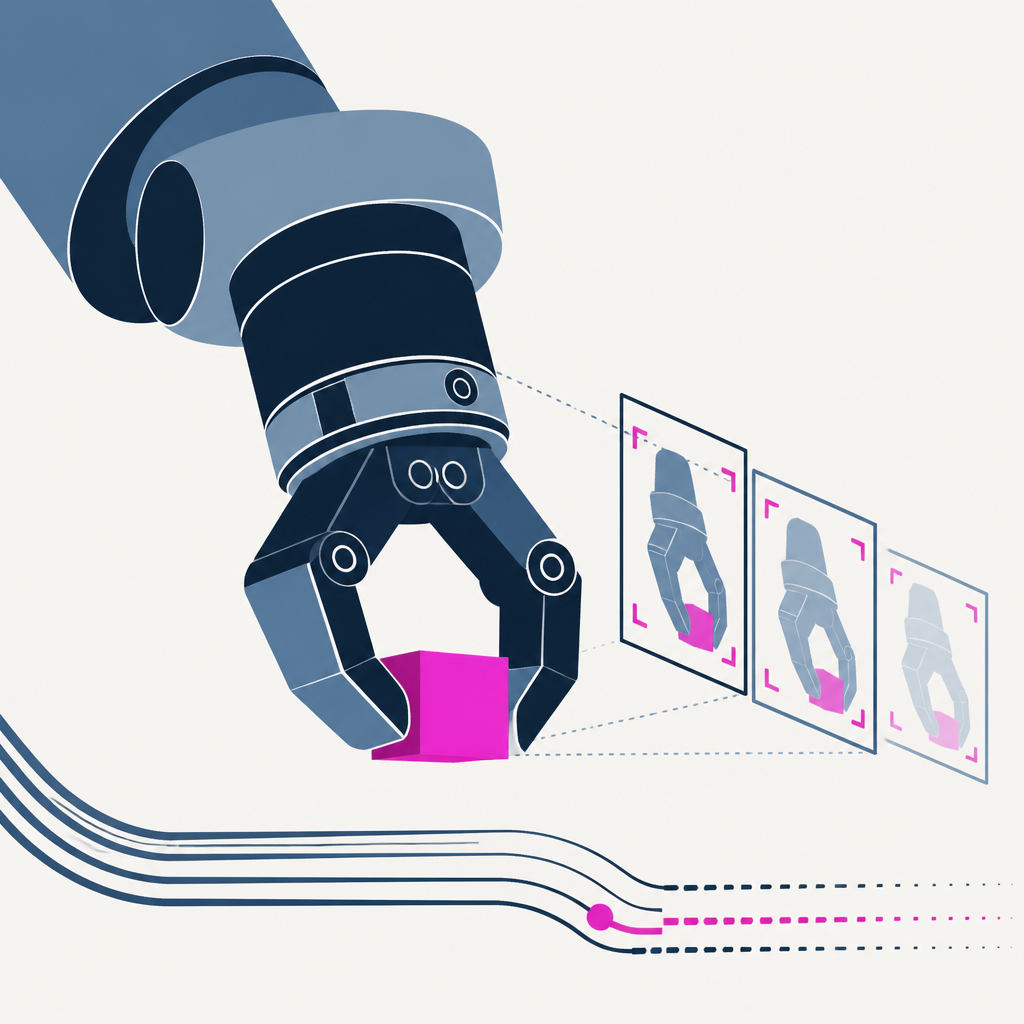
Kyutai dropped REKI, a 2.4B robot-control model trained only on public data. Its little memory helps it stay steady, and the weights are already on Hugging Face.
Based on reporting by MarkTechPost, Asif Razzaq — read the original for the full story.
Summary, retelling and take written by AI under human oversight; images are AI-generated illustrations. How we work · Report an error
Kyutai, working with Inria and École des Ponts, has released REKI, a 2.4B vision-language-action model for robot manipulation. It takes camera images plus an instruction and turns them into robot actions. The model is built from a 2.2B Qwen3.5-2B visual-language backbone and a 200M action expert, and Kyutai says the whole thing was pretrained only on public data.
The unusual bit is the memory. Instead of bolting on a heavy external system, REKI keeps a cheap rolling cache of the last three frames, one second apart. That memory lives inside the action expert as 32 learned register tokens, which can look back at earlier frames without reading action tokens. In Kyutai’s setup, the extra cost is tiny: 0.1 ms on top of a 21.8 ms action chunk, with about 2 MiB of GPU memory per past frame.
And it seems to matter. On RoboTwin, oscillating episodes drop from 18.6% to 4.1% when memory is enabled. Kyutai says that addresses perceptual aliasing, the annoying robot habit of wobbling between two poses because the scene looks too similar from one moment to the next. The model was pretrained on a mixture of 1.0B frames and 12.2M vision-language samples, including real-robot teleoperation, simulation, and egocentric human video.
On benchmarks, REKI does best among VLAs pretrained on public data in Kyutai’s comparison on LIBERO-Plus and RoboTwin Clean2Rand. It scores 90.4% on LIBERO-Plus, 65.8% on RoboTwin Clean2Rand, and 38.4% on RoboCasa365. That last number is far below Xiaomi-Robotics-1’s 57.4%, so this is not a clean sweep. But the interesting part is how competitive a public-data model can be at this size, and how far a small memory trick can go. All weights are live on Hugging Face, with BF16 weights and no quantized version announced.
My take — AI-written commentary, not fact-checked reporting
This is the kind of robotics work that actually deserves attention: small memory, less drama, real numbers. The industry loves stuffing more parameters into the box and calling it progress; Kyutai took a much less glamorous path and got something useful out of it. Open weights with a non-commercial license is still not full freedom, but at least it’s not vapor dressed up as a robot revolution.
Read more about this at: MarkTechPost
Related stories
 Reka Releases Rho-1: A 19B Omni-Reasoning Model That Understands, Generates Video and Outputs Robot Actions in One
MarkTechPost · 1 week ago ·
34
Bringing Robotics AI to Embedded Platforms: Dataset Recording, VLA Fine‑Tuning, and On‑Device Optimizations
Hugging Face · 7 months ago ·
16
LeRobot v0.6.0: Imagine, Evaluate, Improve
Hugging Face · 3 months ago ·
38