
LingBot-Map Tutorial: GPU-Aware Inference and Point Cloud Export
MarkTechPost Sana Hassan
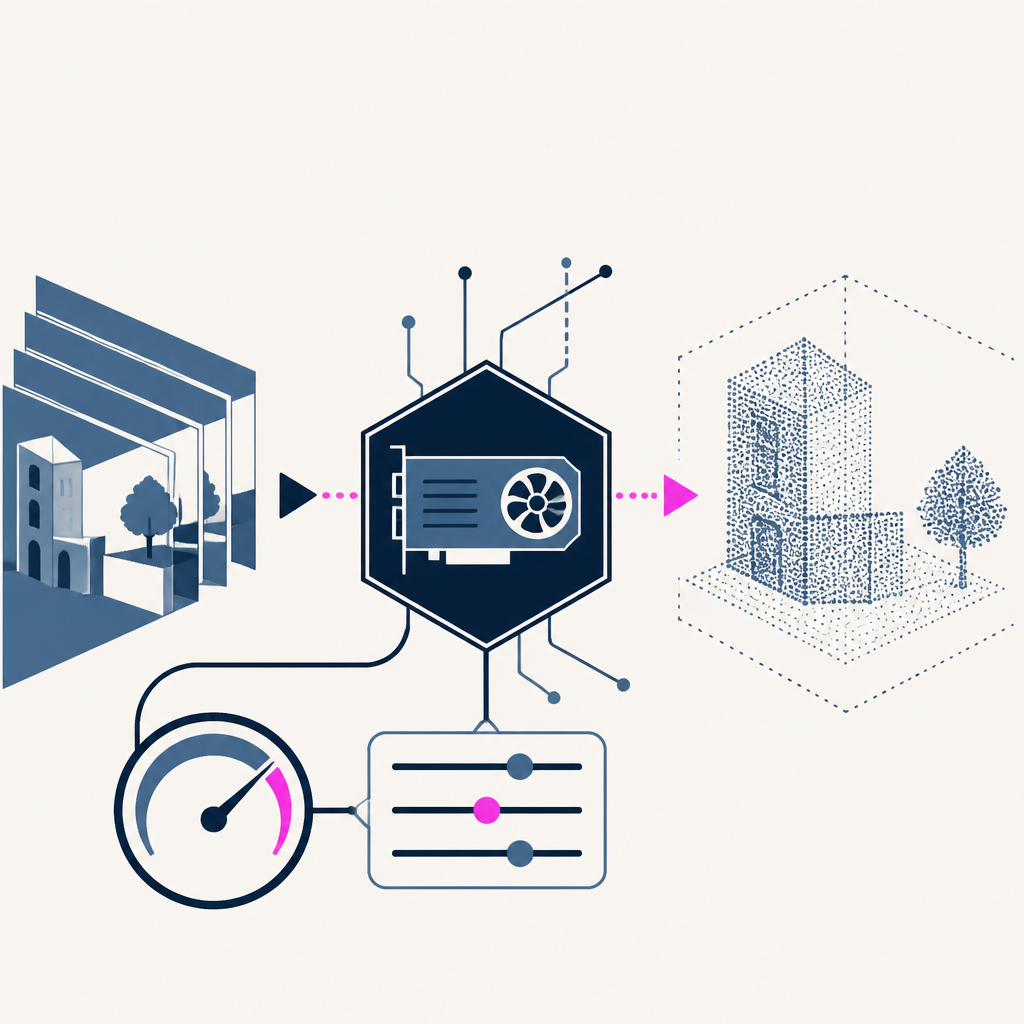
A new open-source tutorial walks through LingBot-Map, a streaming 3D reconstruction pipeline that turns video or photos into point clouds on a single GPU. It auto-tunes itself to whatever VRAM you've got, so a laptop GPU and an A100 both get a workable setup.
Based on reporting by MarkTechPost, Sana Hassan — read the original for the full story.
Summary, retelling and take written by AI under human oversight; images are AI-generated illustrations. How we work · Report an error
Building a 3D scene from a stack of photos or a walking-tour video usually means wrestling with mismatched dependencies, guessing at memory limits, and hoping your GPU doesn't choke halfway through. The LingBot-Map tutorial from MarkTechPost tries to strip that friction out entirely, packaging a full pipeline — from raw frames to exportable PLY, NPZ, or GLB point clouds — into a Colab notebook that mostly configures itself.
The interesting design choice here is the GPU-aware auto-tuning. Before any heavy lifting happens, the script probes VRAM with nvidia-smi and slots the machine into one of three tiers: under 18GB, 18 to 30GB, and 30GB-plus. Each tier gets its own preset for max frame count, scale frames, camera refinement iterations, and KV-cache sliding window size. A modest 16GB card caps out around 48 frames with a 48-slot cache, while a 30GB-plus card can chew through 240 frames at once. That's not a small gap — reconstruction quality scales directly with how many viewpoints the model sees, so the tutorial explicitly nudges users to push max_frames higher if their hardware allows it.
Under the hood, the actual model is GCTStream, a streaming transformer that uses 3D rotary embeddings, scaled dot-product attention, and a long-range KV cache to keep track of camera trajectory across potentially over a thousand frames without holding everything in memory at once. The checkpoint, hosted on Hugging Face at robbyant/lingbot-map, runs about 4.6GB and gets pulled down alongside the repo clone and a lightweight dependency install that deliberately avoids clobbering Colab's existing NumPy and OpenCV builds — a small but telling detail for anyone who's lost an afternoon to a broken Colab environment.
Once inference runs, the pipeline decodes predicted camera poses and intrinsics, converts per-pixel depth into world-coordinate points using a confidence threshold (55th percentile by default), and subsamples with a pixel stride to keep point counts manageable. It logs practical numbers too — focal length in pixels, depth range, total camera trajectory length, frames-per-second throughput, and peak GPU memory — so users aren't flying blind about what their hardware is actually doing.
The pipeline also supports both streaming and windowed inference modes, letting it handle sequences well beyond the model's native context by chunking with overlapping keyframes. That flexibility, paired with the automatic hardware tuning, is what makes this feel less like a research demo and more like something meant to actually get used on whatever GPU happens to be lying around.
My take — AI-written commentary, not fact-checked reporting
I like this less for the model itself and more for what it represents: someone finally writing tooling that treats "what GPU does the user actually have" as a first-class variable instead of an afterthought buried in a README. Too much open-source AI tooling assumes an A100 and shrugs when you show up with a 3060. If more releases shipped with tiered auto-config like this instead of a single hardcoded config file, the gap between research demos and things people actually run at home would shrink a lot faster than any new architecture will.
Read more about this at: MarkTechPost
Related stories
 AllenAI Open Instruct Tulu 3 Post-Training with SFT, DPO, RLVR, GRPO, and Verifier-Based Evaluation
MarkTechPost · 1 month ago ·
44
AllenAI Open Instruct Tulu 3 Post-Training with SFT, DPO, RLVR, GRPO, and Verifier-Based Evaluation
MarkTechPost · 1 month ago ·
44
 Implementation of Machine Learning Workflows with NVIDIA cuML, RAPIDS, GPU Benchmarking, Explainability, Clustering, and Model Inference
MarkTechPost · 4 days ago ·
3
Teaching AI to read a map
Google Research · 6 months ago ·
4
Implementation of Machine Learning Workflows with NVIDIA cuML, RAPIDS, GPU Benchmarking, Explainability, Clustering, and Model Inference
MarkTechPost · 4 days ago ·
3
Teaching AI to read a map
Google Research · 6 months ago ·
4