Learning Multi-Agent Coordination via Sheaf-ADMM
Sakana AI
Sakana AI built agents that solve puzzles by arguing over shared borders instead of sharing everything. It crushed baselines on Sudoku and stayed sane when images got weird.
Based on reporting by Sakana AI — read the original for the full story.
Summary, retelling and take written by AI under human oversight; images are AI-generated illustrations. How we work · Report an error
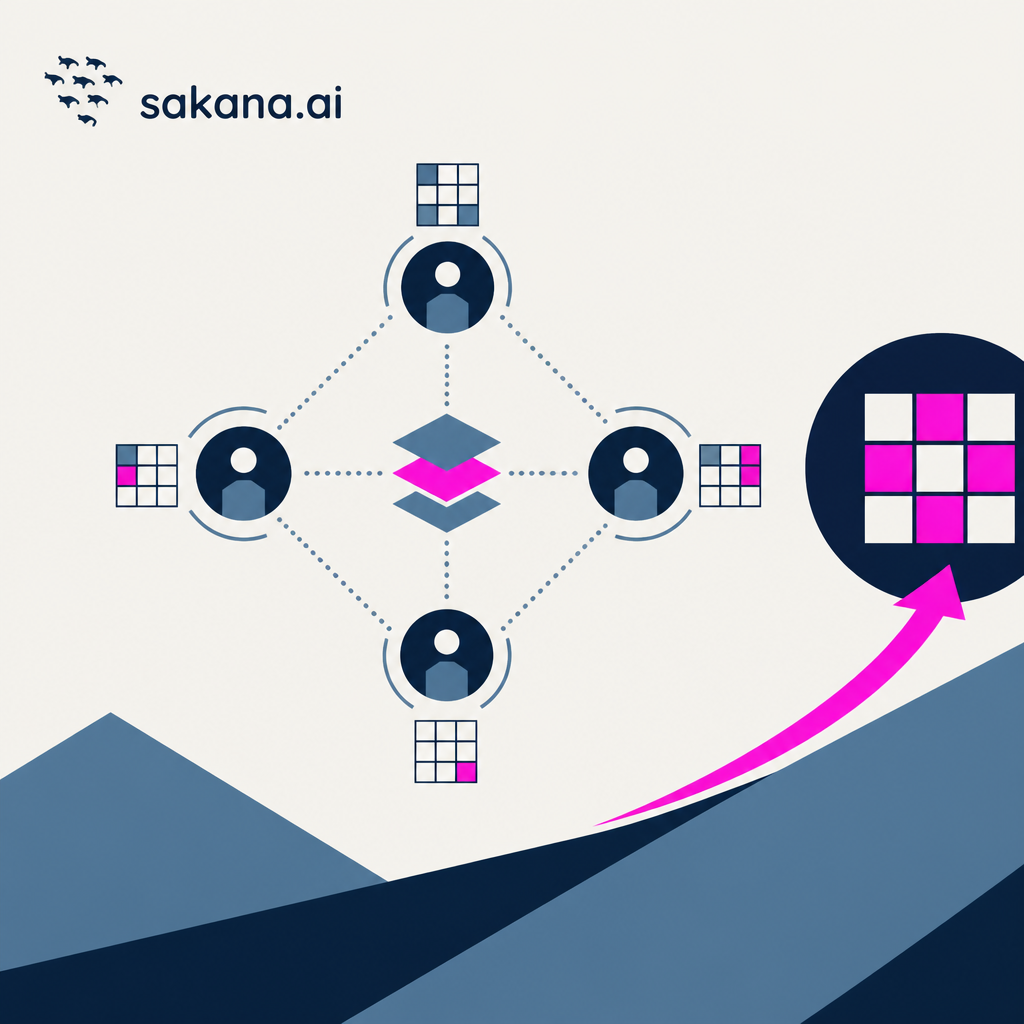
Sakana AI has a new paper heading to ICML 2026 called "Learning Multi-Agent Coordination via Sheaf-ADMM," and the pitch is refreshingly simple: stop building one giant model that sees the whole problem, and instead hand out pieces of it to agents that can only see their slice. Each agent gets an overlapping fragment of a bigger task. They don't need to agree on the whole picture. They just need to agree at the edges where their pieces touch.
The negotiation happens in three steps. First, every agent makes a local guess based on what little it can see. Then neighbors compare notes and iron out conflicts at the boundaries. When they can't settle a disagreement, the system doesn't just move on — it keeps a memory of that friction and uses it to push harder for compromise on the next round. That's the ADMM part, borrowed from distributed optimization, paired with sheaf theory from applied topology to formalize how local pieces stitch into a coherent whole.
The results are where this gets interesting. On a multi-agent Sudoku task, where each agent only ever sees a single row, column, or 3x3 box, Sheaf-ADMM solved 93% of puzzles. A parameter-matched message-passing baseline — same size, different coordination style — managed just 11%. On MNIST image classification under canvas-size shifts, a standard CNN's accuracy fell to 11%, while Sheaf-ADMM held onto 86%. And in maze pathfinding, the framework matched a message-passing baseline's accuracy while agents talked to each other over a channel just 5 dimensions wide — eight times smaller than the 42 dimensions the baseline needed.
What Sakana seems most excited about, beyond the numbers, is that you can actually watch the process happen. Standard message-passing networks bury their reasoning inside hidden states nobody can inspect. Here, the back-and-forth between agents — the guesses, the disputes, the eventual consensus — is visible step by step, which is not something most coordination architectures can claim.
My take — AI-written commentary, not fact-checked reporting
Efficiency gains are nice, but the real selling point here is that the coordination is inspectable rather than buried in a black box of hidden states — something distributed AI systems badly need if anyone is going to trust them at scale. Borrowing decades-old math from optimization and topology instead of just throwing more parameters at the problem is a good instinct, and it is refreshing to see a paper win on smaller communication channels rather than bigger ones.
Read more about this at: Sakana AI