
iHermes brings Hermes Agent into iMessage
Scientific American
Anthropic’s Claude helped find two new elliptic curves with ranks of at least 30 and 31. That’s a huge jump in a field where progress usually crawls for years.
Based on reporting by Scientific American — read the original for the full story.
Summary, retelling and take written by AI under human oversight; images are AI-generated illustrations. How we work · Report an error
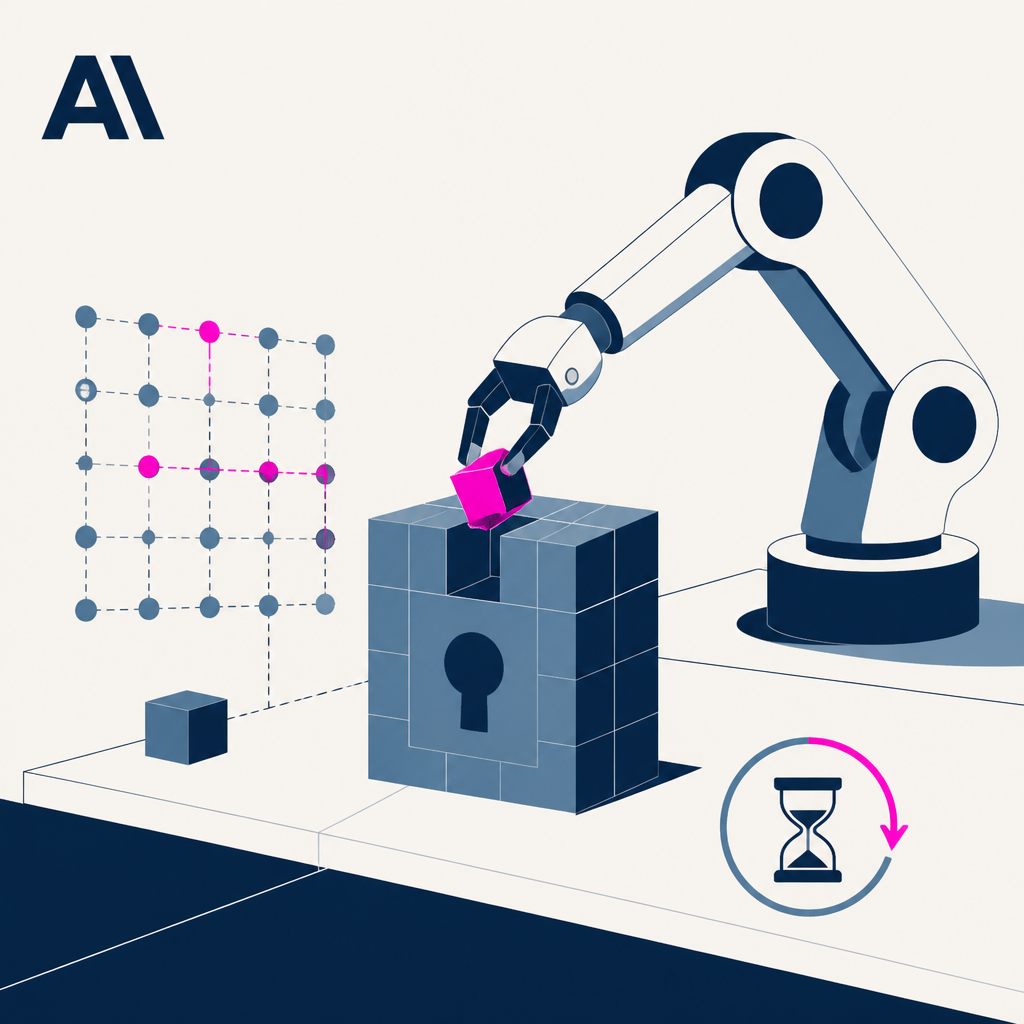
A pair of mathematicians says Anthropic’s Claude helped them find something number theorists have been chasing for a very long time: elliptic curves with ranks of at least 30 and 31. The result sounds tidy on paper — just a curve and a line — but in practice it marks a serious step up in a problem where progress has been painfully slow.
Levent Alpöge, who works at Anthropic, and cryptographer Ava Howell used an internal version of Claude that isn’t publicly available. With a relatively simple prompt, they came back with two examples of higher-rank elliptic curves in just a few days. That is a striking contrast to the usual pace in this corner of mathematics, where moving from rank 28 to rank 29 took more than 18 years.
Elliptic curves are defined by equations of the form y2 = x3 + Ax + B. What makes them fascinating is the structure of their rational points — the x and y values that can be written as fractions and still satisfy the equation. Rank 0 curves have only finitely many such points. Rank 1 curves have infinitely many, but they follow a single pattern. Rank 2 adds a second independent family, rank 3 adds a third, and so on.
That is why rank matters so much. The higher the rank, the more complicated the pattern of rational points becomes, and the harder the curve is to find. Until recently, the field had just reached a curve of at least rank 29 in August 2024. Now an AI model has apparently pushed that frontier twice in short order.
There’s also a little timing drama here. The result lands just after OpenAI said its own model had solved the Navier-Stokes problem, one of the seven Millennium Prize Problems. This one is not that, but it still shows the same pressure building around AI and hard math: not a party trick, not a spreadsheet stunt, but a machine helping push at a genuinely difficult research boundary.
My take — AI-written commentary, not fact-checked reporting
This is the kind of AI story that actually matters: not chatty fluff, but a tool helping experts move a stubborn problem forward. The hype merchants will call it intelligence; the rest of us can call it useful, which is already rare enough. If models keep showing up in places where progress used to take decades, the real question stops being whether they can do math and starts being who gets to verify the answer.
Read more about this at: Scientific American
Related stories
 Hermes vs. OpenClaw, Cybersecurity Alarms Ring, More-Interactive Conversations, Can Agents Do Human Work?
The Batch ·
44
An unreleased Anthropic model made progress on one of math’s biggest unsolved problems
TechCrunch · 1 month ago ·
26
Hermes vs. OpenClaw, Cybersecurity Alarms Ring, More-Interactive Conversations, Can Agents Do Human Work?
The Batch ·
44
An unreleased Anthropic model made progress on one of math’s biggest unsolved problems
TechCrunch · 1 month ago ·
26
 Anthropic AI Model Finds Flaws in Tough-to-Crack Encryption Algorithms
The New York Times · 1 month ago ·
15
Anthropic AI Model Finds Flaws in Tough-to-Crack Encryption Algorithms
The New York Times · 1 month ago ·
15