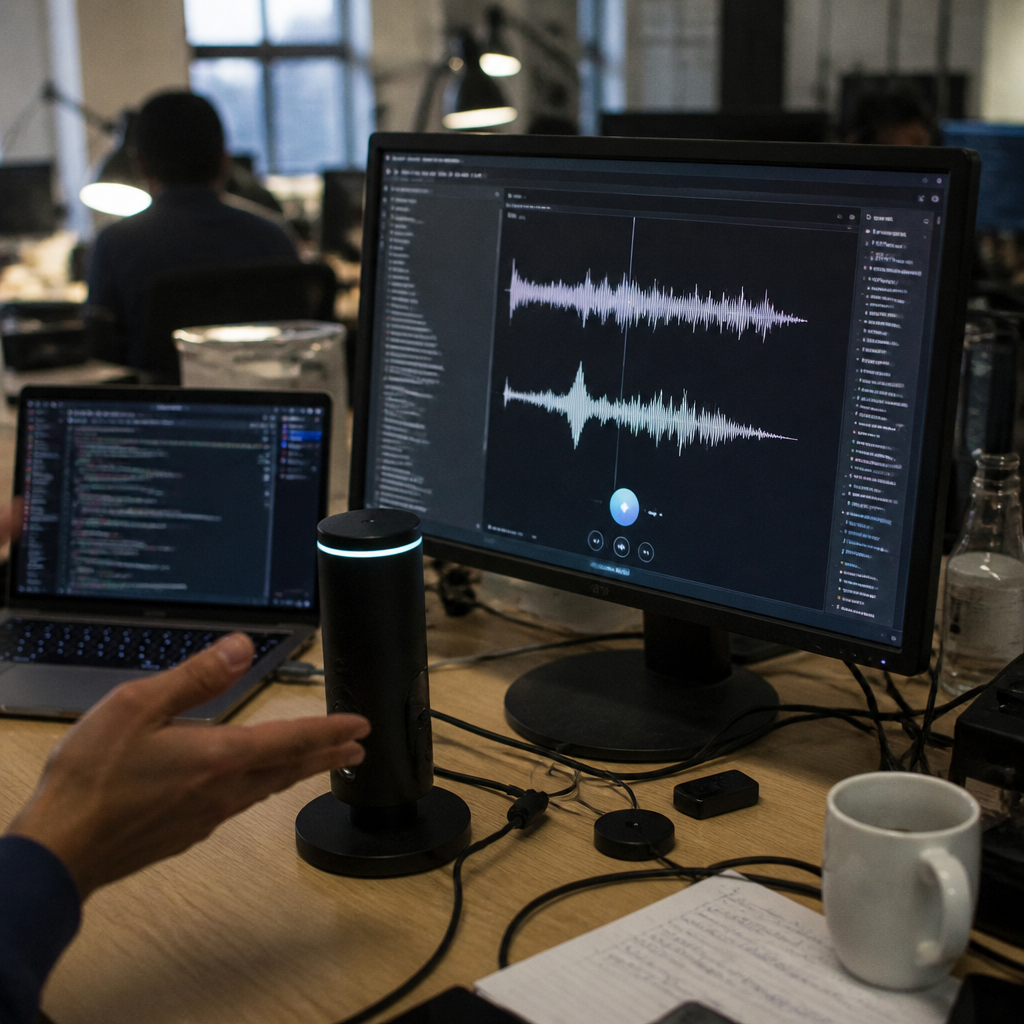
How we built a realtime system for responsive voice AI in six months
OpenAI ● Covered by 2 sources
OpenAI built GPT-Live, a voice AI system that talks in real time without waiting for you to finish your sentence. It ditches the clunky 'turn-based' back-and-forth that makes most voice assistants feel robotic.
Based on reporting by OpenAI — read the original for the full story.
Summary, retelling and take written by AI under human oversight; images are AI-generated illustrations. How we work · Report an error
Anyone who has talked to a voice assistant knows the drill: you speak, there's an awkward pause, then the bot replies as if reading from a script. OpenAI says it spent the last six months tearing that model apart with a new system called GPT-Live, built around what it calls a turnless speech architecture. Instead of chopping a conversation into rigid turns — you talk, then it talks — the model listens continuously and can respond, interrupt, or adjust mid-thought, closer to how two people actually talk over each other, correct themselves, and pick up cues in real time.
The engineering problem here isn't really about language understanding. It's about latency and coordination. Getting a model to react within a few hundred milliseconds, while still parsing incoming audio and deciding when a pause means "I'm done" versus "I'm just thinking," is a genuinely hard systems challenge, not a modeling one. OpenAI frames GPT-Live as the result of rebuilding the plumbing beneath the model rather than just training a bigger one.
What's notable is the timeline. Six months is fast for infrastructure of this kind, especially when the goal is a fundamentally different interaction pattern rather than an incremental speed bump. Most voice AI products, including OpenAI's own earlier offerings, have leaned on turn-based designs because they're easier to engineer and easier to make reliable. Removing that turn boundary means the system has to make judgment calls constantly, in real time, without the luxury of waiting for silence to confirm a full utterance.
If it works as described, the practical effect is conversations that feel less like issuing commands to a machine and more like actual dialogue — the kind where you can cut someone off, add a clarifying word mid-sentence, or trail off without the whole exchange falling apart. That's a meaningfully different bar than transcription accuracy or response quality, which is where most voice AI marketing still focuses.
My take — AI-written commentary, not fact-checked reporting
Six months to rebuild the entire interaction model for voice is either an impressive sprint or a sign that the previous turn-based approach was held together with duct tape all along — probably both. I'll believe the 'natural conversation' claim when I can actually interrupt one of these things mid-ramble without it either ignoring me or restarting from scratch, which is where every voice assistant before this has quietly failed.
Read more about this at: OpenAI