Google Research Introduces an AI Video Co-Director: 4 Agentic Frameworks for Coherent, Minutes-Long Video Generation
MarkTechPost Asif Razzaq
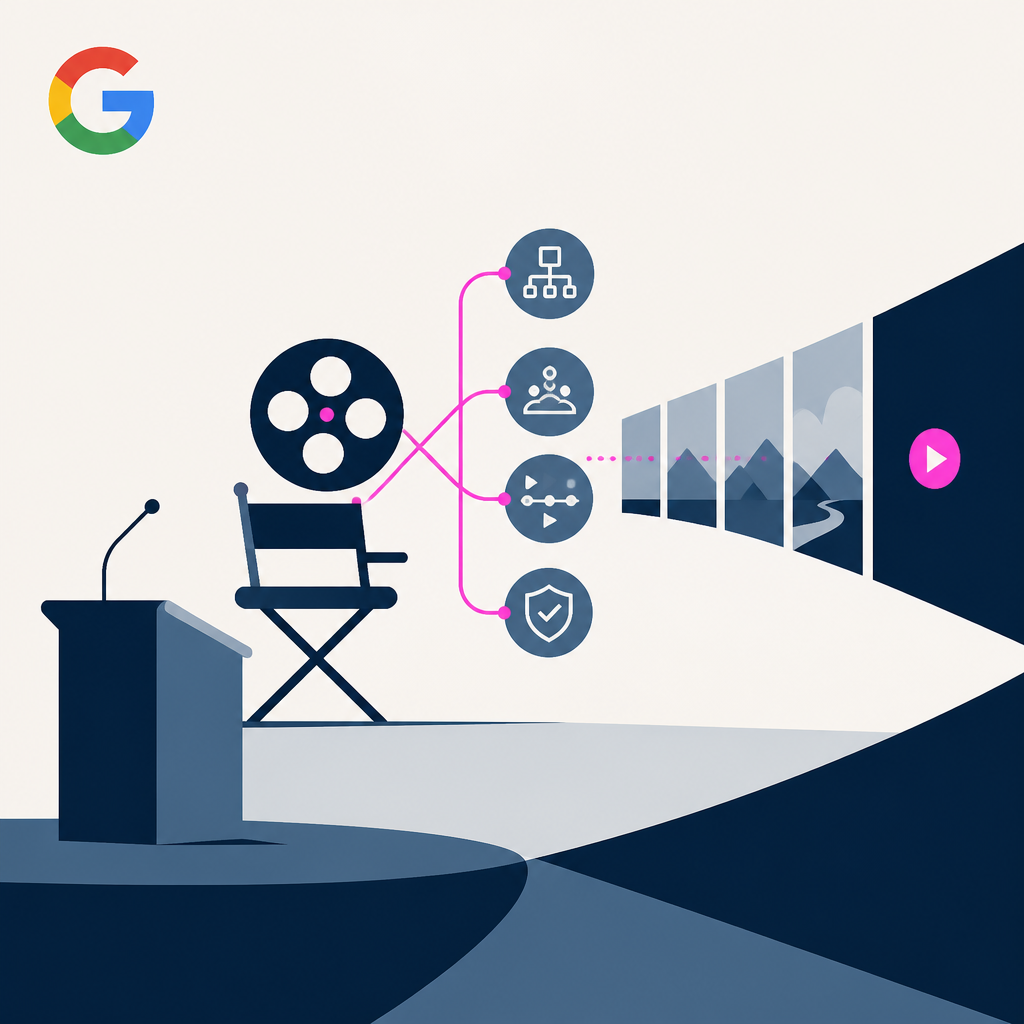
Google built an AI video co-director that keeps long clips coherent. It tackles the two things that usually wreck multi-shot AI video: drift and chain-reaction mistakes.
Based on reporting by MarkTechPost, Asif Razzaq — read the original for the full story.
Summary, retelling and take written by AI under human oversight; images are AI-generated illustrations. How we work · Report an error
Google Research is pushing past the usual short AI clip demo and into something harder: a system meant to keep a story together for minutes at a time. The new setup sits on top of Gemini and Veo, but Google says it is model-agnostic, so the orchestration layer can drive other generators too. SynthID watermarking carries through from the base models.
The big idea is simple enough. Long-form video breaks when each shot is planned in isolation. Clothes change. Props disappear. A bad early frame poisons everything that follows. Google frames that as a credit-assignment problem, because once the final video looks wrong, it is hard to tell which prompt or intermediate step caused the mess.
To handle that, Google split the job into four agentic frameworks. Co-Director uses a multi-armed bandit to choose a creative setup, then a Pre-Production Agent builds the storyboard and media sub-agents generate keyframes, video, and audio. An MLLM Judge scores the result and feeds that back into the search. CANVAS keeps persistent memory of characters, places, and object states so returning scenes can reuse the right visual anchors. In Google’s museum heist test, it kept a thief’s cap and a gemstone consistent where other systems drifted.
A²RD takes a different route. It is a training-free setup that works segment by segment with a Retrieve, Synthesize, Refine, Update loop over multimodal video memory, and Google says it can switch between extrapolating new beats and interpolating returning entities. The company shared a 10-minute film made this way. VQQA then closes the loop by generating visual questions from prompts, using VLM critiques as semantic gradients to rewrite the text prompt, and choosing the best output across all iterations rather than just the last one.
Google also built three benchmarks to test the idea: GenAD-Bench with 400 ad scenarios, HardContinuityBench for reappearing scenes and changing props, and LVBench-C for assets that vanish for at least 10 segments before coming back. On the project page, Co-Director scored 81.4 on GenAD-Bench and 3.96 out of 5 in human ratings. CANVAS improved background continuity, character consistency, and props consistency. A²RD showed gains on 1 to 10 minute videos, and VQQA improved results on T2V-CompBench and VBench2 over vanilla generation.
My take — AI-written commentary, not fact-checked reporting
This is the right fight to pick. Long video is not a bigger diffusion model problem; it is a memory and control problem, and Google is finally treating it that way instead of tossing more prompts at the wall. The nice part is that the system sounds less like a magic trick and more like plumbing, which is usually how the useful stuff gets built.
Read more about this at: MarkTechPost