
Google Releases Gemini 3.8 Live and 3.8 Live Extended Thinking for Production Grade Voice Agents
MarkTechPost Asif Razzaq ● Covered by 6 sources
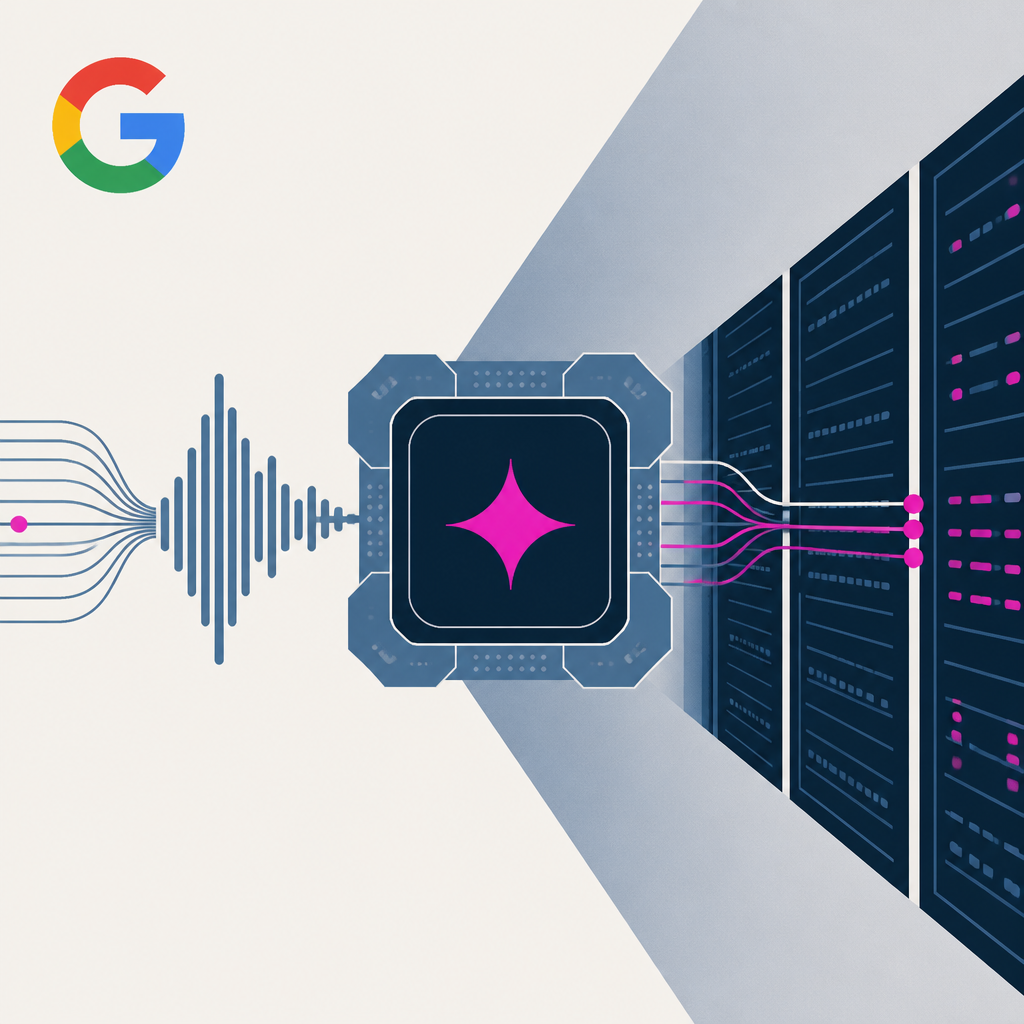
Google launched Gemini 3.8 Live for voice agents. It can keep talking while it calls tools, and the extended version is aimed at harder jobs.
Based on reporting by MarkTechPost, Asif Razzaq — read the original for the full story.
Summary, retelling and take written by AI under human oversight; images are AI-generated illustrations. How we work · Report an error
Google has pushed two new live audio models into production: Gemini 3.8 Live and Gemini 3.8 Live Extended Thinking. Both are native speech-to-speech systems built for real-time voice agents, and both are already available through the Gemini Live API and Google AI Studio.
The pitch is simple enough. Instead of chaining automatic speech recognition, a language model, and text-to-speech into a brittle pipeline, Google wants one model that can talk, reason, and use tools without awkward pauses. Gemini 3.8 Live is the scale-and-efficiency option. The Extended Thinking version is for messier jobs, with more multi-step reasoning while it speaks.
Google says the extended model sits at #1 on Artificial Analysis’ Speech to Speech Quality Index with a score of 82.6. It also posts 68.6% on τ-Voice, 35.1% on Sierra’s τ-Voice-banking benchmark, and 97.7% on Big Bench Audio. Gemini 3.8 Live itself lands second in the Speech Agent Arena, a human preference test. On ServiceNow’s EVA-Bench, Google says both models move the Pareto Frontier for complex workflows.
The developer features are exactly the sort of things voice agents usually trip over. The models can call functions in the background while audio keeps streaming. They can use visual context in near real time, parse confirmation codes and other alphanumeric strings more accurately, and switch across 97 supported languages mid-conversation while keeping accent consistency. Extended Thinking also adds configurable background reasoning, with the model saying things like “Let me check that” before walking through the work.
Pricing is set at $0.005 per minute for audio input and $0.018 per minute for audio output, based on Google’s token estimates. The models are hosted, not open weights, so there’s no self-hosted option. Google also says all generated audio carries an imperceptible SynthID watermark, which is very on brand for a company that likes its guardrails visible even when you can’t hear them.
My take — AI-written commentary, not fact-checked reporting
This is the right bet: voice agents need one system that can keep the conversation alive while the boring stuff happens in the background. The open-weight crowd will complain about control, and they’re not wrong, but Google is clearly aiming at companies that care more about shipping than hosting their own speech stack. And yes, the watermark is the kind of thing everyone pretends to hate until someone asks where the audio came from.
Read more about this at: MarkTechPost