Flow-based Deep Generative Models
Lil'Log
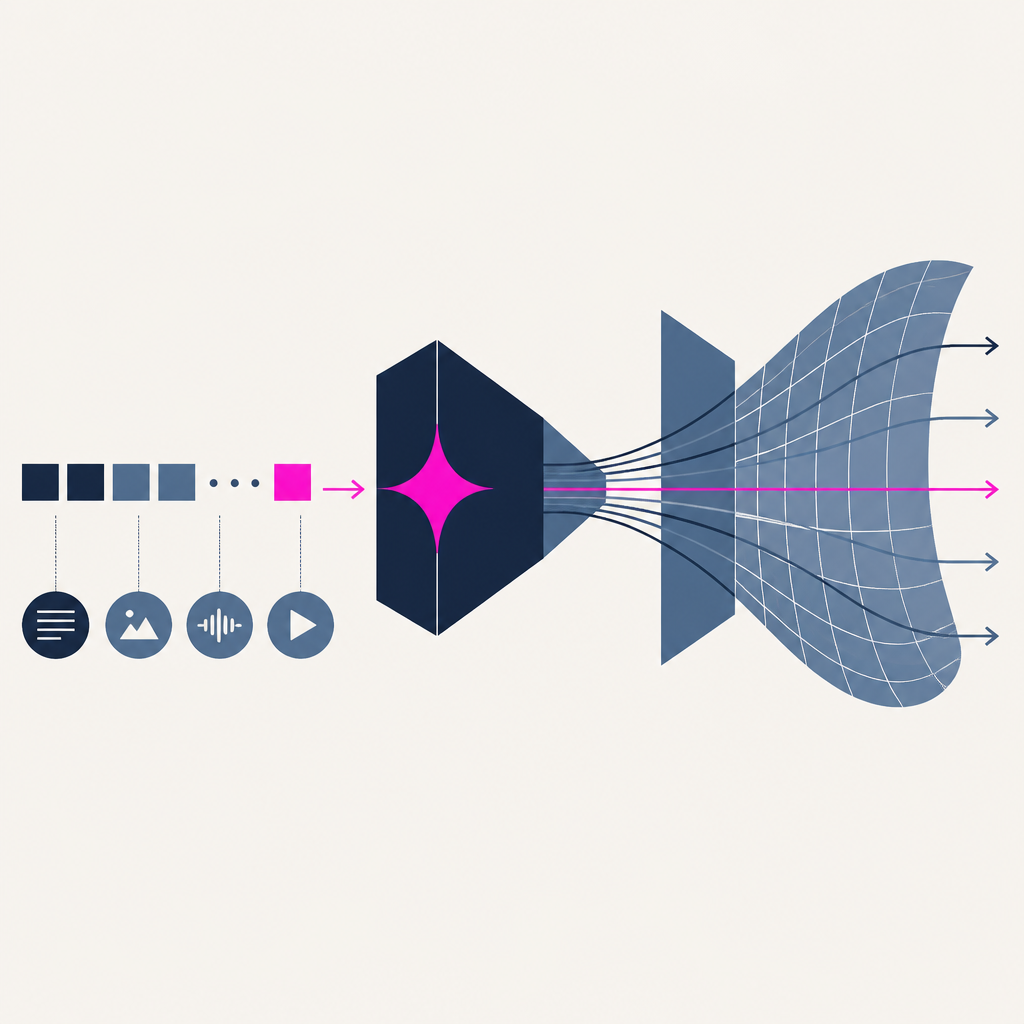
Flow-based generative models use normalizing flows to explicitly learn the probability density function of data by applying sequences of invertible transformations, addressing a limitation of GANs and VAEs which cannot directly calculate this density. RealNVP implements this approach using affine coupling layers that split input dimensions and apply scale-and-shift transformations, with Jacobian determinants that are computationally tractable. This enables training via negative log-likelihood loss, allowing the models to generate samples, estimate densities, and perform inference on incomplete data more effectively than prior generative model architectures.
Why it matters
So far, I’ve written about two types of generative models, GAN and VAE. Neither of them explicitly learns the probability density function of real data, $p(\mathbf{x})$ (where $\mathbf{x} \in \mathcal{D}$) — because it is really hard! Taking the generative model with latent variables as an example, $p(\mathbf{x}) = \int p(\mathbf{x}\vert\mathbf{z})p(\mathbf{z})d\mathbf{z}$ can hardly be calculated as it is intractable to go through all possible values of the latent code $\mathbf{z}$.