Building a safer path to autonomous industrial AI
MIT Technology Review MIT Technology Review Insights ● Covered by 3 sources
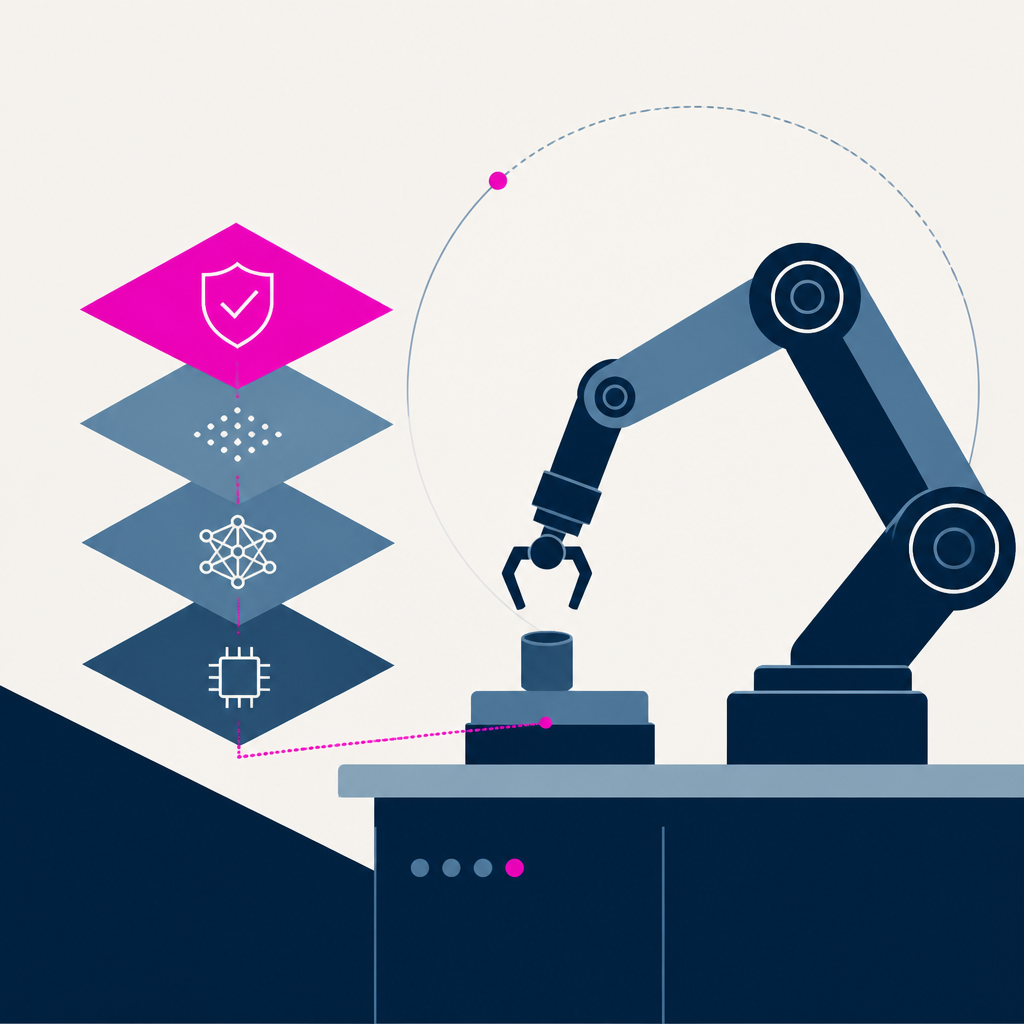
Industrial AI is moving from predictions to robots and agents in plants and mines. That raises the payoff and the risk, because one bad call can hit real equipment and people.
Based on reporting by MIT Technology Review, MIT Technology Review Insights — read the original for the full story.
Summary, retelling and take written by AI under human oversight; images are AI-generated illustrations. How we work · Report an error
Industrial AI is having a much bigger moment than the phrase suggests. AVEVA’s Arti Garg says the field has spent more than 20 years on industrial uses of AI, but the last few years brought a new mix: foundation models, physical AI, and agentic AI. That shift is pulling AI out of the screen and into places where software touches pumps, mixers, power systems, mines, and other machinery that cannot shrug off mistakes.
The core problem is still data. Industrial systems spread useful information across telemetry, service logs, engineering documents, and maintenance records, and the hard part has always been connecting those pieces fast enough to help someone act. Newer tools, including graph databases and AI that can match disparate datasets quickly, are making that easier. In Garg’s picture, an operator with a tablet could get a near-real-time diagnosis, instead of digging through files and system logs by hand.
Then the idea gets more physical. A robot could move through a hazardous environment and gather information without sending a worker into the danger zone. That is the kind of autonomy industrial vendors are chasing now. But it also raises the stakes, because these systems are not just answering emails or drafting code. They can interact with infrastructure that keeps power flowing and materials moving.
That is why AVEVA’s version of responsible AI puts security, efficiency, environmental efficiency, human safety, and human oversight in the same bucket. Garg is blunt that AI should augment people in critical decision loops, not replace them. The company is building guardrails around where automated systems can act and where human supervisors stay responsible.
Sustainability sits right beside safety in this story. AI can help manage complex power systems as renewable generation grows, and Garg is also involved in an IEEE working group that is trying to standardize how to measure AI’s own footprint across electricity, energy, resources, water, and carbon. The next wave could bring autonomous robots, drones, and AI-assisted coding deeper into industrial work. But the win will come only if companies redesign processes, set boundaries, and let experienced workers scale their judgment instead of being quietly written out of the loop.
My take — AI-written commentary, not fact-checked reporting
The industry keeps selling autonomy like it is just another software upgrade, which is a nice way to ignore physics. Industrial AI should stay boringly supervised until the guardrails are real, not decorative. Europe will be right to demand that discipline; closed systems with a safety sticker are still just expensive mystery boxes.
Read more about this at: MIT Technology Review