
AWS Trainium Frontier competition: Co-design models and kernels on purpose-built AI chips
Amazon Science
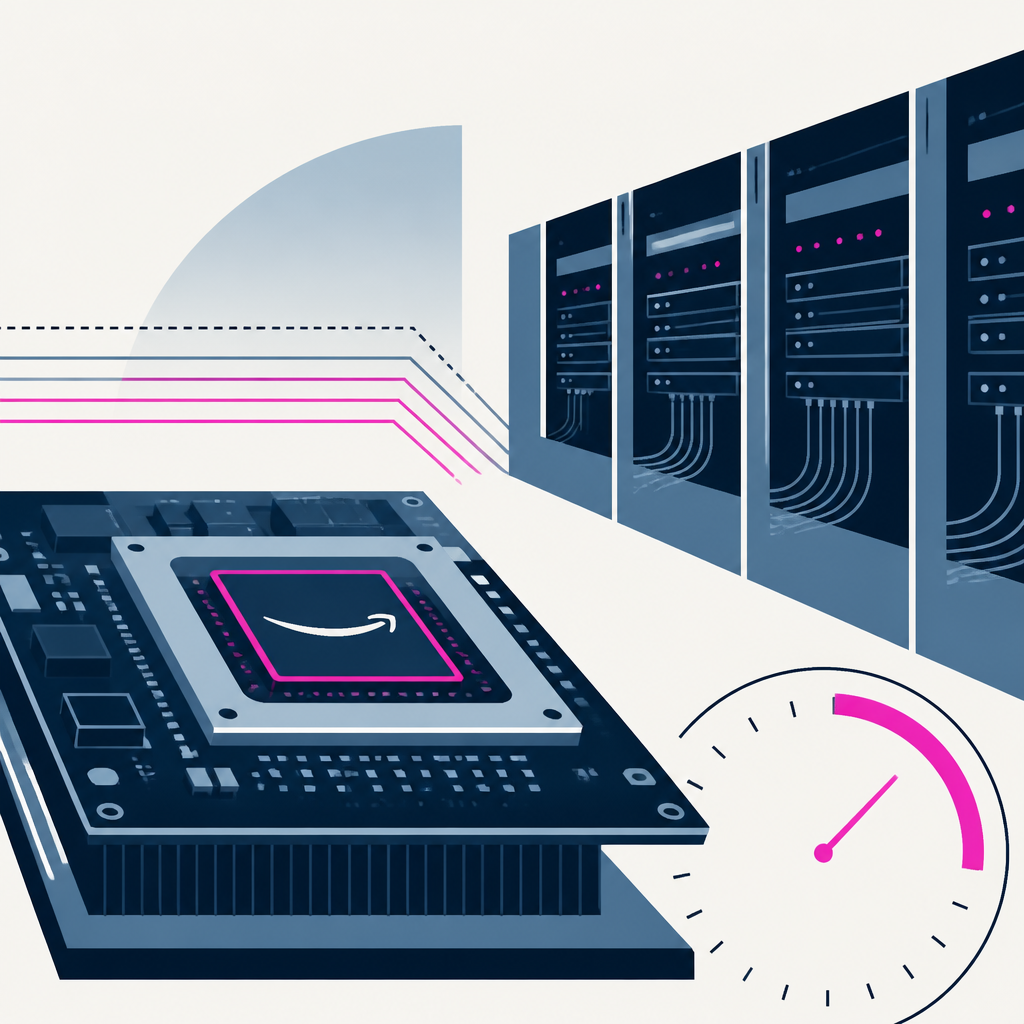
AWS is running a Trainium contest where teams train a language model from scratch on its chips. The twist: the best model may be the one built for the hardware, not copied from GPUs.
Based on reporting by Amazon Science — read the original for the full story.
Summary, retelling and take written by AI under human oversight; images are AI-generated illustrations. How we work · Report an error
Amazon is using its Trainium chips as a research playground, and it’s asking a blunt question: what does a strong language model look like when the hardware rules change? The company says modern LLMs were shaped around earlier accelerator limits, from attention layouts to MLP design to parallelism choices. Trainium shifts those limits with more on-chip SRAM, explicit control over data movement, and a different balance between compute and memory traffic.
That is the premise behind the AWS Trainium Frontier competition. Teams start from a roughly 50 million parameter baseline model derived from nanochat — a GPT-style dense LLM with RMSNorm, rotary embeddings, and a ReLU² MLP — and then they can change the architecture, optimizer, training loop, and even custom NKI kernels. The point isn’t to tweak one knob and call it a day. It’s to see how far model design and hardware-specific code can be pushed together.
The contest is split into two phases. In Phase 1, each team gets a single Trainium2 chip and 30 minutes of training, with scoring based on validation bits-per-byte after that fixed window. Phase 2 raises the stakes for the top 10 teams: a full Trainium2 server, four hours of training, and a second score based on CORE, an inference benchmark covering reasoning, comprehension, and world knowledge. The final result is a 50/50 composite, so a fast trainer alone won’t win it.
Amazon is also trying to make the hardware accessible. Participants get a complete training pipeline, NKI documentation, a profiling tool called Neuron Explorer, and native PyTorch support without extra package installation. Eligible academic teams can also get AWS Promotional Credits and Amazon Bedrock access. The competition opens August 31, 2026, closes Phase 1 on September 30, and ends with finalist presentations in Sydney in December 2026.
There’s a real idea here: stop pretending every model should be treated like a generic GPU tenant. Hardware-native design is where the interesting work is, and it’s overdue. The open question is whether this competition produces better science, or just a fresh way to turn chip quirks into bragging rights.
My take — AI-written commentary, not fact-checked reporting
This is the right kind of contest: less benchmark theater, more actual co-design. The annoying part is that the industry keeps rediscovering the same truth — the hardware shapes the model, and the model shapes the hardware — then acts surprised when a new chip changes the answer. Open enough to let researchers explore, narrow enough to force real tradeoffs. That’s healthier than another “just scale it harder” pageant.
Read more about this at: Amazon Science
Related stories
 34 Amazon Research Awards Build on Trainium recipients announced
Amazon Science · 1 month ago ·
15
Amazon hopes to challenge Nvidia more directly by selling its AI chips
TechCrunch · 2 months ago ·
11
Amazon’s AI Resurgence: AWS & Anthropic’s Multi-Gigawatt Trainium Expansion
SemiAnalysis · 1 year ago ·
30
34 Amazon Research Awards Build on Trainium recipients announced
Amazon Science · 1 month ago ·
15
Amazon hopes to challenge Nvidia more directly by selling its AI chips
TechCrunch · 2 months ago ·
11
Amazon’s AI Resurgence: AWS & Anthropic’s Multi-Gigawatt Trainium Expansion
SemiAnalysis · 1 year ago ·
30