[AINews] Here are 6 Clones of Jev in 2 days
Latent Space ● Covered by 11 sources
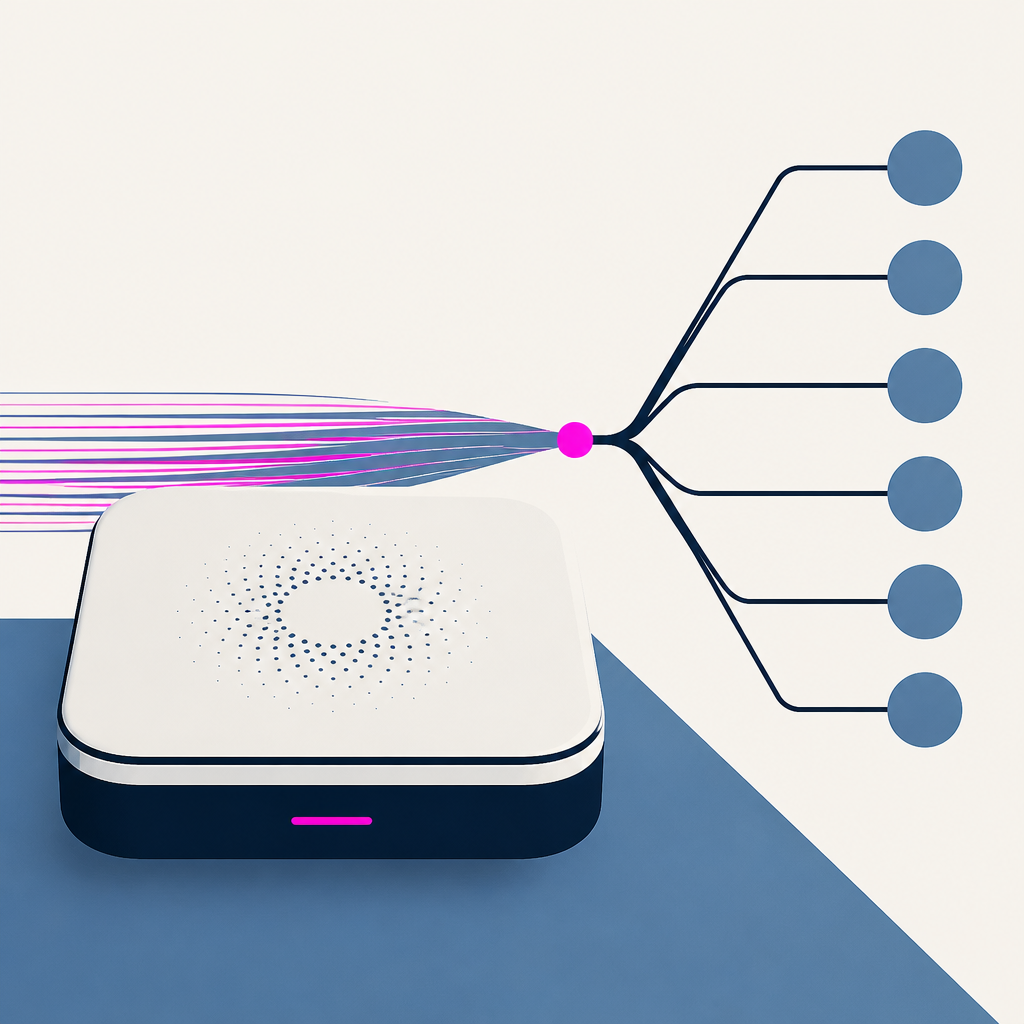
Jev blew up, and 6 clones popped up in 2 days. The hype is about a non-generative model that people want to use for routing, not chatting.
Based on reporting by Latent Space — read the original for the full story.
Summary, retelling and take written by AI under human oversight; images are AI-generated illustrations. How we work · Report an error
Jev landed on Wednesday and immediately turned into the thing everyone in AI had to have an opinion about. Latent Space says the launch video has pulled 36 million views in just two days. That’s a huge number, even before you stack it against OpenAI’s Navier Stokes result at 74 million and Anthropic’s Fable 5 at 57 million. The catch, of course, is that Jev wasn’t open source. So the internet did what it always does: fill the gap with speculation, demos, and a lot of overconfident guessing.
The guesses came fast. One cluster of takes points to ModernBERT and Diffusion:Laya, described as a 421M-parameter setup with a ModernBERT-large encoder, two extra transformer layers, PPO over sequence embeddings, and turn-by-turn probabilities from 0.0 to 1.0. Another camp thinks it’s DiffusionGemmaJev, built from a diffusion-model basis and looking close on benchmarks. There’s also Bespoke Nimble, a LoRA fine-tune of Qwen3.5-9B with contrastive data curation, SemIf, a Qwen3.5-based model with a tiny three-class NLI classifier on the last token, Jevlike, a 40K byte embedding option-attention model, and Kev-0.5B, a LoRA adapter plus small readout head on Qwen2.5-0.5B. The data side is not exactly a mystery either: it’s acknowledged to be 100% synthetic.
That openness gap may be the real story. Because while the launch itself fed the usual cycle of hype and hot takes, the practical reaction was much more focused. People were talking about Jev as a discriminative decision model, a kind of fast System 1 layer for routing, escalation, citation selection, and other calls that don’t need a long generative answer. Braintrust reportedly already has it available as an eval model with about 400x lower scoring cost than prior setups, and the strongest use cases being discussed were browser and computer-use workflows. Box incident triage, browser tasks, structured workflows like folding laundry — that’s where the model starts looking interesting.
The clones showed up almost immediately, which says something in itself. Bespoke Nimble is being pitched as an open Jev recipe, Kev-0.5B is the tiny local version, and the whole ecosystem is already trying to turn a closed splash into a reusable pattern. That fits the larger shift Latent Space is tracking: less chatbot spectacle, more specialized control layers, routing logic, and cheap judgment models that can sit underneath bigger systems.
The meta-problem is still the same one the post keeps circling back to. Speed is easy to demo. Quality is harder to benchmark. Until there’s a standard for this class of model, every launch will keep looking like a magic trick, a clone factory, and a benchmark argument all at once.
My take — AI-written commentary, not fact-checked reporting
This is what happens when a closed model lands in public and the field has no agreed way to score it: everybody starts playing detective and calling it research. The real tell isn’t the clone count, it’s that people want this class of model for routing and decisions, not chat. Closed labs still get the first-mover glory, and open builders get the synthetic-data knife fight afterward. Very efficient system, if the goal is endless benchmarking theater.
Read more about this at: Latent Space