
TechCrunch AI
·
21 hours ago
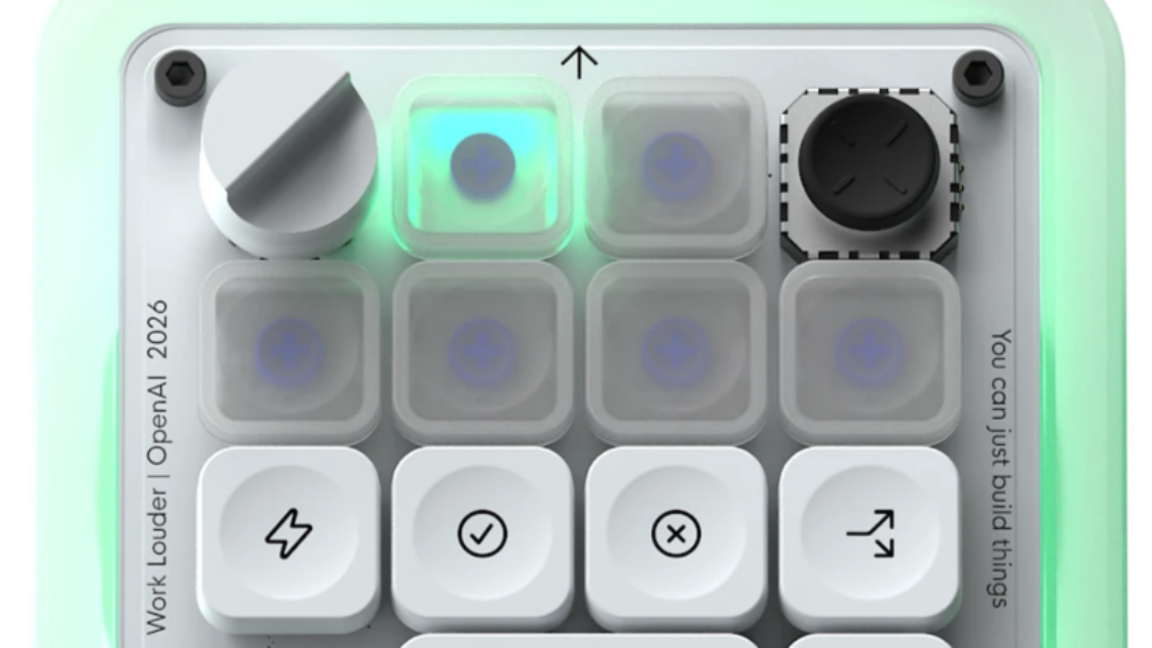
OpenAI released a $230 light-up keyboard called the Codex Micro, designed to control AI coding agents through customizable keys, status lights, and a dial for adjusting computational reasoning levels. The keyboard is a limited-run collaboration with specialty keyboard designer Work Louder and connects to ChatGPT's desktop app. OpenAI is simultaneously developing a separate screenless smart speaker with moving mechanical parts, designed by former Apple engineers, which is still in development and unfinished.
Ars Technica
·
1 day ago
OpenAI released its first branded hardware product, the $230 Codex Micro, a custom mini-keyboard with color-coded keys for monitoring AI agents. The device features six frosted keys that display status updates—white for idle, blue for processing, green for completion, amber for requiring feedback, and red for errors—across up to six concurrent Codex threads. Users can tap the illuminated keys to quickly switch between different AI agent tasks without manually searching for windows on-screen.

The Verge
·
1 day ago
Google's Pixel 11 phones will feature a glowing, color-shifting orb on the camera bar, as shown in a teaser video on Google's store page. The feature is expected to launch on August 12. The orb may serve as a physical indicator for Gemini AI or other phone functions, though Google has not yet disclosed its purpose.

Ars Technica
·
1 day ago
SpaceX plans to deploy a constellation of 1 million satellites in orbit to serve as data centers, shifting its business focus away from rockets toward hosting artificial intelligence computing infrastructure. The company aims to power up to 100 million frontier-class GPUs across these orbital facilities, with individual AI1 satellites designed to generate 120 GW of power. This orbital data center approach would allow SpaceX to offer computing services directly from space rather than relying on ground-based infrastructure.
