VentureBeat AI
·
18 hours ago
Anthropic's Claude platform dominates enterprise agent deployments with 40% of organizations choosing it as their primary orchestration platform, more than double any competitor. However, 71% of enterprises report that a quarter or fewer of their deployed "agents" are true multi-step orchestrated workflows rather than single-prompt chatbot wrappers, despite defining success by reliable multi-step execution. Enterprises plan to address this gap by building hybrid control planes that combine provider-native platforms with external orchestration tools they own, driven by fears of vendor lock-in.

TechCrunch AI
·
23 hours ago
Thinking Machines Lab released Inkling, an open-weight AI model with 975 billion total parameters that developers can download and modify, departing from the closed models sold by OpenAI, Anthropic, and Google. The model uses about 41 billion parameters per task and requires a third as many tokens as Nvidia's Nemotron 3 Ultra to achieve equivalent coding performance, according to the company's benchmarks. The startup is positioning Inkling as a customizable foundation for enterprises to fine-tune through its Tinker platform rather than a finished product, betting that organization-specific AI will outperform general-purpose models.

TechCrunch AI
·
1 day ago
Whatnot acquired Shaped, a machine learning company specializing in real-time recommendations and search systems, to improve product discovery as its livestream shopping marketplace expands. The company has reduced recommendation latency from roughly a day to minutes over six years and processes more than 500,000 hours of live video weekly. The integration of Shaped's technology is expected to push recommendations closer to real time, addressing live commerce's core challenge of matching shifting buyer demand with constantly changing inventory and auction schedules.
Ars Technica
·
1 day ago
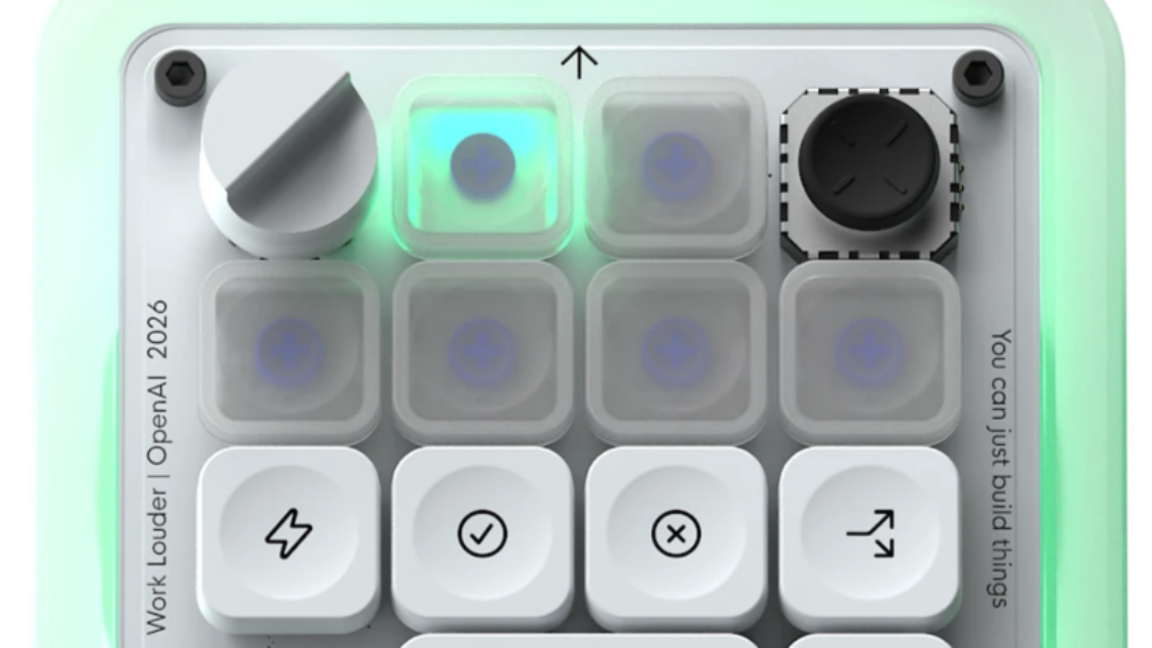
OpenAI released its first branded hardware product, the $230 Codex Micro, a custom mini-keyboard with color-coded keys for monitoring AI agents. The device features six frosted keys that display status updates—white for idle, blue for processing, green for completion, amber for requiring feedback, and red for errors—across up to six concurrent Codex threads. Users can tap the illuminated keys to quickly switch between different AI agent tasks without manually searching for windows on-screen.

TechCrunch AI
·
1 day ago
Ode with Anthropic, a joint venture backed by Anthropic, Blackstone, Hellman & Friedman, and Goldman Sachs, was formed by acquiring Fractional AI to deploy engineers directly into enterprise companies for AI implementation. The venture's founders Chris Taylor and Eddie Siegel argue that most enterprise AI pilots fail to reach production environments. The model positions AI-native services as a major emerging category by embedding technical staff within client organizations rather than relying on traditional consulting approaches.

TechCrunch AI
·
1 day ago
Anthropic and Blackstone launched Ode, a $1.5 billion AI implementation company, to deploy engineers who help enterprises integrate AI systems into their operations, following a similar move by OpenAI. Ode currently employs 100 engineers and acquired AI services startup Fractional AI as its foundation, operating on a "Claude-first" principle while remaining open to other AI models. The venture assumes that consulting services for AI deployment—not just model development—represents the next trillion-dollar business opportunity, though it faces competition from OpenAI's Deployment Company and consulting firms like Deloitte and Accenture.

TechCrunch AI
·
1 day ago
Rime, a voice AI startup founded in 2022, raised $24 million in Series A funding led by M13 Ventures to develop conversational AI systems for enterprise customer service calls. The company operates a recording studio in San Francisco to train models on proprietary conversational data and now focuses on speech-to-speech models with latency reductions rather than orchestrating multiple separate models. Rime plans to expand its 35-person team and aims to capture enterprise contracts from companies that currently rely on legacy interactive voice response systems.

Ars Technica
·
1 day ago
SpaceX plans to deploy a constellation of 1 million satellites in orbit to serve as data centers, shifting its business focus away from rockets toward hosting artificial intelligence computing infrastructure. The company aims to power up to 100 million frontier-class GPUs across these orbital facilities, with individual AI1 satellites designed to generate 120 GW of power. This orbital data center approach would allow SpaceX to offer computing services directly from space rather than relying on ground-based infrastructure.
