Why we're bullish on loops
build mode ● Covered by 2 sources
Coders are swapping one-off prompts for self-running agent loops. Give an agent a goal and a way to grade itself, and it just keeps working — fast.
Based on reporting by build mode — read the original for the full story.
Summary, retelling and take written by AI under human oversight; images are AI-generated illustrations. How we work · Report an error
When Peter Steinberger (OpenClaw) and Boris Cherny (Claude Code) both start talking about the same idea in the same week, it's worth paying attention. Their pitch: stop prompting agents line by line and start building loops — systems that prompt themselves, check their own output, and keep going until a job is actually done. Not a single request. A machine that runs itself.
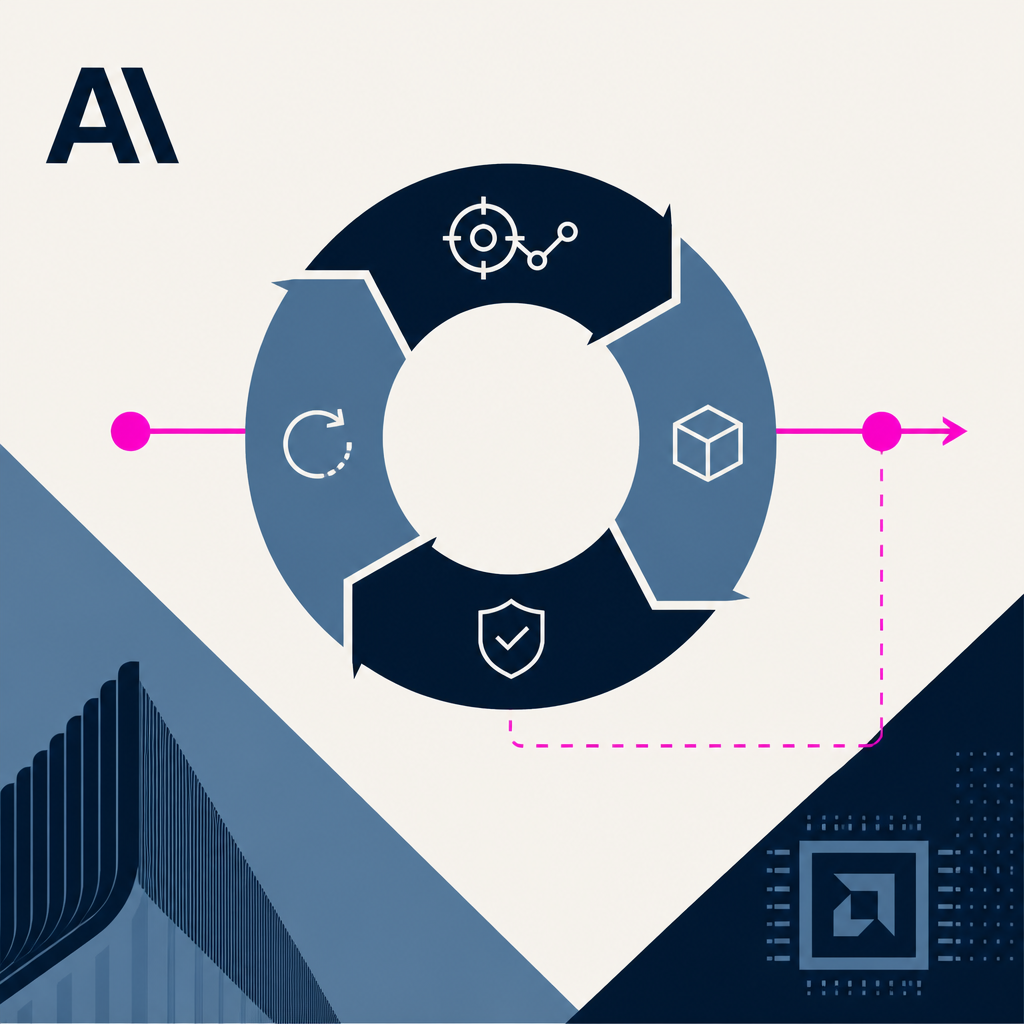
PostHog's writeup breaks the recipe into four parts. First, a scoped goal, because an agent with no target is just a slop cannon with good grammar. Second, context — tools, error logs, analytics, memories — fed in continuously rather than dumped all at once, so the agent can react instead of guessing. Third, verification: tests, evals, LLM-as-judge setups, anything that lets the agent grade its own work instead of waiting on a human to spot the bug. Fourth, a harness, ranging from a simple Claude Code while-loop (nicknamed Ralph) up to purpose-built systems running on a cron, pulling product signals and dispatching subagents.
The examples make it concrete. A 'PR babysitter' loop just wants CI green, feeding itself the diff and test suite until it passes. A bug-fixer loop chews on stack traces and logs until the failing test turns green. A 'flaky test hunter' hammers CI history until a test stops randomly failing. PostHog says it ran Karpathy's autoresearcher loop against its own query engine and it found — and fixed — a three-year-old bug, boosting performance by 11%. That's not a demo trick; that's an agent finding work nobody assigned it.
None of this works without the underlying models getting genuinely better at staying on task. METR's numbers show Opus 4.6 completing half of twelve-hour tasks, versus one hour forty minutes for Opus 4 a year earlier — a six-fold jump. Stripe reportedly ran a codebase-wide migration in a day that would've taken a team two months by hand. Claude Code and Codex have both shipped native loop and automation commands, and compaction plus MCP tooling means agents can now run longer without losing the thread. The infrastructure caught up to the idea.
PostHog's own angle is that this isn't really about writing less code — it's about closing the loop product engineers already run manually: gather data, ship a fix, measure the result, repeat. They're building Slack integrations, code tools, and session-replay features aimed at letting the product improve itself between human check-ins. The claim isn't that engineers vanish. It's that the boring 1% fixes — flaky tests, UX papercuts, conversion tweaks — get put on autopilot, freeing people for the work that actually needs taste and judgment.
My take — AI-written commentary, not fact-checked reporting
I'm sold on the mechanics here — verification loops are just TDD with better hardware, and the METR numbers on long-horizon task completion are the real story, not the branding. But I'd push back on 'self-driving products' as a phrase; it's doing the same rhetorical work as 'autonomous agents' did last year, making incremental automation sound like a paradigm shift. The honest version is that engineers now spend less time on grunt fixes and more time deciding what's worth fixing at all — which is a real change, just a less cinematic one.
Read more about this at: build mode