
The Sequence AI of the Week #899: Inside Inkling: A Trillion-Parameter Model That Only Wakes Up 41 Billion at a Time
Substack Jesus Rodriguez
Inkling is a new AI model with 975 billion parameters, but it only 'wakes up' about 41 billion of them for any given word. That's roughly 4% of its brain doing the work at any moment — the rest sits ready but idle.
Based on reporting by Substack, Jesus Rodriguez — read the original for the full story.
Summary, retelling and take written by AI under human oversight; images are AI-generated illustrations. How we work · Report an error
Inkling is the kind of model that makes raw parameter counts almost meaningless as a headline stat. Yes, it's built from 975 billion parameters, close enough to a trillion that only pedants would argue the difference. But the number that actually explains how the thing behaves is 41 billion — the slice of the model that activates for any single token passing through it. That's about 4.2 percent of the total capacity doing real work at any given instant.
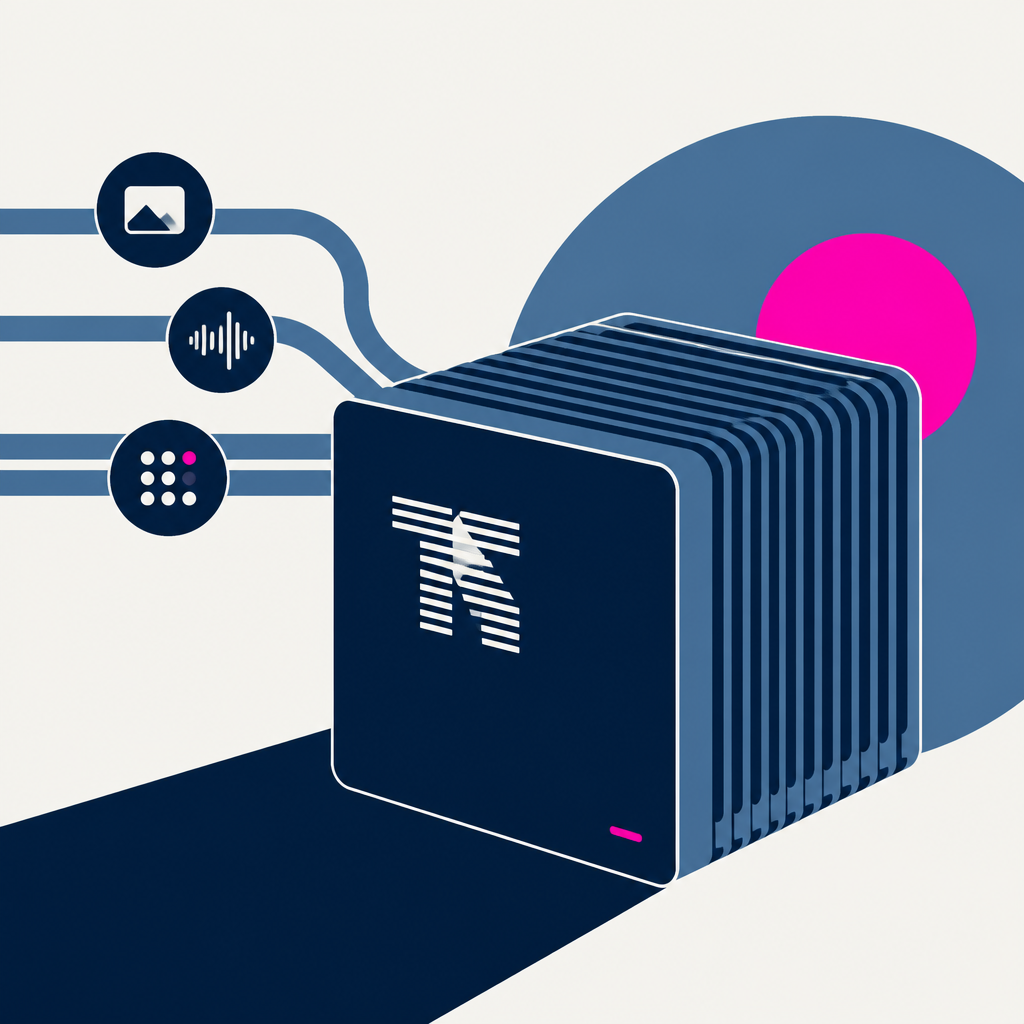
The architecture behind this is a mixture-of-experts setup, and the university analogy fits better than most technical descriptions. Picture a campus with 256 specialist departments per relevant layer. A token walks in, and instead of convening the whole faculty, a router picks six departments that seem relevant plus two generalists who always show up, blends their output, and sends the token on its way. A snippet of Python code might trigger a different set of departments than a phrase in Greek or a caption on an image. The routing decision happens fresh for every token, which is why the same model can feel like dozens of narrower models stitched together on demand.
What this buys Inkling is a strange kind of efficiency. The compute cost per token stays low because you're only running a sliver of the network's parameters through the math. But the storage, the memory bandwidth, and the networking requirements don't shrink to match — you still have to keep the entire trillion-ish-parameter warehouse loaded and addressable, because you never know in advance which departments a given token will need. So the sparse arithmetic hides a very unsparse infrastructure bill.
This is the tradeoff that mixture-of-experts models have been chasing for a few years now, and Inkling is a fairly extreme point on that curve. Dense models spend every parameter on every token, which is simple but expensive. Sparse models like this one try to get the quality benefits of massive scale while keeping the per-token compute closer to what a much smaller model would cost. The catch is that building and serving something like this requires infrastructure that can handle the full trillion-parameter footprint even though most of it sits idle at any moment — which is a very different engineering problem than just training a bigger dense network.
My take — AI-written commentary, not fact-checked reporting
I think we're watching parameter counts turn into a marketing number that increasingly means less each year, and Inkling is a good example of why. The real story is always the active-parameter count and the routing design, not the headline figure that sounds impressive in a press release. If MoE architectures keep scaling this way, expect more models where the 'size' you're told is mostly a warehouse footprint, not a measure of how much thinking actually happens per word.
Read more about this at: Substack
Related stories
 Thinking Machines Lab Releases Inkling-Small: A 276B Total, 12B Active Open Weights Multimodal MoE Model
MarkTechPost · 1 month ago ·
16
Thinking Machines Lab Releases Inkling: A 975B-Parameter Open-Weights Multimodal MoE With 41B Active Parameters And Controllable Thinking Effort
MarkTechPost · 2 months ago ·
39
Thinking Machines Lab Releases Inkling-Small: A 276B Total, 12B Active Open Weights Multimodal MoE Model
MarkTechPost · 1 month ago ·
16
Thinking Machines Lab Releases Inkling: A 975B-Parameter Open-Weights Multimodal MoE With 41B Active Parameters And Controllable Thinking Effort
MarkTechPost · 2 months ago ·
39