The AI Picbreeder Experiment: Can AI agents be creative when nobody tells them what to create?
Sakana AI
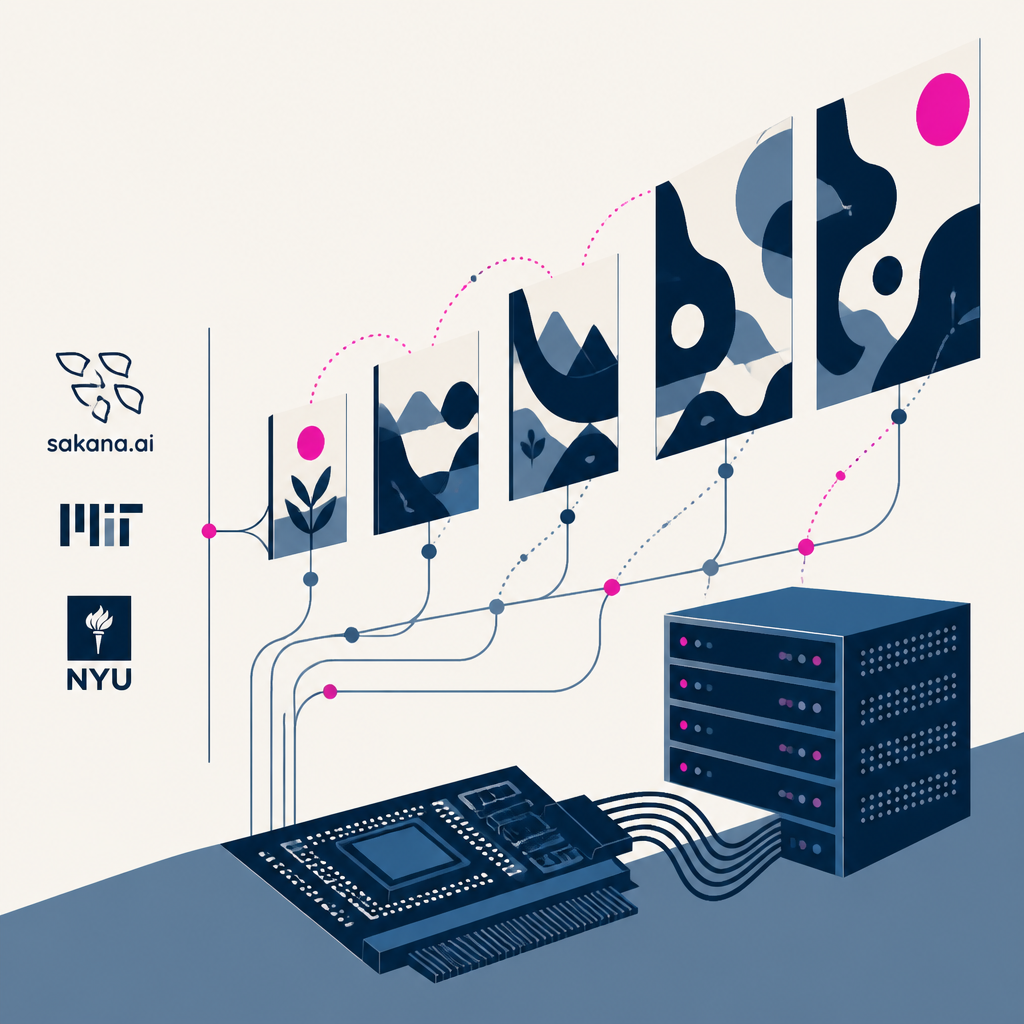
Sakana AI had chatbot agents recreate Picbreeder, the old site where people bred weird images with no goal at all. Turns out AI gets stuck admiring its own work while humans know when to leap to something totally new.
Based on reporting by Sakana AI — read the original for the full story.
Summary, retelling and take written by AI under human oversight; images are AI-generated illustrations. How we work · Report an error
Picbreeder was a strange little corner of the internet where nobody was trying to make anything in particular. Users just evolved images generation after generation, picking whatever caught their eye, and somehow faces, skulls, cars, and creatures emerged out of pure aimless curiosity. Sakana AI, working with MIT and NYU, decided to see if vision-language model agents could pull off the same trick. The results, detailed in a new GECCO 2026 paper nominated for best paper, land somewhere between impressive and a little humbling.
The setup mirrors the original almost exactly. Agents browse a shared archive, pick an image to branch from, mutate it, publish anything they like, and rate what other agents produce. Nobody defines success. Nobody sets a target. It is evolution by vibes, basically, except the vibes come from an LLM instead of a person scrolling a website in 2008.
Left alone, the agents behave like a group of people who keep ordering the same dish at a restaurant. They gravitate toward familiar shapes and concepts, pick similar parent images over and over, and tend to polish an idea rather than abandon it for something weirder. Give the population a mix of distinct agent personalities, though, and the picture changes substantially. Diversity in the agents themselves translated into diversity in the images, with some runs approaching the semantic spread that human archives achieved decades ago.
One of the more unexpected findings involves robustness. A skull image that emerged through this open-ended process held together smoothly when its internal representation was nudged or perturbed, unlike a skull generated by straightforward gradient descent, which fell apart under the same test. It was not as cleanly organized as anything humans produced on the original site, but it hinted that evolving through undirected exploration can build sturdier internal structure than optimizing straight for a target.
What the agents could not replicate is the human knack for noticing a happy accident and running with it. People are oddly good at spotting when something unplanned is actually interesting, then using that spark to make a genuinely large creative jump rather than just refining what is already there. The AI agents notice the interesting stuff too. They just get stuck admiring it instead of leaping past it, and Sakana AI is upfront that nobody yet knows exactly what ingredient is missing.
My take — AI-written commentary, not fact-checked reporting
This is one of the more honest AI papers I have read in a while, mostly because Sakana AI just admits they do not know what makes humans good at this and does not dress it up as a solved problem. It is a nice antidote to the constant drumbeat of AI-is-already-more-creative-than-us takes, and a reminder that curiosity without direction is a genuinely hard thing to engineer, not a trivial feature you bolt on with a diverse persona prompt.
Read more about this at: Sakana AI