
Remarks at the Global Nobel Laureates Assembly on Artificial Intelligence and Nuclear War in Borgo Laudato Si’, Vatican
CSET Georgetown Emily Tavenner
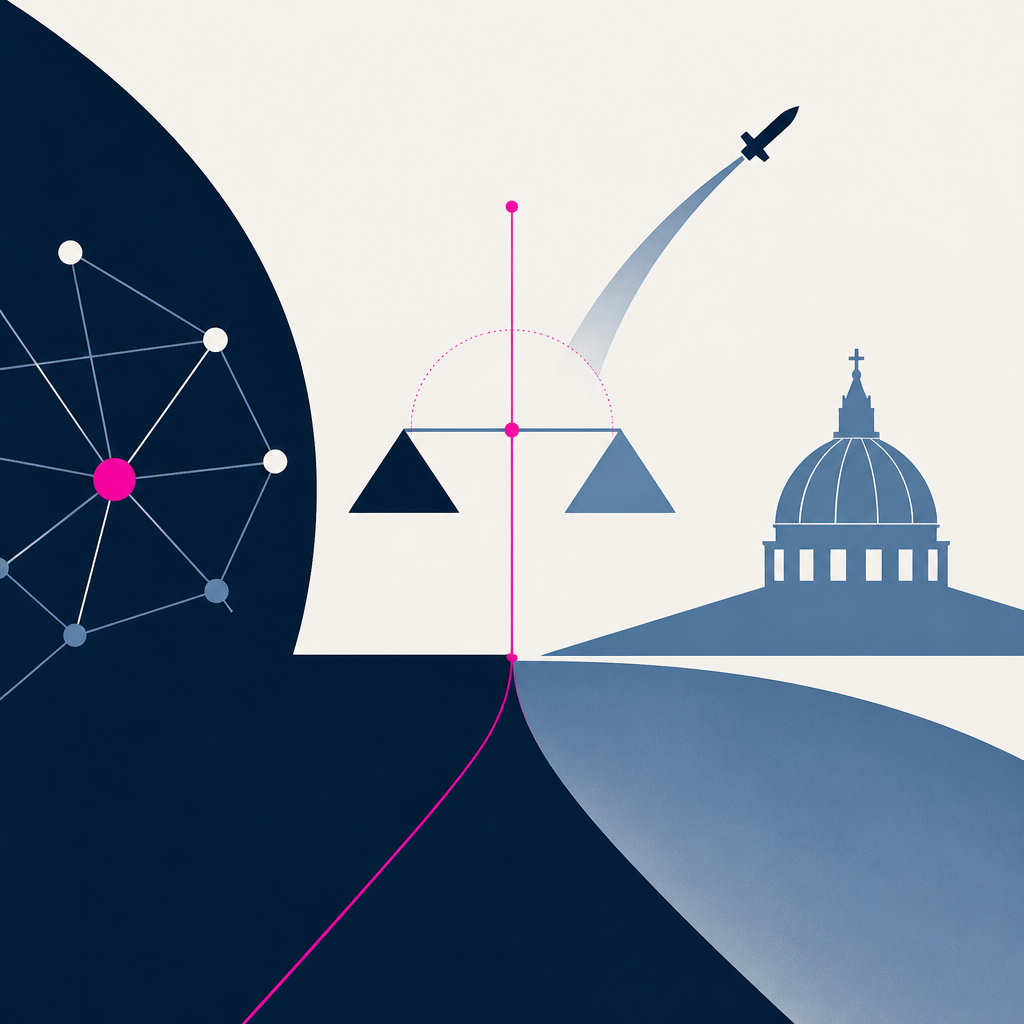
A former Navy officer told Nobel laureates at the Vatican how AI should (and shouldn't) enter military decisions on war and nukes. His pitch: use AI to challenge human blind spots, not replace judgment at the worst possible moment.
Based on reporting by CSET Georgetown, Emily Tavenner — read the original for the full story.
Summary, retelling and take written by AI under human oversight; images are AI-generated illustrations. How we work · Report an error
The Vatican doesn't usually host debates about killer robots, but last week Borgo Laudato Si, the Pope's summer residence, did exactly that. Nobel laureates, diplomats, technologists, and religious leaders spent two and a half days there wrestling with nuclear risk and its collision with artificial intelligence, all under the shadow of the Pope's encyclical on AI, Magnifica Humanitas. One speaker stood out for bringing a resume most of the room lacked: actual combat-adjacent experience operating some of the most autonomous weapons the U.S. military has ever fielded.
At 26, this speaker was trained on the Tomahawk missile and the AEGIS missile-defense system, tools that were autonomous long before anyone slapped the AI label on them. Years later, he found himself studying the Pentagon's Maven Smart System, the military's most widely used AI decision-support tool, tracking its rollout to servicemembers stationed around the globe. That arc, from operator to researcher, shaped a talk built around three arguments rather than a laundry list of fears.
The first argument cuts against the instinct to see AI as inherently corrupting of human judgment in war. Military decision-making today already runs on what troops jokingly call a BOGSAT, a bunch of guys sitting around a table, often short on time and information. The proposal on the table wasn't a single AI oracle whispering answers, which the speaker flagged as dangerous precisely because a lone confident voice can distort group thinking. Instead: ten or more models generating competing scenarios, forcing humans to confront their own blind spots rather than outsourcing the thinking entirely.
The second argument is blunter. Putting a human nominally in the loop means nothing if that human wasn't properly trained, certified, and drilled for the moment. Accountability without preparation is just someone to blame after the fact. Any government that skips the training, the embedded engineers, the oversight matched to the stakes has effectively handed the decision to the machine no matter what the policy memo says.
The third point takes aim at the phrase everyone loves to repeat: machine-speed warfare. The speaker's example was a soldier checking a target against the laws of war, necessity, proportionality, distinction. An AI that just spits out yes or no at machine speed is a problem. An AI that speeds up finding evidence for that soldier to weigh, while leaving the weighing itself unhurried, is a different animal entirely. The real fight in coming years, he argued, is over what militaries do with the time AI frees up, and whether that time gets reinvested into deliberation or simply spent going faster everywhere.
My take — AI-written commentary, not fact-checked reporting
I run TLDRocket because I think most AI coverage swings between doom and cheerleading with nothing useful in between, and this speech is a rare example of someone actually doing the harder work of specifying which parts of a process should speed up and which shouldn't. The Vatican hosting this conversation is genuinely useful precisely because governments distrust each other too much to have it themselves. My only gripe: a declaration from Nobel laureates means nothing without follow-through from the militaries actually buying these systems, and history suggests procurement offices care a lot more about speed than about preserving time for human conscience.
Read more about this at: CSET Georgetown
Related stories
 Pope Leo XIV on AI's new 'form of domination': it risks becoming a tool of 'economic colonialism'
Fortune ·
1
Import AI 458: Reckoning with the future; and a singularity story
Import AI · 3 months ago ·
36
What execs and politicians are saying about slowing down AI development
The Verge · 2 days ago ·
33
Pope Leo XIV on AI's new 'form of domination': it risks becoming a tool of 'economic colonialism'
Fortune ·
1
Import AI 458: Reckoning with the future; and a singularity story
Import AI · 3 months ago ·
36
What execs and politicians are saying about slowing down AI development
The Verge · 2 days ago ·
33