
Powerful Compute So Compact, It’s Clutch — Build AI Anywhere With NVIDIA Jetson
NVIDIA Matthew Leib ● Covered by 4 sources
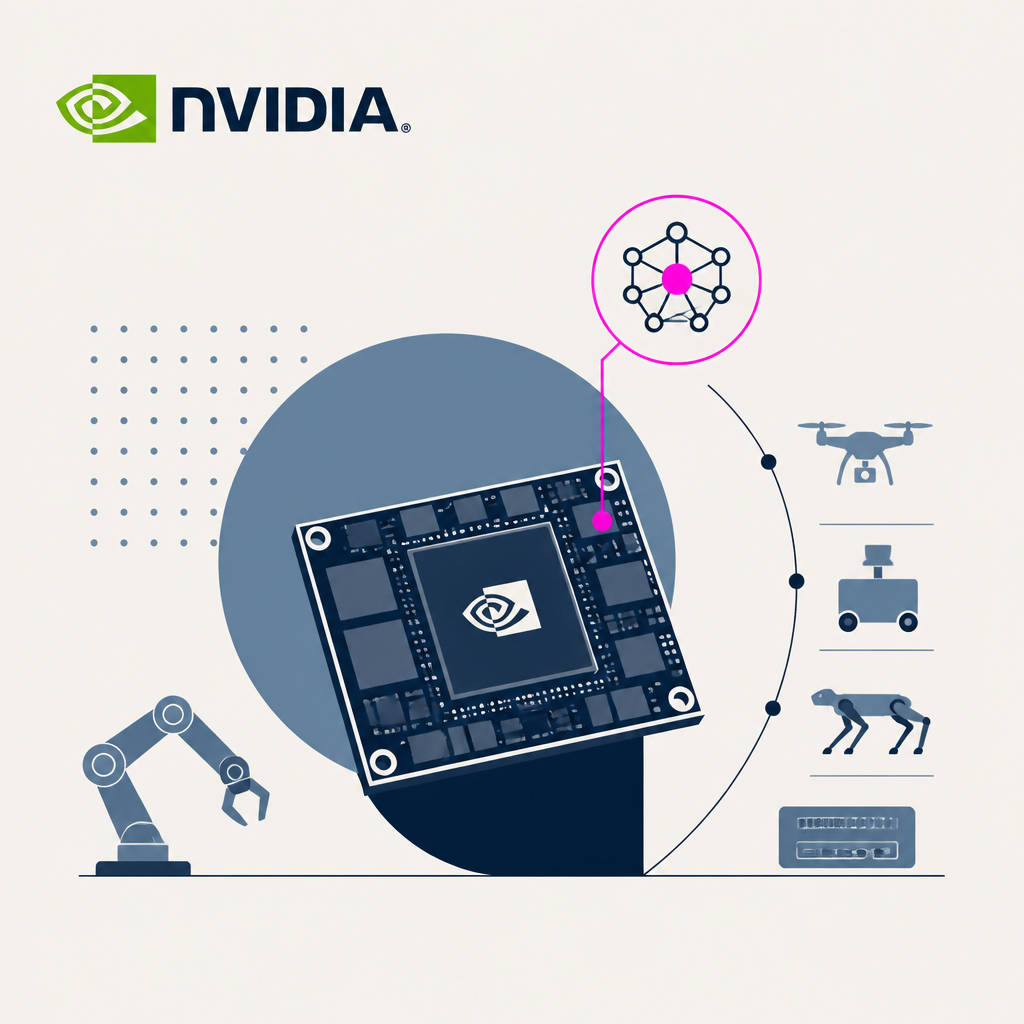
NVIDIA is pitching its Jetson Orin Nano Super as tiny enough to fit in a handbag, and VC Sarah Guo showed it off in hers. It packs 67 trillion AI operations per second into something smaller than a purse pocket.
Based on reporting by NVIDIA, Matthew Leib — read the original for the full story.
Summary, retelling and take written by AI under human oversight; images are AI-generated illustrations. How we work · Report an error
Sarah Guo, who runs the AI-focused venture firm Conviction and co-hosts the No Priors podcast, spent a recent video doing something you don't usually see venture capitalists do: unpacking a robotics chip from her Jacquemus Mini handbag. The chip in question is NVIDIA's Jetson Orin Nano Super, a developer kit built for edge AI and robotics, and the point Guo was making is that the barrier to building physical AI has gotten almost absurdly small.
The Orin Nano Super delivers 67 trillion operations per second of AI performance, which NVIDIA calls desktop-class generative AI in a package that fits comfortably in a bag. That's the entry point in a wider Jetson lineup, one that scales up to the Jetson AGX Orin for classroom and curriculum use and the Jetson AGX Thor for researchers pushing autonomous systems further. NVIDIA frames the whole stack as something meant to work in classrooms, labs and makerspaces, wherever someone happens to get an idea.
What makes this more than a marketing stunt with a designer purse is the list of projects NVIDIA is showcasing to prove the Orin Nano Super actually does something. There's SidewalkPilot, a custom model that autonomously steers a toy electric vehicle. There's the Reachy Mini Jetson Assistant, a voice-and-vision assistant that runs entirely on-device — no cloud, no API keys, nothing phoning home at runtime. A developer going by Coding with Lewis built an AI-powered robot from scratch using the open-weight model Mistral, aimed squarely at first-timers. And Asier Arnaz used the same board to build a Yocto-powered robotics podcast where two AI models talk to each other in real time.
NVIDIA is also leaning on something it calls Jetson Device Skills and Jetson BSP Skills, tools meant to let coding agents handle more of the grunt work of creating, optimizing and deploying edge AI. The company says this is meant to smooth the path from having an idea to actually shipping it, which is the same pitch every dev-tools company makes, except here the output is a robot rather than an app.
This is the first entry in a week-long series NVIDIA is running, with the AGX Orin getting its turn next. The throughline is consistent: physical AI development shouldn't require a lab full of server racks, just a board small enough to carry around and, apparently, a nice handbag to carry it in.
My take — AI-written commentary, not fact-checked reporting
Strip away the handbag gimmick and the actual story is that a chip barely bigger than a phone can now run generative AI models locally, no cloud round-trip required, which matters a lot more than the styling. Edge compute has been creeping toward this point for years, and NVIDIA clearly wants Jetson to be the default board hobbyists and students reach for once they decide to build something physical rather than just prompt a chatbot. The open-weight Mistral example is the detail worth watching — cheap, portable hardware paired with open models is exactly the combination that lets robotics tinkering spread beyond people with corporate lab budgets.
Read more about this at: NVIDIA