
Poolside Releases Laguna S 2.1, an Open-Weight Agentic Coding Model Punching Above Its Weight Class on SWE-Bench Multilingual
MarkTechPost Asif Razzaq ● Covered by 4 sources
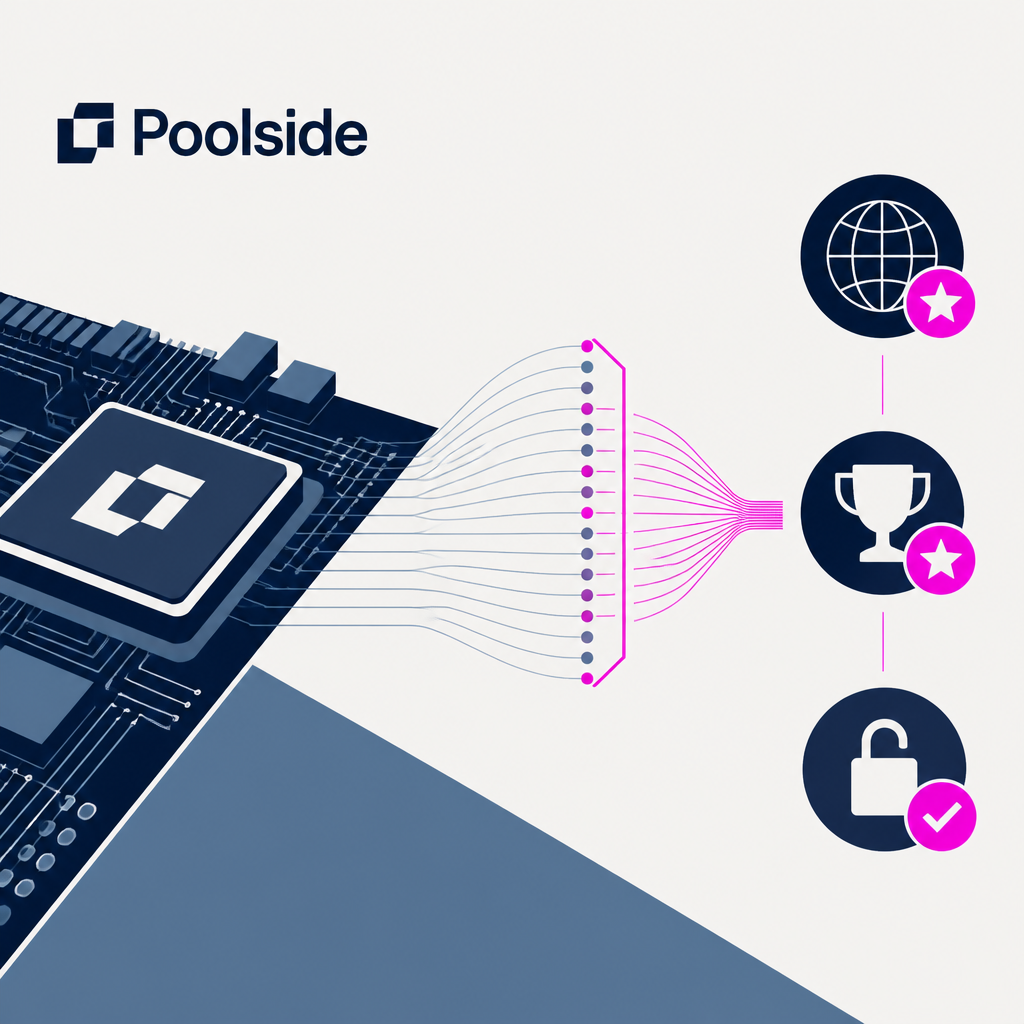
Poolside dropped Laguna S 2.1, an open-weight coding AI that's small but scores like a giant. It beats models 10x its size on key coding tests, and runs on a single desktop-sized DGX Spark.
Based on reporting by MarkTechPost, Asif Razzaq — read the original for the full story.
Summary, retelling and take written by AI under human oversight; images are AI-generated illustrations. How we work · Report an error
Poolside just shipped its third model in under three months, and this one actually has receipts. Laguna S 2.1 is a 118-billion-parameter Mixture-of-Experts model that only activates about 8 billion parameters per token, roughly 6.8% of the whole thing. That sparsity is the whole trick: you get the reasoning capacity of a much bigger model while the compute bill stays closer to something you'd run at home, or at least on a single NVIDIA DGX Spark.
The numbers back up the pitch. On Terminal-Bench 2.1, Laguna S 2.1 hits 70.2% with thinking mode on, which puts it ahead of every other open, disclosed-size model on Poolside's own leaderboard. On SWE-Bench Multilingual it scores 78.5%, topping the table outright, ahead of much larger systems like DeepSeek-V4-Pro-Max and NVIDIA's Nemotron 3 Ultra. The gap gets almost comedic on DeepSWE v1.1, where Laguna scores 40.4% against DeepSeek-V4-Pro-Max's 9.0%, despite using a sixth of the active parameters. Poolside isn't claiming to beat Claude Fable 5 or Kimi K3 outright, and it doesn't. The claim is narrower and more interesting: pound for pound, this is the most capable open model in its weight class.
What's happening under the hood matters as much as the scores. The model ships with two thinking modes, off and max, and max is on by default because it does most of the heavy lifting. Flipping it on takes DeepSWE from 16.5% to 40.4%, but it also roughly doubles token usage per trajectory, from about 99k to 249k completion tokens. Poolside published three raw, unedited runs to show what that extra thinking buys: the model built a working HTML/CSS browser engine from scratch in 181 steps and validated it against headless Chromium, sped up Poolside's own agent harness by 5.2% while cutting memory allocation 71%, and re-derived a published Erdős problem in Perl over 68 minutes after discovering the sandbox had no Python. That last one is a genuine rediscovery, since the model's knowledge cutoff predates the problem's public solution.
Deployment is where Poolside clearly wants developers to pay attention. Because every expert stays resident in memory even though only 8B parameters fire per token, sizing runs off the full 118B count. At 4-bit precision that's about 59GB, comfortably inside a single DGX Spark's 128GB of unified memory. FP8 needs roughly 118GB, still one Spark or H200. BF16 pushes past 236GB and needs two linked Sparks or a proper multi-GPU node. Poolside worked directly with NVIDIA to get NVFP4 inference tuned for Blackwell hardware, and the model has day-one support across vLLM, SGLang, Ollama, and hosted access through OpenRouter and a handful of other platforms.
The headline detail, though, is the training timeline. Pre-training started May 22, 2026, on 4,096 H200 GPUs, and the whole thing went from kickoff to public release in under nine weeks. It's also Poolside's first model where reinforcement learning ran entirely in FP8. Whatever you think about the benchmark race, that turnaround speed is the part that should worry the bigger labs.
My take — AI-written commentary, not fact-checked reporting
The efficiency story here is the actual news, not the leaderboard position. A model with 8B active parameters beating things ten times its size tells you the industry has been brute-forcing scale when smarter routing gets you most of the way there, and open weights under OpenMDW-1.1 mean anyone can verify that instead of taking a lab's word for it. Nine weeks from training start to release also quietly signals that the closed labs' speed advantage is eroding faster than their benchmark advantage.
Read more about this at: MarkTechPost
Related stories
 Thinking Machines Lab Releases Inkling-Small: A 276B Total, 12B Active Open Weights Multimodal MoE Model
MarkTechPost · 1 month ago ·
16
Thinking Machines Lab Releases Inkling-Small: A 276B Total, 12B Active Open Weights Multimodal MoE Model
MarkTechPost · 1 month ago ·
16