
NVIDIA Released DeepStream 9.1: Bringing Agentic AI to Vision AI With 13 Skills and Multi-View 3D Tracking
MarkTechPost Asif Razzaq ● Covered by 4 sources
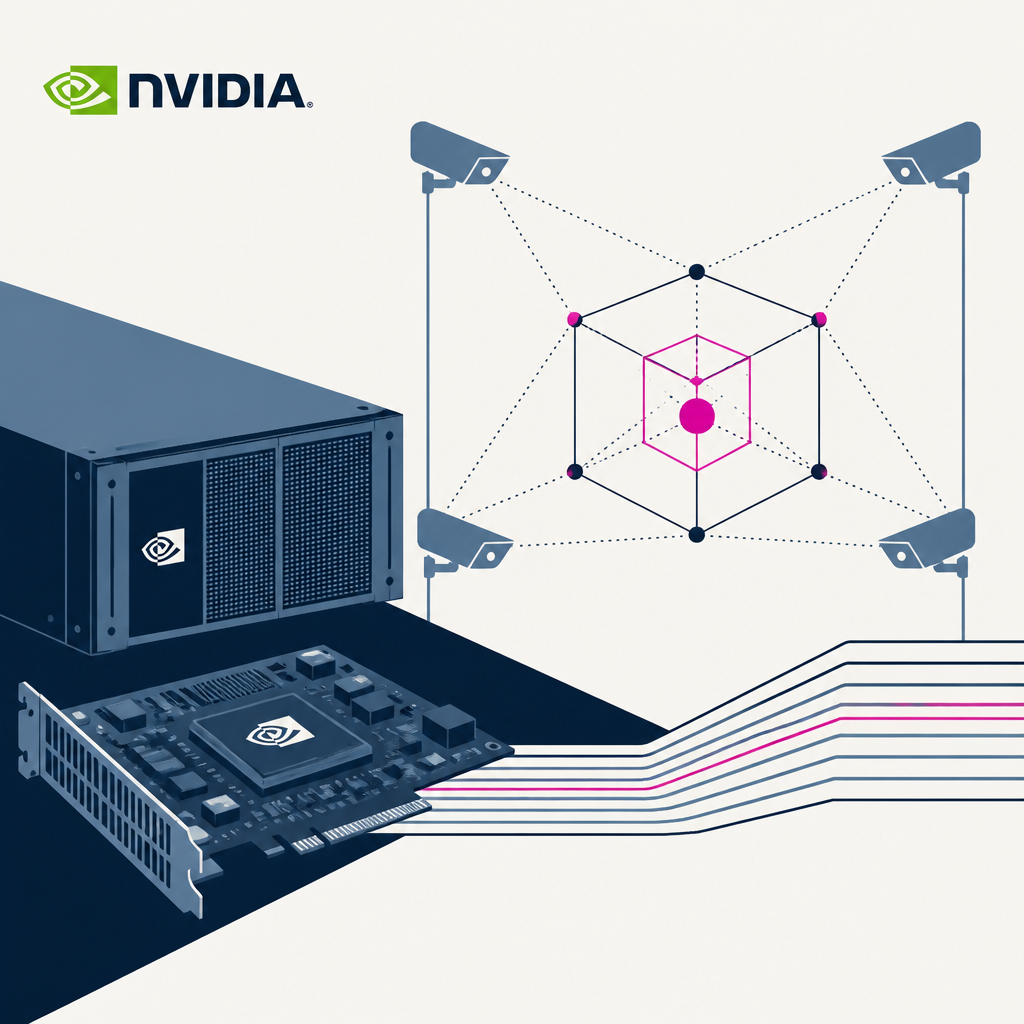
NVIDIA just shipped DeepStream 9.1, letting AI coding agents build multi-camera tracking pipelines from plain-language prompts. A new auto-calibrating skill kills the checkerboard setup, keeping one ID on a person across every camera feed.
Based on reporting by MarkTechPost, Asif Razzaq — read the original for the full story.
Summary, retelling and take written by AI under human oversight; images are AI-generated illustrations. How we work · Report an error
NVIDIA has a new release out for DeepStream, its GStreamer-based toolkit for video and image analytics, and the headline problem it tackles is one that's dogged multi-camera vision systems for years: getting a single object to keep the same identity as it walks from one camera's field of view into another's. Historically that meant manual calibration with checkerboards, tedious math, and a lot of downtime. DeepStream 9.1 goes after that pain point directly with two additions — Multi-View 3D Tracking (MV3DT) and AutoMagicCalib (AMC) — both packaged as skills that coding agents like Claude Code, Codex, and Cursor can invoke from a natural-language prompt instead of a config file edit.
MV3DT is the centerpiece. Each camera stream runs an object detector — NVIDIA offers PeopleNetTransformer, PeopleNet v2.6.3, or RT-DETR 2D depending on the scene — and those 2D detections get back-projected into a shared 3D world using a projection matrix stored in a YAML calibration file. From there, tracklets from different cameras get shared over MQTT and matched by proximity in 3D space, so when two cameras spot the same person, the system merges them under one globally consistent object ID. Results come out three ways: a tiled on-screen display with bounding boxes, a bird's-eye trajectory map, and Kafka messages carrying per-frame metadata like sensor ID and 3D bounding box.
AMC exists because MV3DT is only as good as its calibration, and NVIDIA clearly wanted to remove the checkerboard step entirely. Instead of a physical calibration rig, AMC watches tracked objects moving through existing video and estimates each camera's intrinsics — focal length, principal point, lens distortion — along with extrinsics like rotation and position. It runs through five stages internally, including per-camera trajectory extraction and bundle adjustment, with an optional VGGT refinement pass for scenes where objects don't move around much. It's built as a microservice with a web interface, and a user only needs to supply a layout image and a handful of alignment points to get it going.
What makes this release feel different from a typical DeepStream update is how it's delivered. Rather than a fresh set of NGC packages and documentation to parse, NVIDIA is leaning on the agentic-skills model: clone the repo, drop the skills into an agent's skill directory, and issue something like "deploy mv3dt on the 12-camera sample dataset." The skill then handles container pulls, installs the Kafka and Mosquitto broker services it needs, downloads model weights, and writes the pipeline config itself — and if calibration files are missing, it kicks off AMC automatically rather than stalling out. Compared with DeepStream 9.0, which shipped just two agentic skills and no dedicated multi-camera tracking path, 9.1 jumps to 13 skills, adds JetPack 7.2 support for Jetson Orin and Thor, and consolidates everything into one open-source GitHub repository under CC-BY-4.0 and Apache-2.0 licensing.
NVIDIA is pointing developers toward warehouse safety monitoring, retail dwell-time analytics, smart-building occupancy counts, and robotics or smart-city navigation as the intended use cases, all of which lean on the same core trick: stop treating each camera as its own isolated tracking problem and instead give every camera a shared sense of where things actually are in the physical world.
My take — AI-written commentary, not fact-checked reporting
Automating calibration is the genuinely useful part here — anyone who has manually aligned a dozen security cameras knows it's the kind of grunt work that kills pilot projects before they ship. But wrapping all of this in an agentic-skills workflow that spins up Kafka brokers and downloads models from a single prompt should make people pause, not cheer reflexively; frictionless deployment of persistent, globally-consistent person tracking across camera networks is exactly the kind of capability that outpaces the conversation about who gets watched and why. Open-sourcing the repo is the right call, and NVIDIA deserves credit for it, but easy infrastructure for tracking people across a building isn't a neutral engineering win just because it's well-documented.
Read more about this at: MarkTechPost