
NVIDIA Introduces New Jetson Thor Computers to Advance Mainstream Robotics and Edge AI
NVIDIA Chen Su
Nvidia unveiled two new Jetson Thor chips, T3000 and T2000, aimed at powering mass-market robots and edge AI devices. They're smaller and cheaper than existing chips but pack similar AI muscle, which could make humanoid robots way less expensive to build.
Based on reporting by NVIDIA, Chen Su — read the original for the full story.
Summary, retelling and take written by AI under human oversight; images are AI-generated illustrations. How we work · Report an error
Nvidia wants robots to stop being lab curiosities and start showing up everywhere, and its latest hardware push is aimed squarely at that transition. The company announced two new modules, the T3000 and T2000, built on its Thor architecture, designed to shrink the cost and power draw of running serious AI models inside physical machines. Think humanoid robots, warehouse arms, delivery bots — the stuff that needs to think fast without a data center attached.
The T3000 is the headline act here. It crams 865 FP4 teraflops of compute into a package roughly half the size and power draw of Nvidia's existing T5000 module, pairing a Blackwell GPU with an eight-core Arm CPU, 32GB of memory and 25 GbE networking. Despite the smaller footprint, Nvidia says it matches the T5000 on inference performance for the heavy stuff — large language models, vision-language models, and the vision-language-action models that let robots translate what they see into what they do. There's also an IGX version aimed at factory floors, bundling in functional safety features so machines can work near humans without someone getting a mechanical arm to the face.
The T2000 is the budget sibling, offering 400 FP4 teraflops and 16GB of memory for lower-end edge AI work — think autonomous mobile robots or visual inspection systems that don't need flagship-level horsepower. Combined with existing Jetson products, Nvidia now claims a lineup spanning from 70 TOPS all the way up to 2,000 teraflops, which is a fairly wide net for a company trying to own every rung of the edge AI ladder.
What's arguably more interesting than the silicon is the software squeeze Nvidia is applying alongside it. New
My take — AI-written commentary, not fact-checked reporting
Nvidia is basically trying to make itself the default nervous system for every robot that isn't a research prototype, and the memory-optimization push is the tell — squeezing workloads onto cheaper chips is how you make humanoid robots actually affordable rather than a trade-show novelty. I'd rather see genuinely open competition on the software side (Cosmos being open-weight helps), because a robotics future entirely dependent on one vendor's silicon roadmap is a rough position for the whole industry to be in."}
Read more about this at: NVIDIA
Related stories
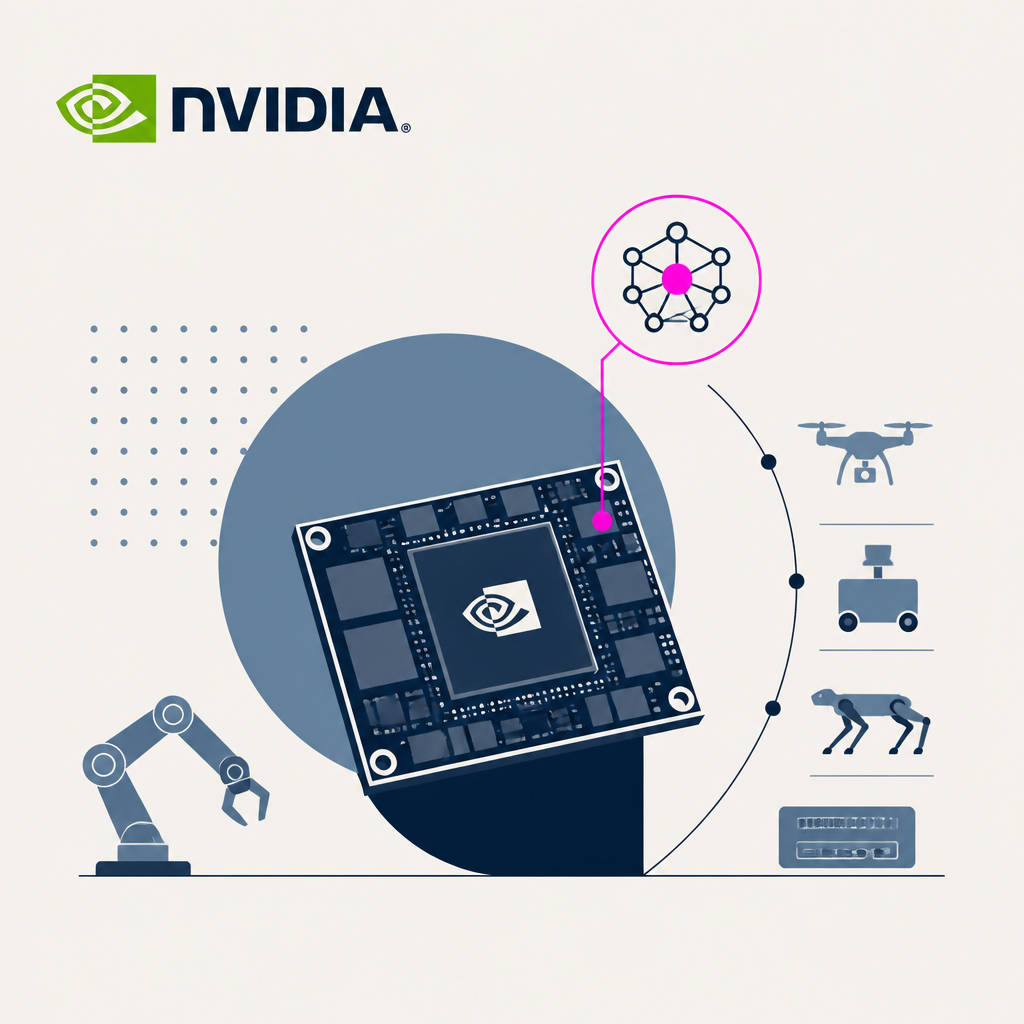 Powerful Compute So Compact, It’s Clutch — Build AI Anywhere With NVIDIA Jetson
NVIDIA · 1 month ago ·
49
Powerful Compute So Compact, It’s Clutch — Build AI Anywhere With NVIDIA Jetson
NVIDIA · 1 month ago ·
49
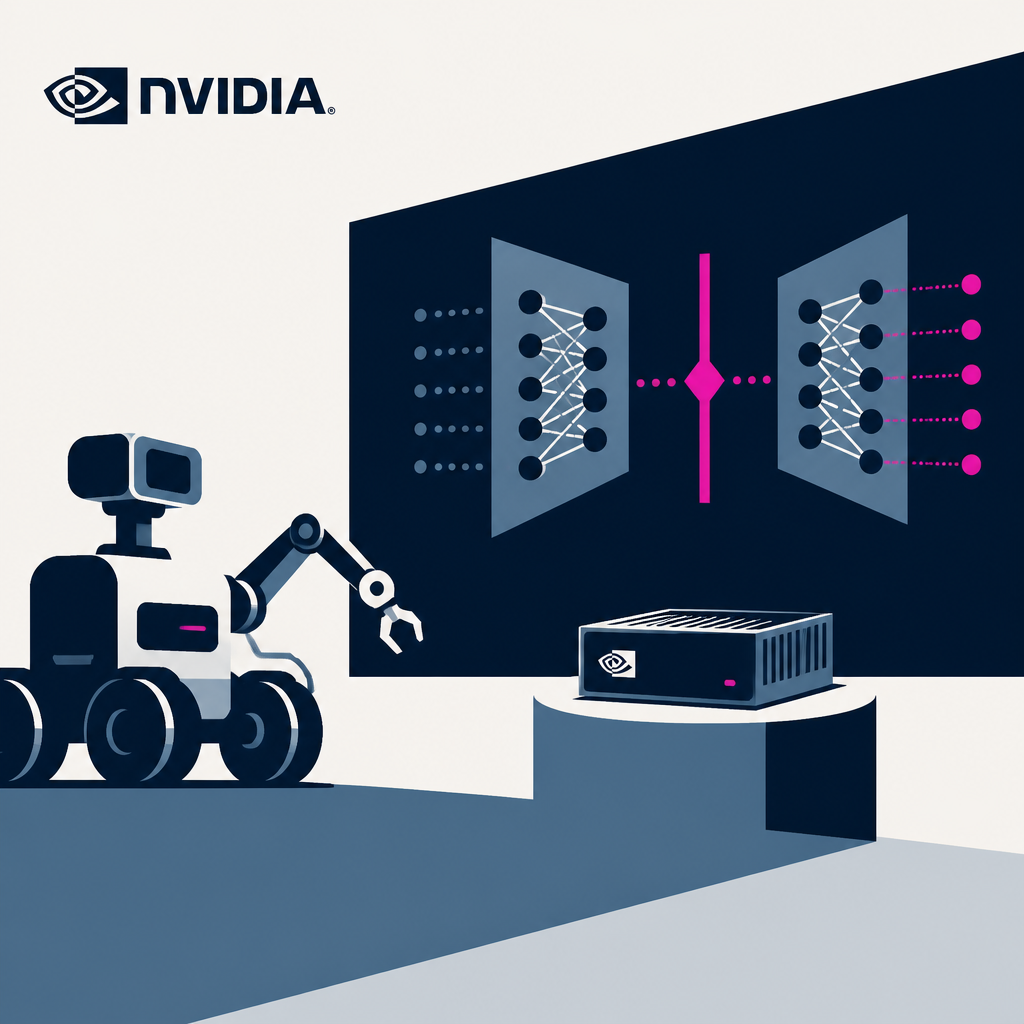 NVIDIA Releases Cosmos 3 Edge: A 4B-Parameter Open World Model That Reasons and Generates Robot Actions On-Device
MarkTechPost · 1 month ago ·
8
NVIDIA Releases Cosmos 3 Edge: A 4B-Parameter Open World Model That Reasons and Generates Robot Actions On-Device
MarkTechPost · 1 month ago ·
8