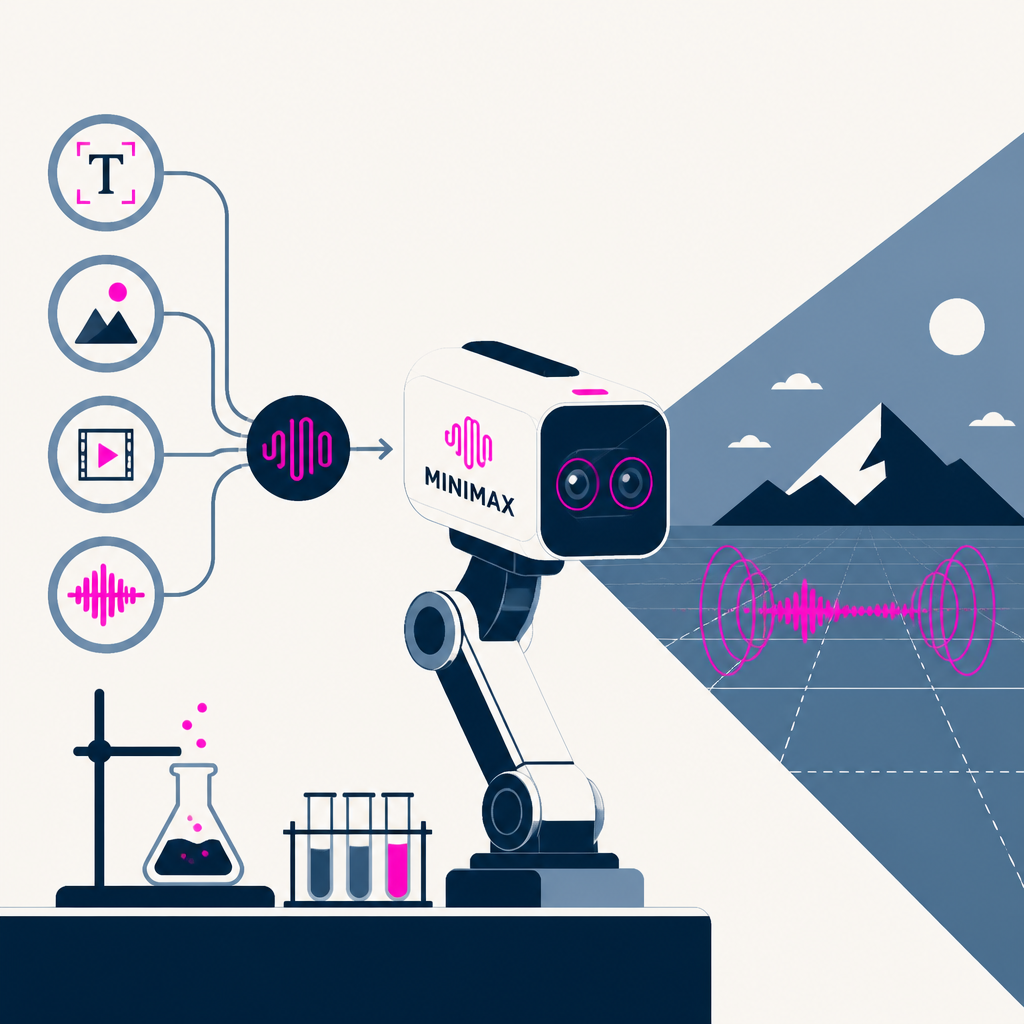
MiniMax Releases MiniMax-Music3: An Open-Weights Music Model Generating Complete Five-Minute Songs From Lyrics and a Structured Caption
MarkTechPost Asif Razzaq
MiniMax released an open-weights music model that can spit out a full five-minute song from lyrics and a caption. It ships weights and code on day one, so this is meant for use, not a demo.
Based on reporting by MarkTechPost, Asif Razzaq — read the original for the full story.
Summary, retelling and take written by AI under human oversight; images are AI-generated illustrations. How we work · Report an error
MiniMax has released MiniMax-Music3, an open-weights text-to-music model that does something a lot of music AI systems still avoid: it tries to finish the whole song in one shot. Feed it lyrics with section tags and a structured music caption, and it can generate up to five minutes of stereo audio at 32 kHz and 16-bit.
That matters because the release is not dressed up as a lab-only preview. MiniMax shipped weights, inference code, and three documented serving paths at the same time. The license also allows commercial use, though there are strings attached: the product UI has to show “MiniMax-Music3” prominently, and organizations whose yearly revenue from products built on it exceeds US$ 20 million need separate written authorization. If you host third-party generation, you also have to maintain safeguards against infringing outputs.
Under the hood, MiniMax-Music3 uses a Hybrid-LM setup that splits the job between an 8B Global LLM and a 0.6B Local LLM. The training tokenizer uses eight layers of residual vector quantization. One semantic codebook has 16,384 entries; the other seven acoustic codebooks have 1,024 each. The company says the Global LLM handles long-range structure while the Local LLM fills in the remaining codebooks inside each frame.
The more unusual piece is the synthesis stage. Instead of decoding from discrete RVQ tokens at inference, MiniMax fuses the final hidden states from both LLMs and feeds them into a 2.4B flow-matching module, which then maps into a latent space decoded by a 123M Flow-VAE. The discrete tokenizer decoder is not loaded during inference at all. MiniMax says the model is built for things like background scoring, game music, localized ad beds, scratch tracks, and offline batch generation where API cost matters.
There are three documented ways to run it. SGLang-Omni is the reference server and uses two CUDA GPUs, with one handling Qwen3 and RVQ autoregressive generation and the other handling flow matching and DAV decoding. The diffusers pipeline can fit under 24 GB of VRAM at full precision, around 22 GB with automatic CPU offload, and down to 8 GB with leaf-level group offloading. ComfyUI also has a native text-to-music template using repacked FP16 and INT8 weights. MiniMax says the model was released on August 13, 2026.
My take — AI-written commentary, not fact-checked reporting
This is the rare AI music release that looks like a product, not a press release with a synth attached. The real tell is the licensing: MiniMax wants commercial adoption, attribution, and some control when the money gets serious. That’s a very sane posture for open weights, which is to say: open enough to matter, closed enough to keep the lawyers employed.
Read more about this at: MarkTechPost