
Introducing Cosmos 3 Edge
Hugging Face ● Covered by 4 sources
NVIDIA just dropped Cosmos 3 Edge, a 4-billion-parameter open model for robots and cameras that runs right on the device. It matters because it brings data-center-grade world understanding to cheap edge hardware, no cloud round-trip needed.
Based on reporting by Hugging Face — read the original for the full story.
Summary, retelling and take written by AI under human oversight; images are AI-generated illustrations. How we work · Report an error
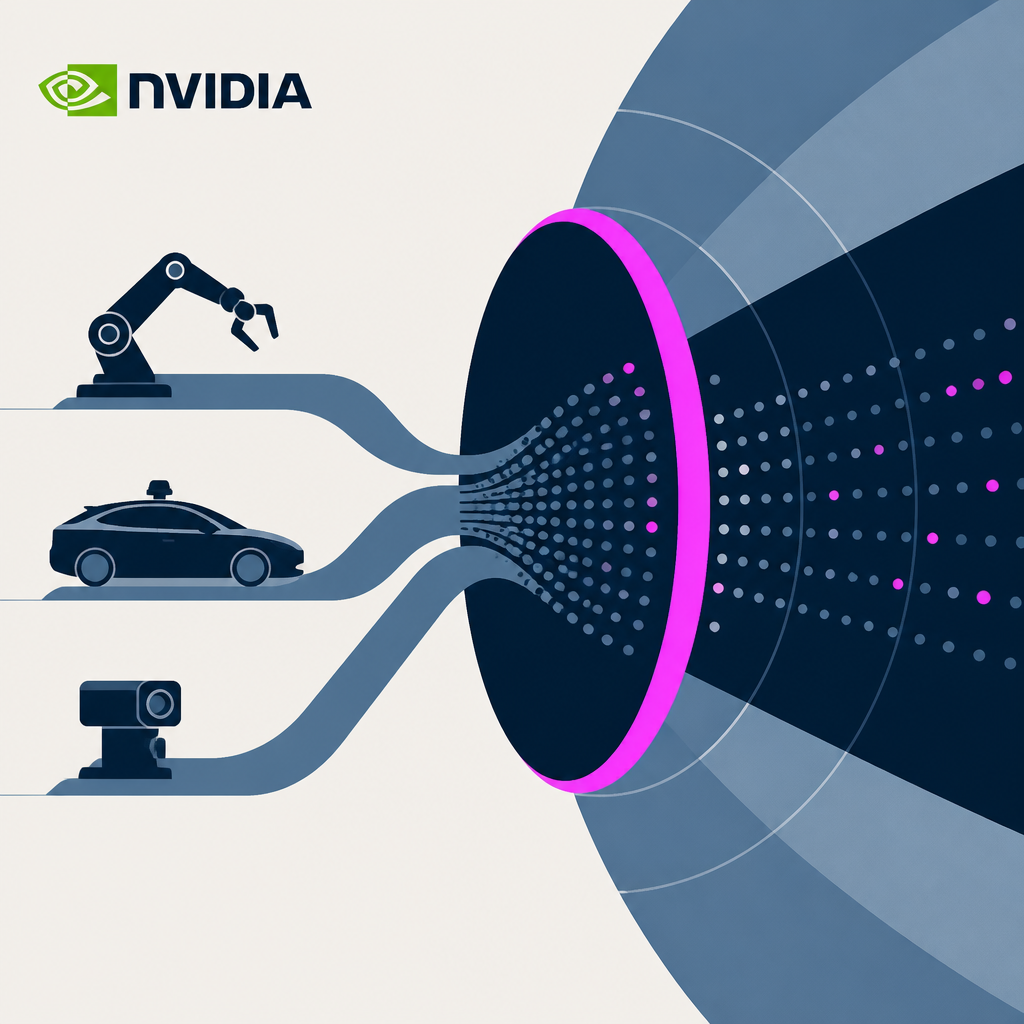
NVIDIA has put a new open model on Hugging Face called Cosmos 3 Edge, and it's aimed squarely at the unglamorous middle layer of physical AI: the chips actually sitting inside robots, warehouse cameras, and hospital equipment. At 4 billion parameters, it's small enough to run on Jetson Thor, Jetson's new T2000 and T3000 modules, RTX PRO cards, and even consumer GeForce RTX GPUs, while still claiming top marks among similarly sized models on the VANTAGE-Bench vision benchmark.
What makes it more than just a compact vision-language model is the world-modeling piece. Cosmos 3 Edge pairs two transformer towers under one roof — an autoregressive tower that handles language and reasoning, and a diffusion tower that handles prediction and generation across video, audio, and action tokens. They share attention layers but keep separate normalization and MLPs, so the model can reason through a scene using causal attention on one side and generate coherent video or action sequences with broader context attention on the other. NVIDIA's pitch is that this lets a robot not just recognize an object but actually simulate what happens if it reaches for it.
The action representation is the clever bit. Instead of forcing every robot arm, drone, or gripper to describe motion in its own format, Cosmos 3 Edge encodes translation, rotation, and manipulation state into one geometric vector space. That means pixel changes in a video can be tied directly to physical motion and control signals — a robot's gripper closing isn't just an image event, it's data the model can learn from and predict against. On Jetson Thor, the model reportedly generates 32 actions per inference pass while holding 15 Hz real-time control, working off 640×360 observations, which is the resolution robots actually operate at rather than the cinematic 4K numbers usually thrown around in AI demos.
NVIDIA also released a companion policy model, Cosmos 3 Edge Policy trained on the DROID pick-and-place dataset, plus post-training recipes so developers can fine-tune the base model on their own robot data using a modest cluster of H100s or a DGX Station. And for the generative side, there's a Cosmos 3 Super checkpoint distilled down to just 4 denoising steps instead of the usual 35 to 50, which NVIDIA says delivers up to 25x faster inference without gutting image or video quality. Everything here is framed less as a finished product and more as scaffolding — open checkpoints and scripts meant to be bent toward specific factory floors, delivery robots, or driving-simulation pipelines.
NVIDIA says more is coming: interactive world generation, driving scenario simulation, and further robotics policy work, alongside efforts to squeeze more speed out of inference frameworks like vLLM. For now, Cosmos 3 Edge reads as NVIDIA's attempt to make "world model" a practical, deployable term rather than a research curiosity — something that fits in a Jetson box instead of a data center rack.
My take — AI-written commentary, not fact-checked reporting
This is NVIDIA doing what it does best: open-washing its hardware moat. Sure, the weights are on Hugging Face, but the entire pitch is built around Jetson, DGX, and RTX silicon, so "open" here mostly means open enough to lock you into their edge stack. Still, unifying action representations across robot arms, drones, and cameras into one geometric vector space is a genuinely useful idea, and I'd rather see that shared openly than buried in a proprietary SDK.
Read more about this at: Hugging Face
Related stories
 Into the Omniverse: How Open World Models Push the Frontier of Physical AI
NVIDIA · 1 month ago ·
22
NVIDIA and Local AI Community Fuel Open Source Models and Intelligent Agents
NVIDIA · 1 month ago ·
24
NVIDIA's GTC 2025 Announcement for Physical AI Developers: New Open Models and Datasets
Hugging Face · 1 year ago ·
57
Into the Omniverse: How Open World Models Push the Frontier of Physical AI
NVIDIA · 1 month ago ·
22
NVIDIA and Local AI Community Fuel Open Source Models and Intelligent Agents
NVIDIA · 1 month ago ·
24
NVIDIA's GTC 2025 Announcement for Physical AI Developers: New Open Models and Datasets
Hugging Face · 1 year ago ·
57