
Grok Build Workflows Enables Parallel Agent Processing
X
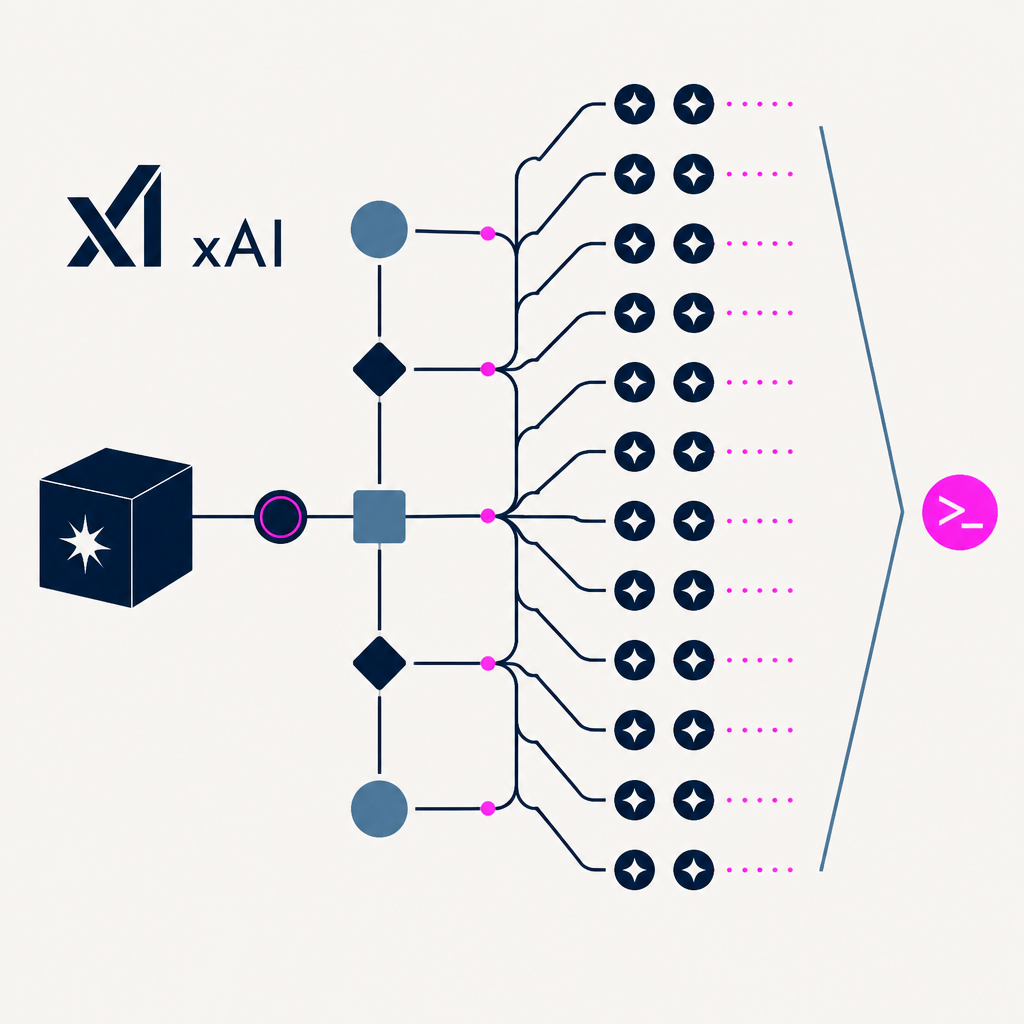
xAI's Grok CLI now has 'Build Workflows,' which splits a big coding task into a plan and runs up to 1,024 agents on it at once. Translation: massive jobs that used to take forever can now get chewed through in parallel, and you can save the whole workflow as a reusable slash command.
Based on reporting by X — read the original for the full story.
Summary, retelling and take written by AI under human oversight; images are AI-generated illustrations. How we work · Report an error
xAI just quietly dropped something that changes how people might actually use Grok day to day: a feature called Build Workflows, tucked into the Grok CLI. The pitch is simple on the surface — hand it a big, messy task, and instead of one agent grinding through it step by step, the system breaks the job into a plan and then fans it out across parallel agents. Up to 1,024 of them, running at the same time.
That number matters more than it might seem. Most agentic coding tools on the market today, from Cursor to various Copilot-style assistants, still lean heavily on a single-agent-at-a-time model, even when they claim to multitask. xAI is betting that a lot of real engineering work is embarrassingly parallel — refactoring hundreds of files, running the same migration across dozens of services, generating tests across a sprawling codebase — and that throwing compute at it in bulk beats waiting on a sequential chain of thought.
The other piece worth noting is the slash command angle. Once you build a workflow, you can save it and share it, turning what would normally be a one-off prompt into a reusable tool your whole team can invoke with a short command. That's a small thing on paper but it's the kind of feature that turns a chatbot into an actual piece of internal tooling — the difference between asking an assistant for help every time versus building a library of automations that outlast the person who wrote them.
It's also a signal about where xAI wants to compete. Grok has spent much of the last year chasing benchmark headlines and chatbot personality quirks; this feels like a pivot toward developer workflow, the same territory where Anthropic and OpenAI have been fighting hardest with their own coding agents. Whether 1,024 parallel agents actually behave coherently on a shared codebase, without stepping on each other's changes, is the real test — and one that won't show up in a launch post.
My take — AI-written commentary, not fact-checked reporting
I'll believe the 1,024-agent number is more than a marketing flex once someone shows a messy real-world repo getting refactored without merge conflicts and hallucinated file paths. Parallelism is easy to promise and brutally hard to coordinate, and xAI's track record on shipping polished tooling is thinner than its rivals'. Still, the slash-command sharing idea is the smarter long-term bet here — that's how you build lock-in, not benchmark charts.
Read more about this at: X