Fine-tune NVIDIA Nemotron 3 models with Amazon SageMaker AI serverless model customization
AWS Sandeep Raveesh-Babu
AWS SageMaker AI now lets you fine-tune NVIDIA's Nemotron 3 models without managing any servers. It means smaller open models can be tuned to beat bigger proprietary ones, cheaper and with your data staying private.
Based on reporting by AWS, Sandeep Raveesh-Babu — read the original for the full story.
Summary, retelling and take written by AI under human oversight; images are AI-generated illustrations. How we work · Report an error
Amazon has quietly added another lever for enterprises trying to squeeze proprietary value out of open-weight AI: serverless model customization for NVIDIA's Nemotron 3 family on SageMaker AI. The pitch is straightforward. Instead of provisioning GPU clusters and babysitting distributed training jobs, you point SageMaker at your data, pick a fine-tuning technique, and let AWS handle the infrastructure.
The models themselves are the interesting part. Nemotron 3 Nano packs 30 billion total parameters but only activates 3 billion per pass, while Nemotron 3 Super runs 120 billion total with 12 billion active. Both use a hybrid Mamba-Transformer Mixture-of-Experts architecture, mixing Mamba-2 layers for fast sequence processing with Transformer attention for recall and Latent MoE layers that compress tokens before routing them to specialized experts. That combination is what lets these models support context windows up to 1 million tokens without demanding proportionally more compute. NVIDIA also trained them with multi-environment reinforcement learning through something called NeMo Gym, aimed at making them better at multi-step agentic tasks like coding and long-context reasoning. Nano, notably, hits 4x the throughput of its Nemotron 2 predecessor.
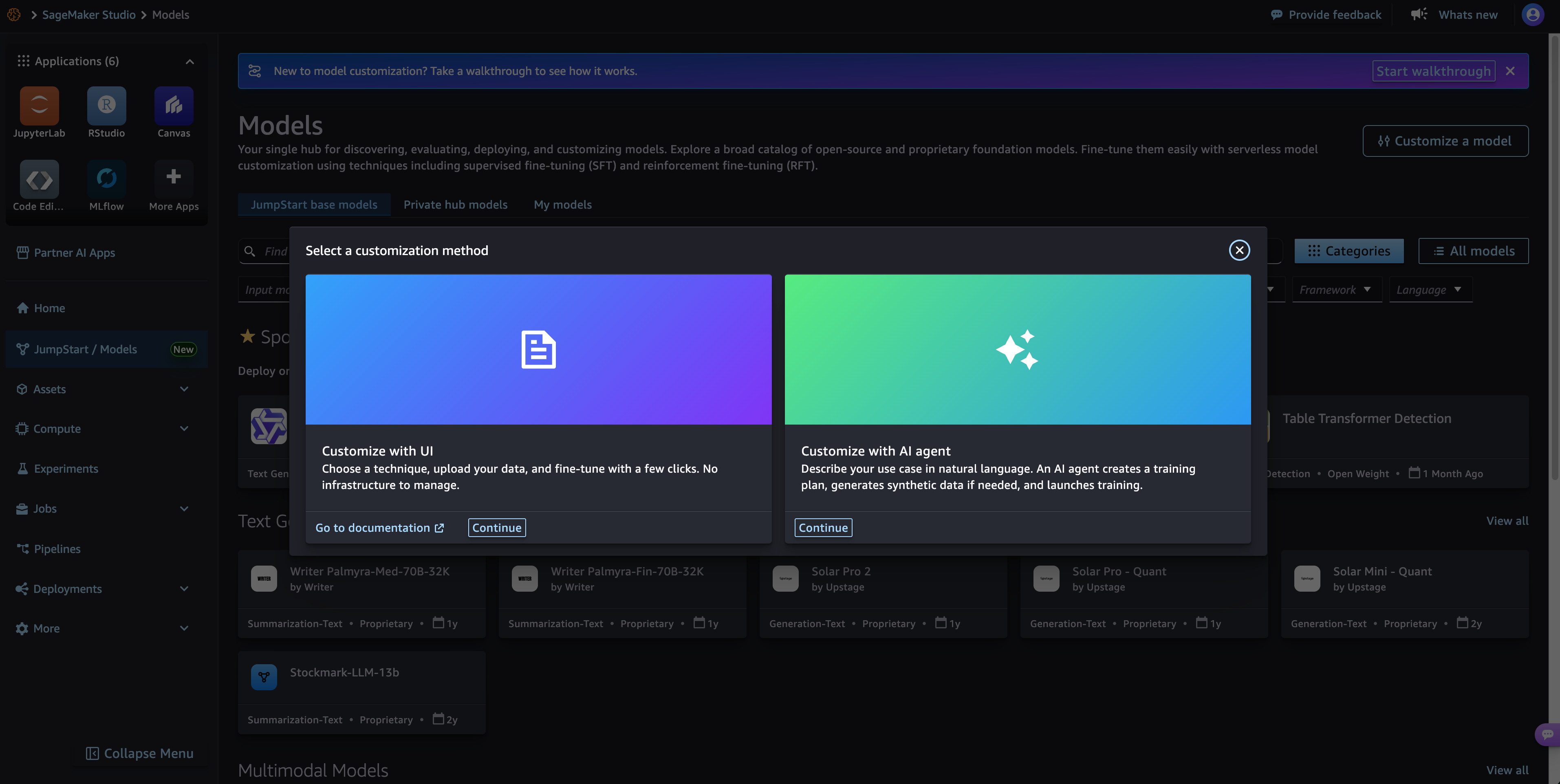
What AWS is really selling here is choice of technique. Supervised fine-tuning works for teaching a model new behaviors from labeled examples — think domain Q&A pairs or brand-aligned responses. Reinforcement learning with verifiable rewards suits tasks where correctness can be checked automatically, like tool-calling accuracy or code execution. And reinforcement learning from AI feedback steps in when you want to shape tone or helpfulness but human evaluation is too slow or expensive to scale. SageMaker AI Studio walks users through picking a model, choosing a technique, configuring training data in JSONL format, and launching the job — with training metrics logged automatically to SageMaker's MLflow app so you can watch reward curves, loss, and gradient norms without digging through raw logs.
Once training wraps, SageMaker offers three ways to check whether the fine-tune actually worked: an LLM-as-a-judge setup using a Bedrock frontier model, custom scorers for NLP metrics like F1 and BLEU, or standardized benchmarks including MMLU and MATH. You can even compare the tuned model directly against its untrained base. Deployment then happens straight from the console, either to SageMaker Inference endpoints or by pulling weights from S3 for self-managed hosting — AWS shows an example running the fine-tuned Nano model on an ml.g6e instance with NVIDIA L40S GPUs, serving merged LoRA weights by default while still leaving the option to run the adapter separately.
My take — AI-written commentary, not fact-checked reporting
Serverless fine-tuning is the boring-but-correct move: most companies don't want to run GPU clusters, they want a smaller model that knows their business better than a giant general-purpose one ever will. The real story is the architecture choice — hybrid Mamba-Transformer MoE models that activate a sliver of their parameters per pass are quietly becoming the default way to get long-context, agentic performance without the compute bill of a dense frontier model, and that trend deserves more attention than it's getting.
Read more about this at: AWS