
Best Local LLMs You Can Run on a Single 24GB GPU in 2026: Qwen, Gemma, Mistral, DeepSeek Compared
MarkTechPost Michal Sutter
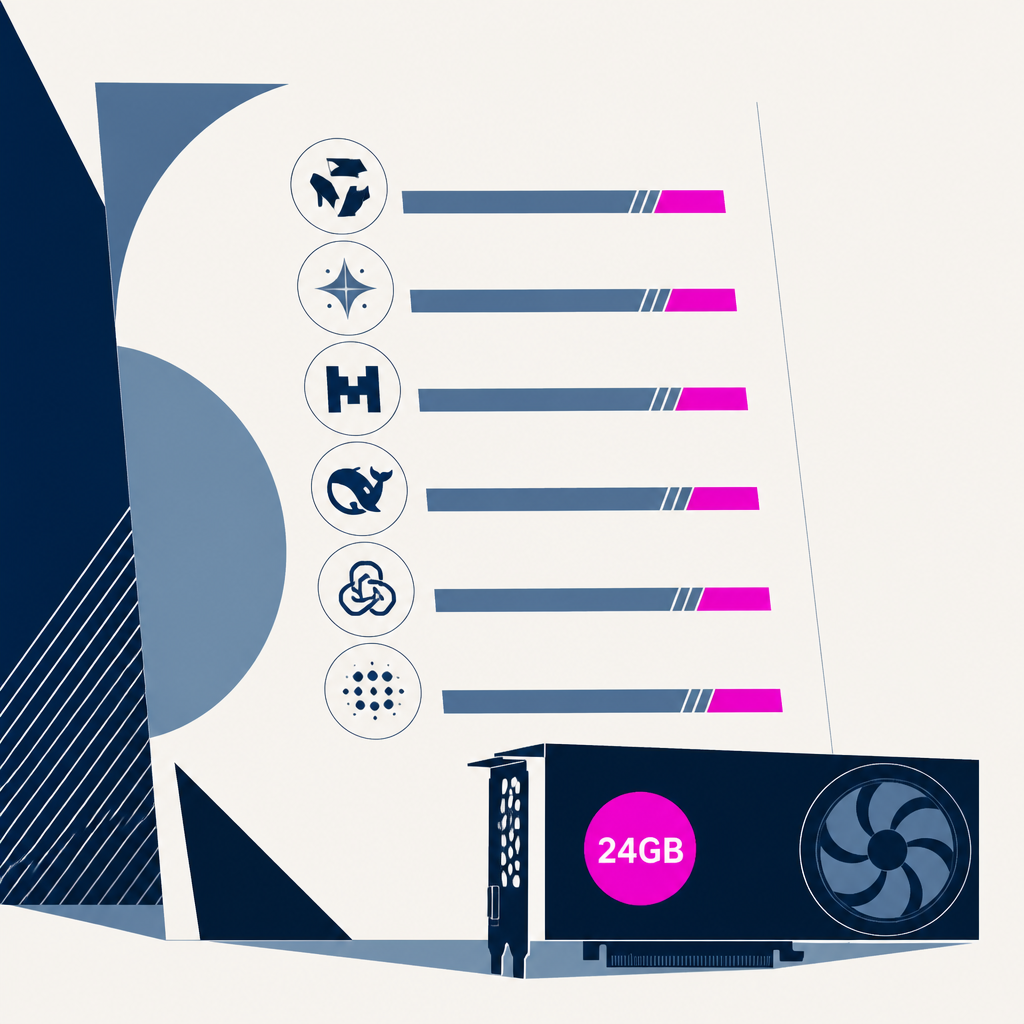
A new guide maps out which open LLMs actually fit on a single 24GB GPU in 2026, and which don't. The old trick of cramming a 70B quant onto your card is dead — 20B–35B models are the smarter play now.
Based on reporting by MarkTechPost, Michal Sutter — read the original for the full story.
Summary, retelling and take written by AI under human oversight; images are AI-generated illustrations. How we work · Report an error
The 24GB GPU has quietly become the baseline for anyone serious about running language models at home, and the advice for what to put on it has changed a lot. Forget the old hobbyist reflex of squeezing a heavily quantized 70B model onto an RTX 3090 or 4090 just because it technically loads. That approach eats your entire VRAM budget on weights alone, leaving nothing for context length or speed. The smarter move in 2026 is picking from a crop of well-built 20B to 35B models that fit cleanly, run fast, and still leave headroom to breathe.
The math behind this is simple but easy to ignore. At Q4_K_M quantization, the standard for home inference, each parameter costs roughly 0.58 bytes, so a 32B dense model needs about 18 to 20GB just for weights. Add another 1 to 2GB for KV cache and runtime overhead at short context, and you're already near the ceiling. Mixture-of-Experts models complicate things further: even though only a handful of experts activate per token, every expert has to sit resident in memory, so a MoE model's VRAM cost tracks its total parameter count, not its active count. That's why a model like Qwen3.6-35B-A3B, despite firing only about 3B parameters per token, still needs roughly 20GB to load.
Among the six models the guide settles on, a few stand out for different reasons. Qwen3.6-27B, Alibaba's April 2026 Apache 2.0 release, comes out as the strongest general default, tuned for agentic coding and repo-level reasoning while needing only about 16GB. Google DeepMind's Gemma 4, released April 2, 2026 under a fully open license for the first time in the family's history, brings multimodal input and coverage of over 140 languages in its 26B MoE configuration. Mistral Small 3.2 24B is the lightest of the bunch at around 14GB, built for low-latency daily assistant work rather than heavy reasoning. And OpenAI's gpt-oss-20b, shipped natively in 4-bit MXFP4, loads in about 14GB and handles structured reasoning well, even if its general knowledge lags behind denser models.
The tightest fit belongs to DeepSeek-R1-Distill-Qwen-32B, a distillation of DeepSeek's R1 reasoning traces onto a Qwen2.5 base, released under MIT and needing 18 to 20GB — leaving little slack but rewarding you with visible chain-of-thought tokens for slow, deliberate problems. Meanwhile, the actual frontier of open models has moved somewhere no single card can follow: GLM-5.2 sits around 753B total parameters, Kimi K2.7 near 1T, and DeepSeek's V4-Pro preview reportedly touches 1.6T. Those numbers make clear that the single-GPU tier and the frontier-model tier are now different conversations entirely.
For actually running any of this, the guide points to three well-worn tools: Ollama for simplicity, llama.cpp for granular quantization control, and vLLM if you need serious throughput under concurrent load. The real advice, though, is less about tooling and more about restraint — pick the model that matches the job you actually have, not the largest file your card can technically hold.
My take — AI-written commentary, not fact-checked reporting
This is the correct instinct finally catching up with hardware reality: bigger quant isn't better if it strangles your context window and your first-token latency. I'd bet most people running these at home are better served by Mistral Small or gpt-oss-20b for daily driving and only reaching for the DeepSeek distill when a problem genuinely needs slow, visible reasoning. The bigger story, though, is the widening gap between what fits on your desk and what the labs are now shipping at 750B-plus — local open models are great, but let's not pretend they're competing with the frontier anymore.
Read more about this at: MarkTechPost